Friday, January 4, 2013

New year's inspection and poisonous pollen

Even though it wasn't quite 60 degrees today, I decided to take a look into the hives and see what was going on.  I have noted a lot of activity at the doors over the past couple of weeks.  Last week I ordered a package for Olea's hive and 2 nucs for the Langstroths.  Mike Pohl sort of talked me into getting nucs rather than just queens.  Since there is a considerable difference in price, I wanted to see if the population was growing fast enough to obviate the need for the boost that a nuc would give.
In the super of the old hive, there were two frames with some capped honey but no bees.  In the top brood box there were many frames of capped honey.  In the bottom brood box, I saw only a few (about 20) capped brood cells, no larvae and I didn't see the queen.  Since there was plenty of honey in the deep boxes, I removed the super.  We will harvest the honey with the smash-and-drain method.  Now the old hive is only two deep boxes; I left the feeder in with 2:1 syrup.  (The feeders have been in both hives for a couple of weeks.  I have only seen one individual bee in the feeder once in either hive.)
In the top super of the new hive there was a group of bees between two frames.  There was nectar present of those frames as well as a couple of others.  The top brood box continues to be empty of bees and comb.  In the bottom box, I spotted the queen.  There were pupae and capped brood cells.  There wasn't much honey in the new hive, but it looks like they're making honey from forage or from the feeder.  I did not change the configuration of the new hive and left the feeder.
The population of both hives was small.  I'll check again, of course, and if by February it seems to be growing adequately, I will change my order to queens alone.
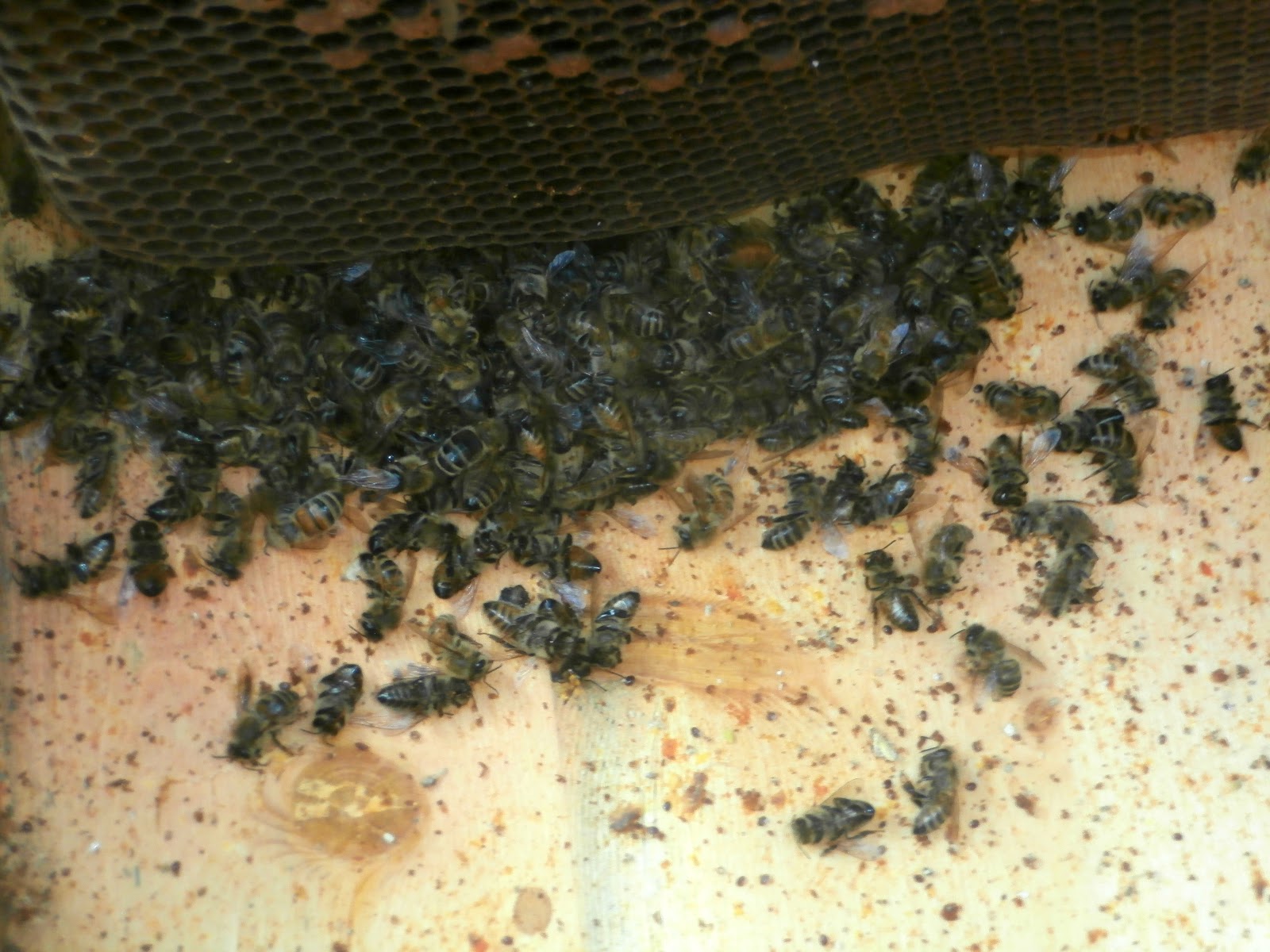
Dying bee with pollen
A couple of days ago I saw a bunch of dead and dying bees in front of the old hive.  What was notable was that they all had pollen on their legs; the amount of pollen varied.  What happened?  I was wondering if the pollen itself could be toxic.  First step of research was going online.  Searching for "dead bees bearing pollen" gave hits involving beekeeping forums.  1 2 3  From these I gathered that the general opinion was due to cold and fatigue.  I searched for toxic pollen and found some references.  One plant that produces toxic pollen is California buckeye, but I don't think it is in bloom now.  So I emailed Professor Mussen at UC Davis.  To summarize his long response, there is a systemic neonicotinoid, imidacloprid, that is used to control a eucalyptus pest.  This chemical will slowly, over time, build up to toxic levels in the nectar.  The bees will return to the hive but not get inside and stumble around on the ground, as if drunk.  This sounds like what my bees were doing.  I later thought I could collect a couple and send the pollen somewhere to be identified to see if it was eucalyptus.  Today, when I went to do so, there were no bees to collect.

Thursday, January 3, 2013

Phorid flies hatched

Today I saw two flies in the container of bees that I collected from the ground on November 8, 2012.
You can easily see the light color and not so easily the veins on the wings.  The flies I had found amongst the dead bees in Olea's hive were larger and darker; they did have the distinct wing veins.  Perhaps I should capture one and send it off to an entomologist.

Thursday, December 27, 2012

Olea's colony has met its demise

For sometime, I have been concerned about the viability of Olea's hive.  There has been no activity at the door, and lately I've seen no bees through the window.  Today, on an uncommon sunny day in the midst of all the rain, I decided to look inside.  At first I was wearing just my usual garden attire, but bees from the two other hives were harassing me, so I put on the bee suit.
Pile of dead bees on floor of hive
Heads down in cells
What I found were a lot of dead bees.  There was a pile on the floor of the hive and some on the frames.  Many bees were head down in the cells.  On close inspection, the bees had their tongues protruding.  These are signs of starvation and there wasn't a bit of honey anywhere.
Probable queen on left.  Note tongues.
I looked through the pile of bees and I think I found the queen.  When I stirred the bees about looking for the queen, I saw many small black flies that ran around rather than flying (like quails).  Phorid flies act that way.
I caught one and tried to identify it.  It has wing veins like a phorid and the femur looks right.  It is a darker color than the pictures, though.  I'm concluding that these are phorid flies.
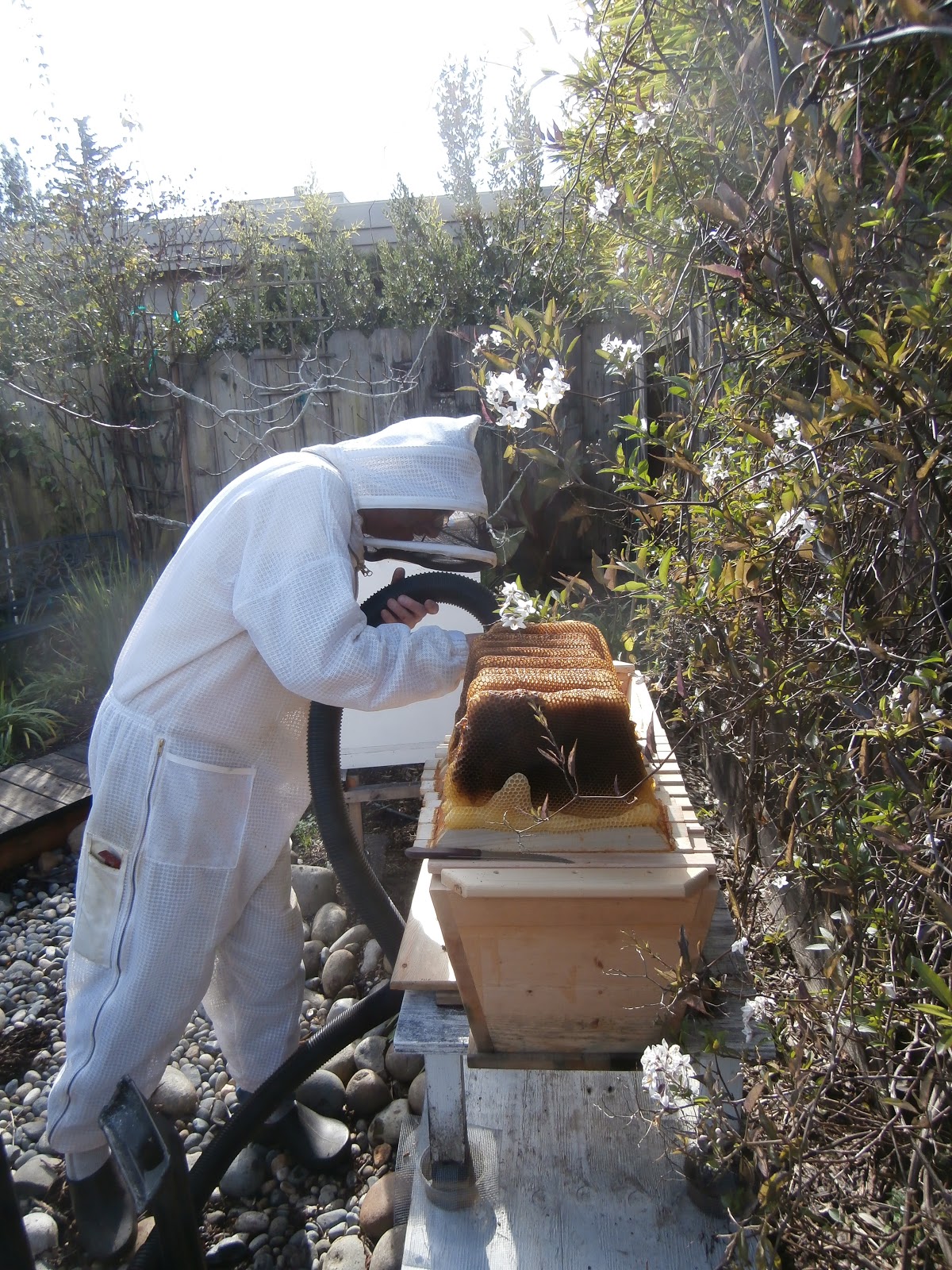
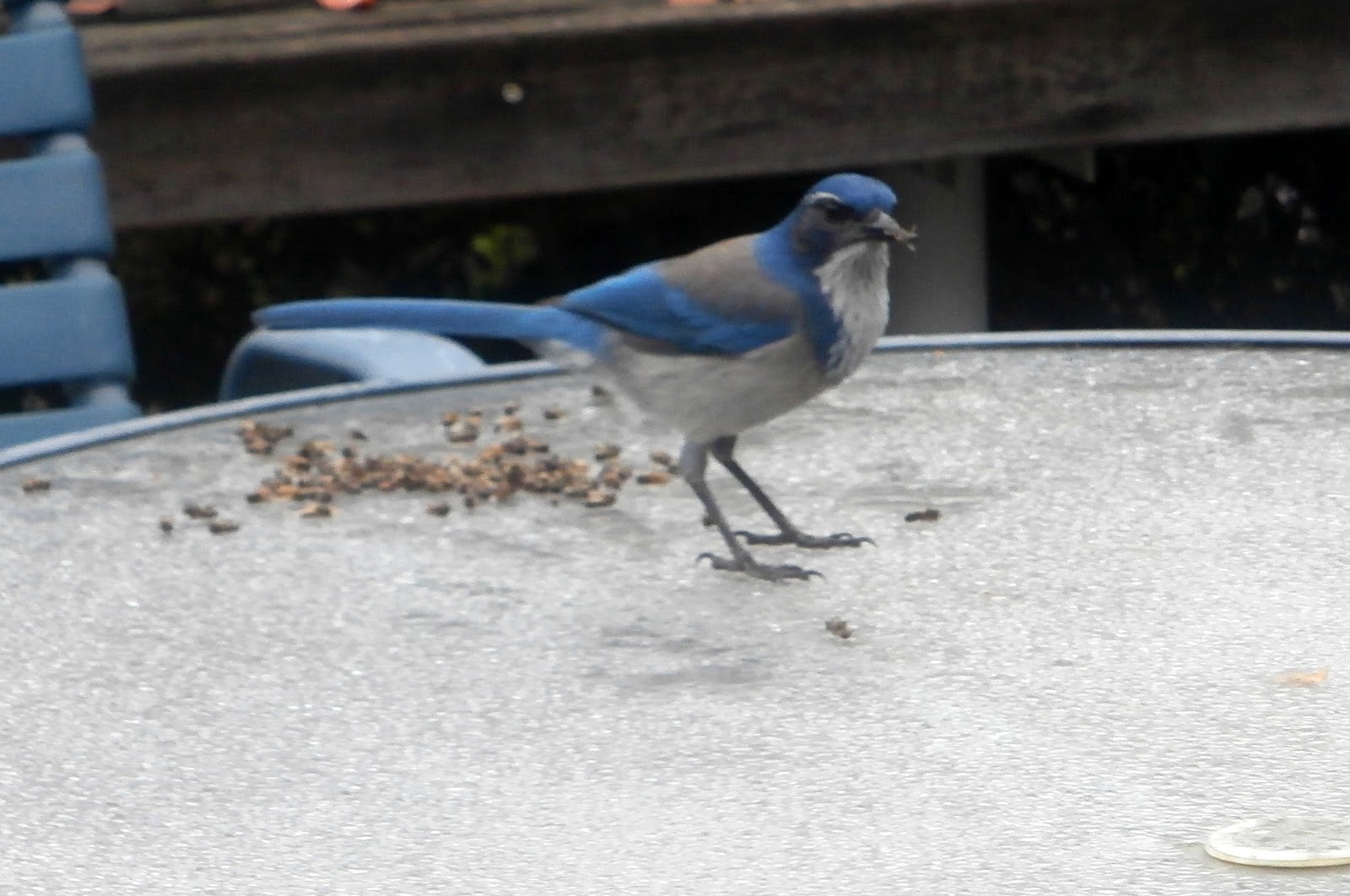
I took out all the bars with comb and used my shop-vac to clean out all the dead bees, flies and debris.  I then used tweezers to pluck the bees and pupae out from the comb.  The pile of bees on the table attracted a blue jay who enjoyed an apian snack.
 I put all the bars with comb back in the hive and moved the false back forwards.  As usual, I don't know if I'm going about this properly.  I hope that there isn't a problem with pests such as the wax moth.  I intend to get a package in the spring for the hive.

Saturday, December 15, 2012

Too cold to look

It's been too cold to go into the hives, but I'd really like to take a look and see what's going on.  I have real concerns regarding their viability.  I may be looking at three packages come spring.  If the colonies survive, I'll be re-queening.
Inside Olea's hive
Olea's hive has a window, so I can get a peek.  The number of bees seems to be declining, although they may just be  in a cluster.  I can also see several dead bees on the floor of the empty part of the hive.  The undertaker bees aren't doing their job and I suspect that that is not a good sign, although this may just be natural winter behavior. 
Under the lid of the new hive
I took a peek under the lids of the other two hives.  There was nothing in the old hive.  There were several dead bees in the new hive and one little fly that flew off.  Could these bees be victims of the Phorid fly?  There were also a lot of dead bees on the porch.
New hive porch
Dead bees and Phorid fly pupae
Speaking of Phorid flies, I had picked up 11 crawlers on the stones in front of the hives November 8 and 5 pupae resulted.  None of the pupae I have in containers have hatched yet.
On November 20, I was watching the girls and I noted two groups of bees on the rocks in the dry creek.  It looked like they were having some sort of meeting.

Saturday, November 24, 2012

Olea's hive with Laura

Laura was down for Thanksgiving weekend and we took a look into Olea's hive.  The bee population looks pretty small.  There was no capped honey and only a few capped brood cells.  We didn't see the queen.  I'm pessimistic regarding this colonie's survival.  I don't intend to requeen the top bar hive, but I may change my mind down the road.

Tuesday, November 20, 2012

Old hive decreasing population

Over the past 1-2 weeks, I've noticed that the activity at the entrance of the old hive seems to have diminished.  It certainly is less active than at the new hive next door.  Yesterday I took a look into the old hive to see if I could spot anything amiss.
There was no honey at all in the top super, so I decided to take it off altogether.  Only two frames in the other super had honey.
In the upper brood box, there were 4-5 frames with honey, no brood. On a few frames, there were some empty cells surrounded by honey, suggesting that brood had once been there.  There was nectar in many of the empty cells.  (So they weren't really empty, were they?)
In the deep box, there was only one small patch of brood and larvae and I didn't spot the queen.
I did get the sense that the population had contracted.  Previously, there had been bees in the Vivaldi box, but there were no bees above the first super on last inspection or this one.  Also, there didn't seem to be as many bees as previously in the upper brood box.  Once again, we'll have to wait and see.
Pieces of propolis
On the bottom of two adjacent frames were leafs of propolis.  It looked like they may have formed a small dome.  I looked in the hive to see if there was anything the bees may have walled off, but I saw no foreign objects.  I took the propolis and added it to my small collection. 
Bees in jar coated with powdered sugar

Only two!
I did another sugar roll count.  This time I changed my collection technique.  I used a larger mason jar, put the powdered sugar in first and used a measuring cup to scoop the bees out of the bucket.  It was much easier, I got the full 1/2 cup and I didn't squish anyone.  This time there were only two mites- hooray!

Saturday, November 10, 2012

After one week of MiteAway Quick strips

I took out the MiteAway quick strips today; they'd been in for one week.  I dumped the contents of the trays from below the screened bottom into a dish.  Most of the brown stuff is mites.

  A close-up  The oval shapes are mites.