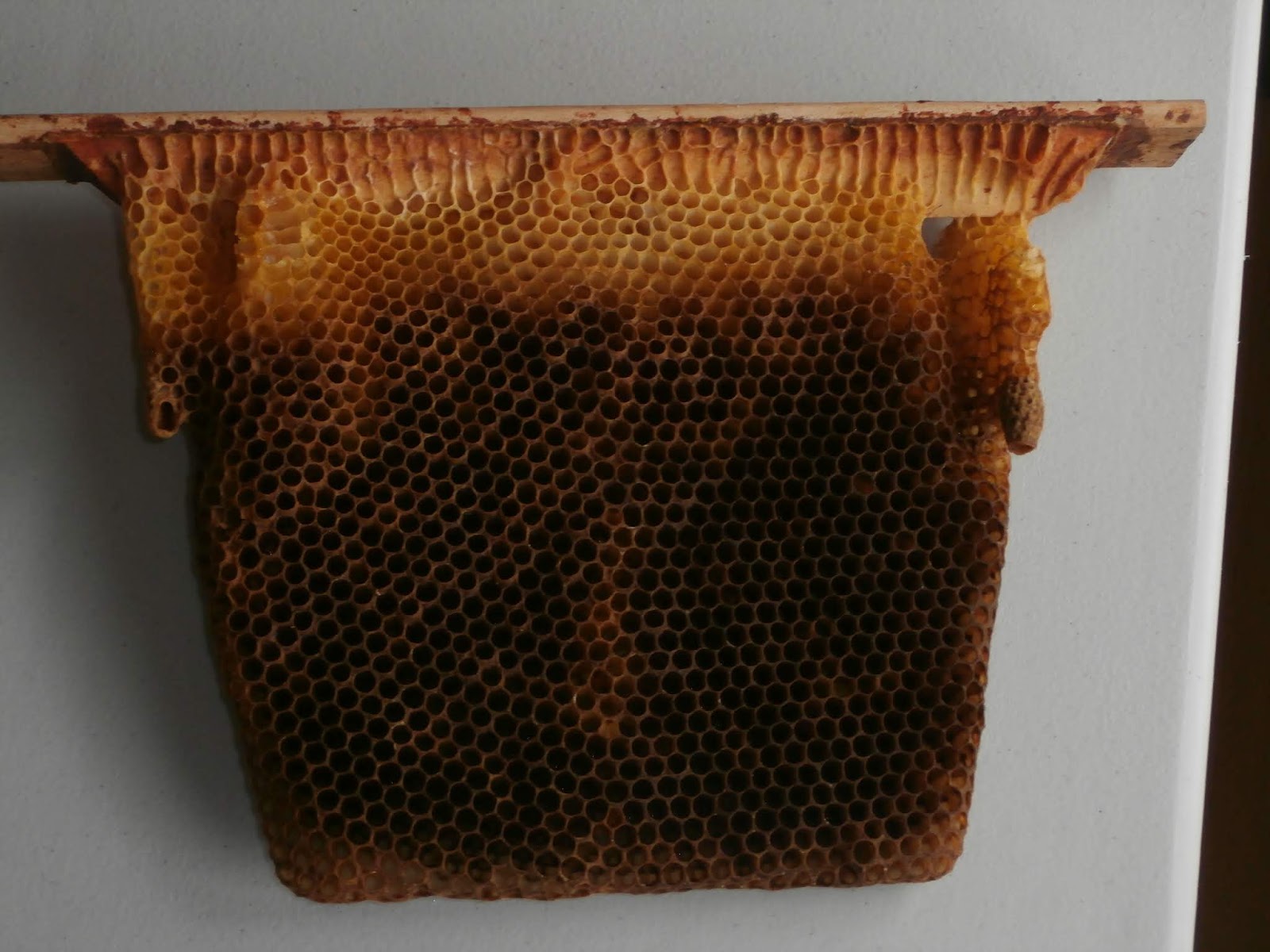
Friday, October 12, 2018

Fall update

Much has happened since the last posting.  I will try to keep it short.
#2 did not make it.  The two boxes never combined and the hive was robbed.  It has been dismantled and awaits bees next year.
Olea's continues to be strong on its 7 bars.  On one inspection, I saw no honey so started feeding with 1:1 syrup.  I used the entrance feeder, placing it inside the box.  The bees accessed it by going under the following board.  I added another bar when I started feeding and saw some new wax today.  I also saw more honey stores so I will no longer feed them after the present batch of syrup is gone.
#1 is still doing well.  When harvesting honey, there was brood in the bottom-most super so no honey was taken from that box.  We did get a fair amount of honey.  This is about half.
After the honey was taken, I put Apivar strips into the hives and the nuc.  I took them out today. 
On earlier looks, the bottom box of #1 seemed pretty empty.  Today I wanted to remove it in order to reduce the hive and do some repairs on the box.  However, after taking out 4 frames with empty comb, I saw a large patch of capped brood on the 5th; end of plan.  So #1 still is two deeps and one medium.  Some of the honey in the medium may have been made when the Apivar was in the hive, so I will not be able to harvest in.  I would like to remove the box before the honey flow next spring but I won't do it as long as brood is present.

Thursday, August 9, 2018

Oh where, oh where has #3 gone?

#3 Hive stand
 As with #2, I noticed a marked decrease in activity at the entrance.  I took a look inside to see what was up.  What I found, in a nutshell, was a dying colony.  Only a few hundred bees, no viable brood, no eggs or larvae, hardly any honey.  All activity, as it were, was in the top brood box and bottom super.  There was nothing but drawn comb in the bottom brood box.  I did see some ants in the box but could find no ant trail on the stand.
I took #3 apart and put the boxes with bees onto #2 using the newspaper combine.  I put the escape board below the super that had capped honey and will take the super off soon.  In the next few days I will also start collecting the supers from #1 for the honey harvest
#2 with deep and super from #3, with escape board and newspaper
The silver lining of this dark cloud:  the bottom brood box was damaged and now I will be able to repair it.
It looks like I may need my nuc after all. (Sorry Matt and Laura)

Saturday, July 21, 2018

#2 has a queen!

I looked into #2 today and saw a queen walking around on the frame.  There are still not a lot of bees and I did not see eggs (nor did I look hard for them).  I took off the super and will harvest the honey from it.  I considered moving the frames into a nuc box or dividing the current box somehow but decided to leave it as it is.

Monday, July 16, 2018

What happened to #2?

The apiary today
#2 used to have two deep and two medium boxes.Why now only one deep and one medium box?, you ask.  I will tell you.
Two days ago I noticed very little activity at #2's entrance.
#1

#2
 I immediately suited up and went into the hive.  Here is a pictorial of what I saw:
Under the telescoping lid
Under the Vivaldi box
Under the top super
Under the bottom super
Under the top deep box
As you can easily see, there are hardly any bees.  Unlike this strong hive (picture from Guildford Dragon NEWS:
A strong hive with bees busy on every frame.

I went through the hive and found only a couple of hundred bees, mostly on 2-3 frames in the top brood box.  There was a spotty patch of capped brood and some larvae.  The only drone brood I saw as on a frame bare of bees.  There were many queen cups, a couple of which were partially drawn out, but all were empty.  There was one (smaller than usual) queen cell with an open end indicative of an emerged queen.  I did not see a queen nor any eggs.  I looked for any bees with DWV Image result for deformed wing virus or any mite feces Image result for varroa mite feces and found none.  I did not want to do an alcohol wash since that would kill a large percentage of the colony.  Not knowing what else to do, I removed one super and changed the entrance reducer to its smallest size.  I figured there were a few options.  1. Do nothing and observe. 2. Perform an assiduous search for a queen. If she is there, do nothing. if she is not there, either repopulate with the nuc or combine the colony with one of my other hives. 3. Either combine or repopulate without searching for the queen.  I then wrote to my mentor and posted on Beesource Beekeeping Forums.  It was my mentor's opinion that, at best, the colony had swarmed and the new queen had not yet started laying.  She suggested waiting a week and if no queen activity then, go ahead and combine the hive.  A beekeeper on the forum said pretty much the same thing.  That is pretty optimistic, but I think that if they had swarmed that there would be many more bees left behind and much more brood.
Today I removed the bottom deep box, as in the opening picture.
If you have any more questions, feel free to ask.
There still is forage in our yard-
Oak hydrangea


Friday, June 15, 2018

Taking apart Olea's hive

Three days ago, I saw only some bees on the front frames of Olea's, so I decided to dismantle the hive.  I started at the back of the box and found nectar in most of the combs.  I took out only three, one of which had two queen cells on it.  One was open at the end and the other on the side.
Queen cells on both sides of the comb
Open end where a queen has emerged

Queen cell opened on side.  The pupa inside had been killed by another queen and the workers removed the corpse

An empty queen cup
I set these in a holder and went to do some other work (Next paragraph).  When I went back to photograph them, there was a small cloud of bees around them.  I moved the comb further from the hives until the bees had cleaned them up at the end of the day.
I hefted the top super of #1 and since it felt pretty heavy I wanted to add a fourth super.  I had some unassembled frames from Bruce and Greg, but after I had nailed together a couple, I realized they were shallows and I only have medium foundation.  I  got my box of medium frames and assembled them.  I had some Duragilt foundations, also from Bruce and Greg.  I found the Duragilt difficult to install, and I am not the only one.  I stopped after 3 and used plastic foundation on the remaining.
I went to #1, stood on the milk crate and took off the top super.  It had 6 frames of capped honey.  Usually one does not add another box until there are 8 frames full, but I went ahead.  I checkerboarded 2 frames of capped honey.  I looked into the top super of #2 and saw that it was pretty much untouched, so I switched in two frames of capped honey from the lower super.  Left #3 alone.
The next day, while working the roses, I was attacked without provocation and stung in the left eyebrow.
I think the bees might have been extra defensive because of possible robbing behavior triggered by the open nectar left near the hives the day before.  To forestall any further robbing, I decided to completely dismantle Olea's hive.  I put the removed comb with nectar at the far side of the house.  There was quite a bit of wax moth damage on the distal combs.
The bees had removed all the nectar by the next morning
When I reached bar #6, I found capped worker brood and larvae!  There must be a laying queen in there after all.  I put in a bar with fresh wax and nectar (total 7 bars), placed the following board and put on an entrance reducer.  It looks like Olea's may survive.
I pinched off the capped queen cell that I had seen through window weeks ago.
 With manicure scissors, I carefully cut a flap in the side.
 There was the desiccated head and thorax of the pupa.
I opened the cell a bit more and could see some strands of the cocoon.
The two nucs seem to be doing fine.


Saturday, May 19, 2018

I am going to need a step-up

I checked the top supers of all three hives today.  #2 and 3 were light and I saw no capped honey when I looked down into the frames.  However, #1 was heavy and had capped honey in 8/10 of the frames!  I added a 3rd super, checker-boarding three frames of capped honey into it.  Now I will need to use Olea's step up to work the hive.
I realized the above picture did not suffice, so I am adding this one.
I am slightly on tip-toe so my eyes are over the hive.
And this photo just to brag a bit.
Rio Samba


Thursday, May 17, 2018

Where did it come from, and where did it go?

It really is swarm season!  Across the street, a swarm was captured in a bait box. 
Yesterday I saw this on the grape vine:
It was a pretty large cluster.  I assume it came from #2 since I had seen a swarm cell in there a week before.  But assumptions are often incorrect.
Today there was no activity around the entrance of my bait box so I figured they were not interested.  (It may be that the bait box is directly above 2 active nucs.)  So I called a bee guild member to see if he was interested in collecting it.  He called me back within a half-hour, and just before he called, the cluster had taken flight.  He could hear the buzzing over the phone.  I followed them down the street, where, instead of going into a hive as I expected, they clustered on a tree branch in front of Pauline's house.  This is approximately 150 feet from where they had been. 
About 2 hours later I went to see if the new owners were home yet.  They were not, nor were the bees.  Where they went is unknown- re-cluster or new home.
I do know that there are quite a few bee hives in this neighborhood.