Thursday, December 27, 2012

Olea's colony has met its demise

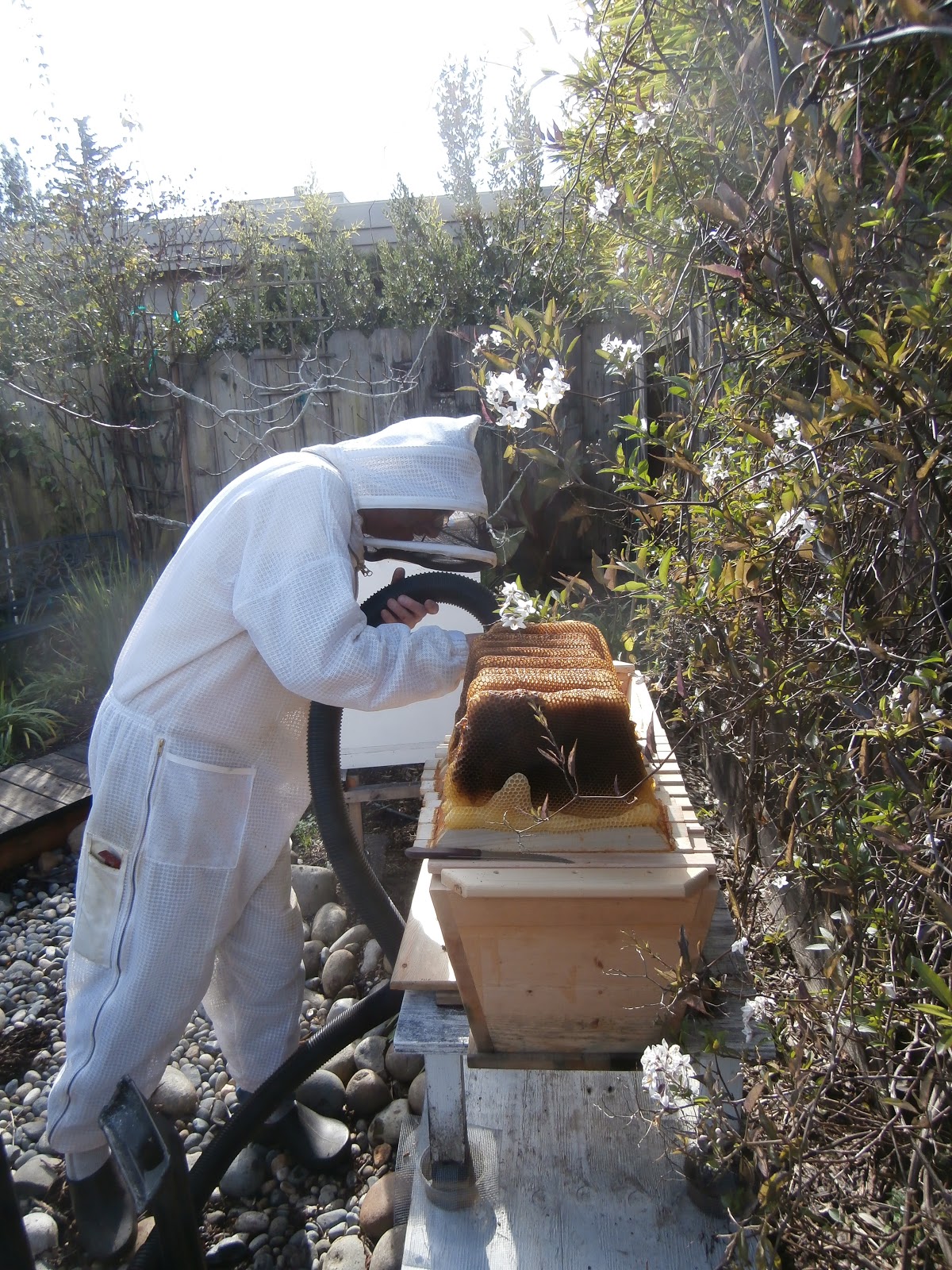
For sometime, I have been concerned about the viability of Olea's hive.  There has been no activity at the door, and lately I've seen no bees through the window.  Today, on an uncommon sunny day in the midst of all the rain, I decided to look inside.  At first I was wearing just my usual garden attire, but bees from the two other hives were harassing me, so I put on the bee suit.
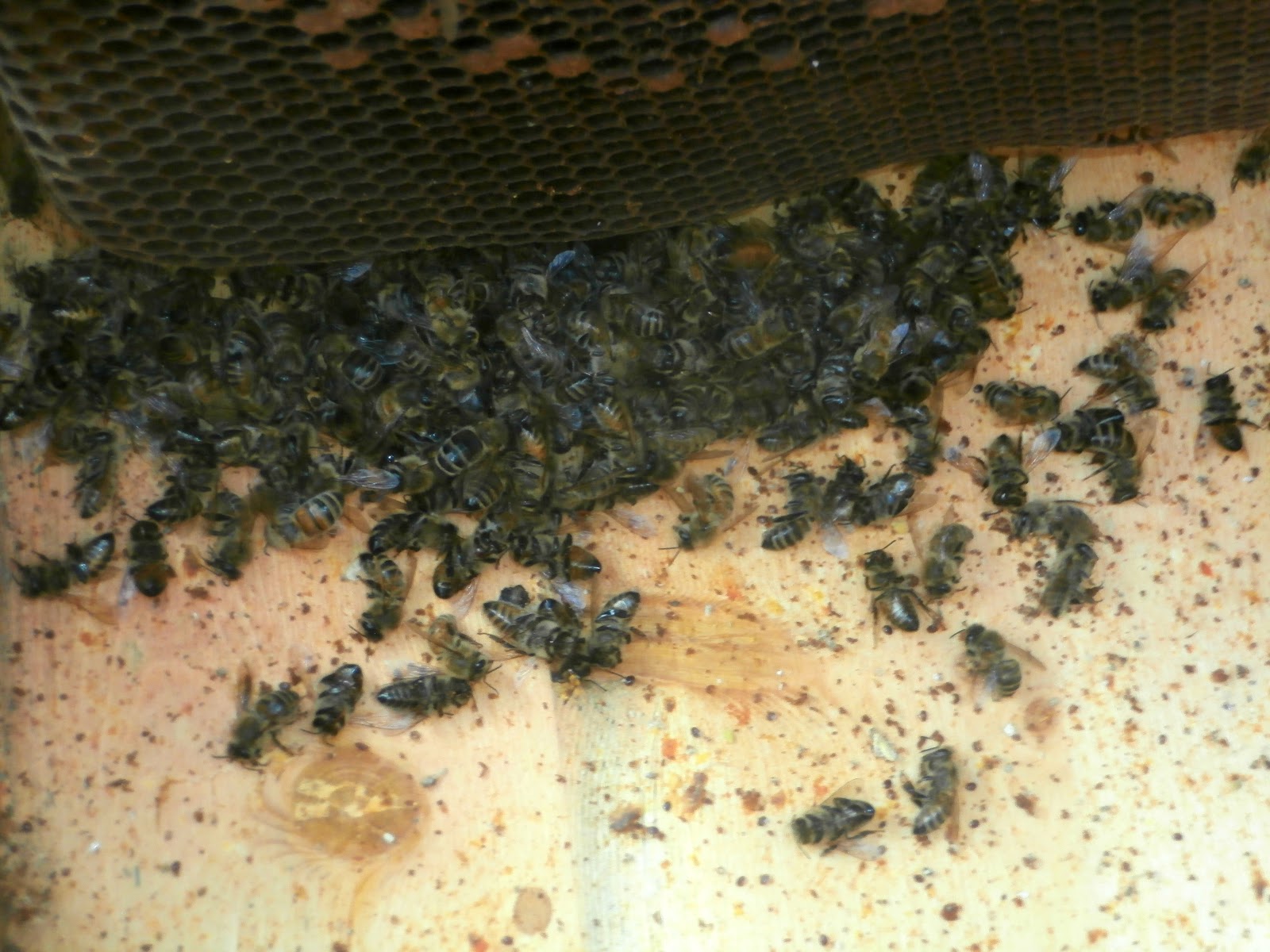
Pile of dead bees on floor of hive
Heads down in cells
What I found were a lot of dead bees.  There was a pile on the floor of the hive and some on the frames.  Many bees were head down in the cells.  On close inspection, the bees had their tongues protruding.  These are signs of starvation and there wasn't a bit of honey anywhere.
Probable queen on left.  Note tongues.
I looked through the pile of bees and I think I found the queen.  When I stirred the bees about looking for the queen, I saw many small black flies that ran around rather than flying (like quails).  Phorid flies act that way.
I caught one and tried to identify it.  It has wing veins like a phorid and the femur looks right.  It is a darker color than the pictures, though.  I'm concluding that these are phorid flies.
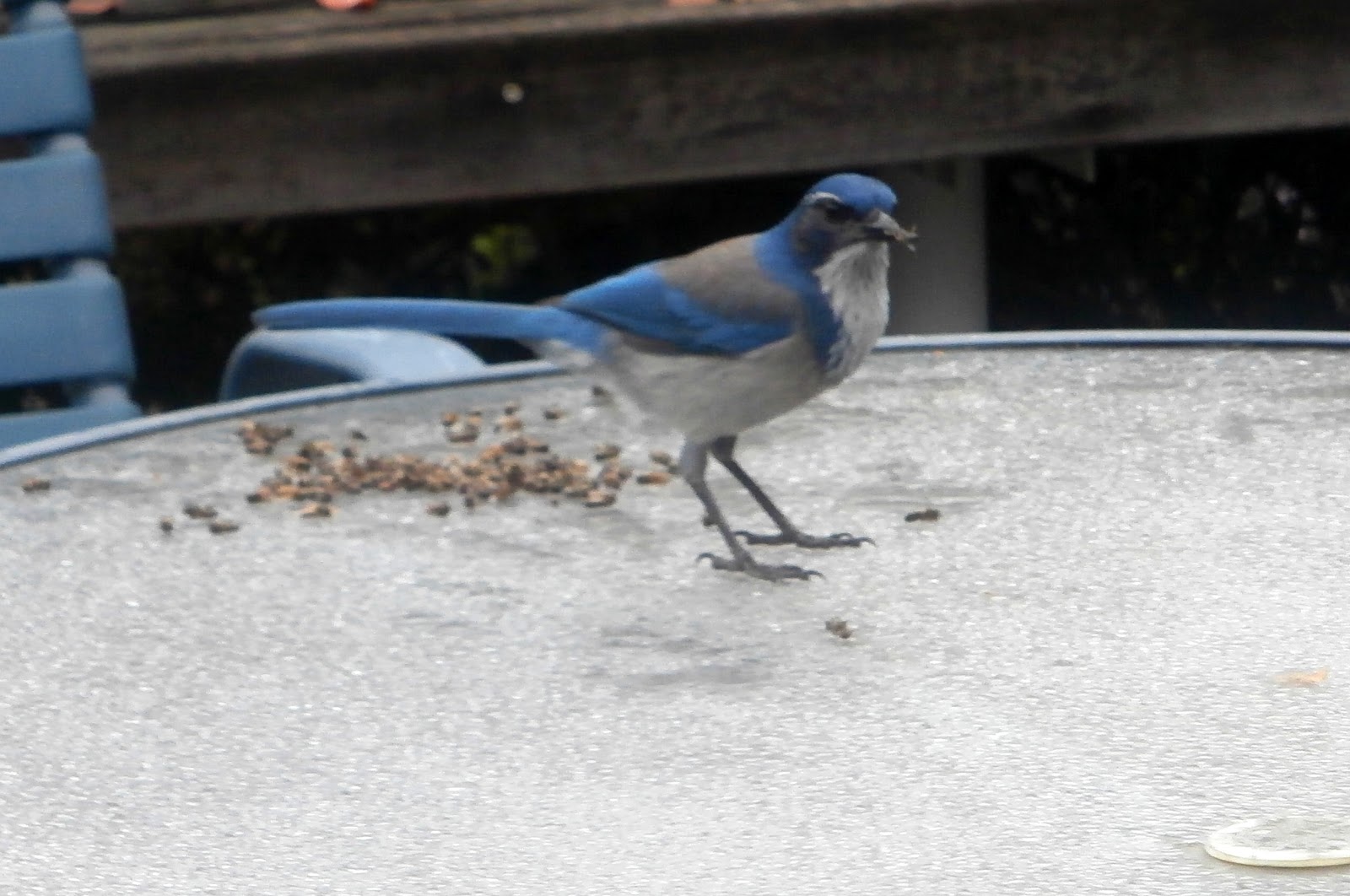
I took out all the bars with comb and used my shop-vac to clean out all the dead bees, flies and debris.  I then used tweezers to pluck the bees and pupae out from the comb.  The pile of bees on the table attracted a blue jay who enjoyed an apian snack.
 I put all the bars with comb back in the hive and moved the false back forwards.  As usual, I don't know if I'm going about this properly.  I hope that there isn't a problem with pests such as the wax moth.  I intend to get a package in the spring for the hive.

Saturday, December 15, 2012

Too cold to look

It's been too cold to go into the hives, but I'd really like to take a look and see what's going on.  I have real concerns regarding their viability.  I may be looking at three packages come spring.  If the colonies survive, I'll be re-queening.
Inside Olea's hive
Olea's hive has a window, so I can get a peek.  The number of bees seems to be declining, although they may just be  in a cluster.  I can also see several dead bees on the floor of the empty part of the hive.  The undertaker bees aren't doing their job and I suspect that that is not a good sign, although this may just be natural winter behavior
Under the lid of the new hive
I took a peek under the lids of the other two hives.  There was nothing in the old hive.  There were several dead bees in the new hive and one little fly that flew off.  Could these bees be victims of the Phorid fly?  There were also a lot of dead bees on the porch.
New hive porch
Dead bees and Phorid fly pupae
Speaking of Phorid flies, I had picked up 11 crawlers on the stones in front of the hives November 8 and 5 pupae resulted.  None of the pupae I have in containers have hatched yet.
On November 20, I was watching the girls and I noted two groups of bees on the rocks in the dry creek.  It looked like they were having some sort of meeting.

Saturday, November 24, 2012

Olea's hive with Laura

Laura was down for Thanksgiving weekend and we took a look into Olea's hive.  The bee population looks pretty small.  There was no capped honey and only a few capped brood cells.  We didn't see the queen.  I'm pessimistic regarding this colonie's survival.  I don't intend to requeen the top bar hive, but I may change my mind down the road.

Tuesday, November 20, 2012

Old hive decreasing population

Over the past 1-2 weeks, I've noticed that the activity at the entrance of the old hive seems to have diminished.  It certainly is less active than at the new hive next door.  Yesterday I took a look into the old hive to see if I could spot anything amiss.
There was no honey at all in the top super, so I decided to take it off altogether.  Only two frames in the other super had honey.
In the upper brood box, there were 4-5 frames with honey, no brood. On a few frames, there were some empty cells surrounded by honey, suggesting that brood had once been there.  There was nectar in many of the empty cells.  (So they weren't really empty, were they?)
In the deep box, there was only one small patch of brood and larvae and I didn't spot the queen.
I did get the sense that the population had contracted.  Previously, there had been bees in the Vivaldi box, but there were no bees above the first super on last inspection or this one.  Also, there didn't seem to be as many bees as previously in the upper brood box.  Once again, we'll have to wait and see.
Pieces of propolis
On the bottom of two adjacent frames were leafs of propolis.  It looked like they may have formed a small dome.  I looked in the hive to see if there was anything the bees may have walled off, but I saw no foreign objects.  I took the propolis and added it to my small collection. 
Bees in jar coated with powdered sugar

Only two!
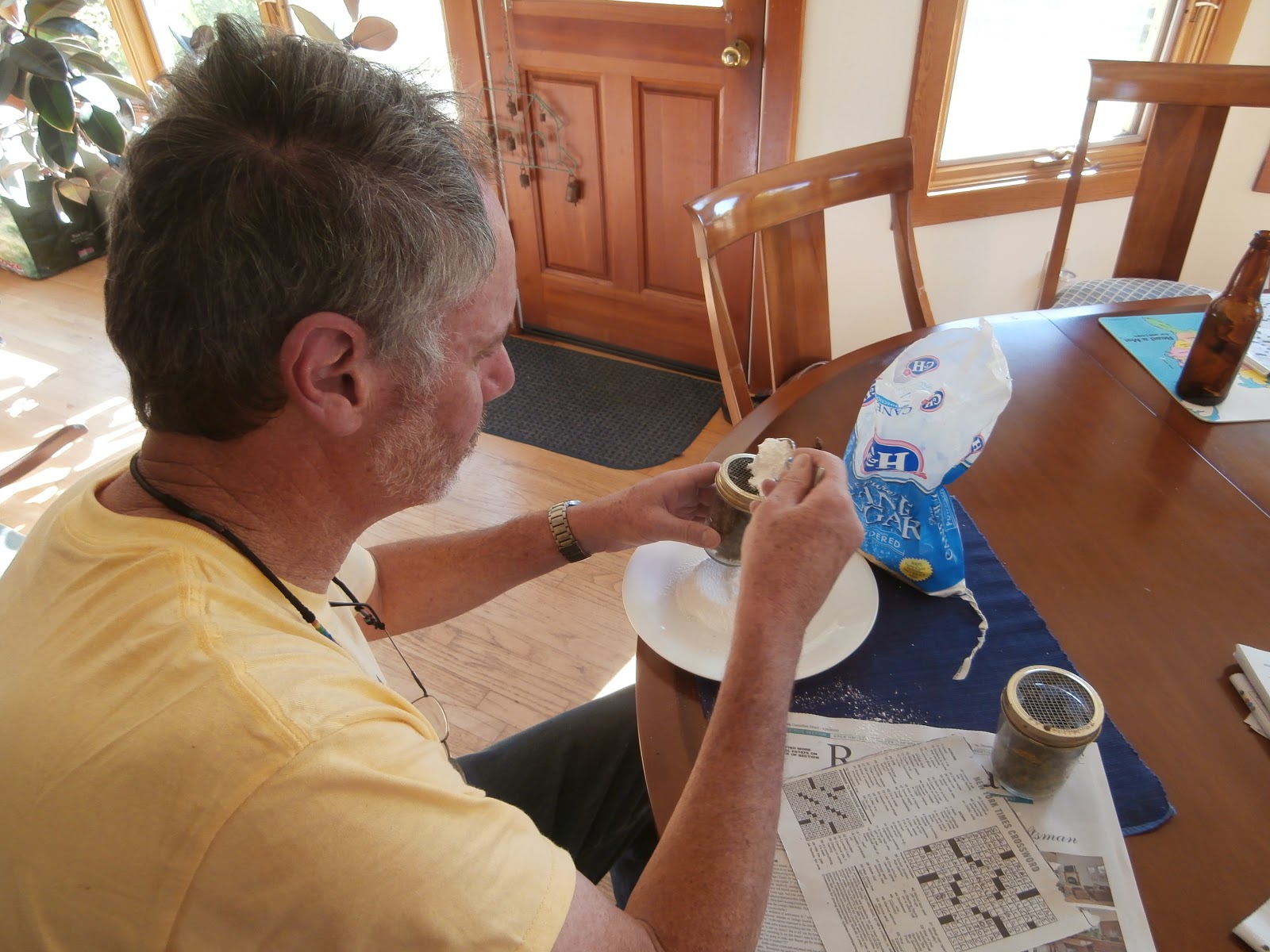
I did another sugar roll count.  This time I changed my collection technique.  I used a larger mason jar, put the powdered sugar in first and used a measuring cup to scoop the bees out of the bucket.  It was much easier, I got the full 1/2 cup and I didn't squish anyone.  This time there were only two mites- hooray!
Saturday, November 10, 2012

After one week of MiteAway Quick strips

I took out the MiteAway quick strips today; they'd been in for one week.  I dumped the contents of the trays from below the screened bottom into a dish.  Most of the brown stuff is mites.

  A close-up  The oval shapes are mites.

Saturday, November 3, 2012

No top queen but plenty of mites

Inspected both hives today.  First the new hive.
Once again I was impressed by the number of bees in the Vivaldi box.  I didn't see the queen or any larvae or capped brood in the top box.  Honey was being made in most of the cells in the central frames, including where there had previously been brood.  I did take a good look for the queen.  I assume she's gone.
In the bottom brood box, I did see the queen.  There was only a little honey and a bit of capped brood.  I didn't see, nor look hard for, any larvae.  I collected bees for a sugar shake count by dumping them into a bucket and then scooping them up into the jar.  Results of count below.

In the old hive, I checked for honey in the supers by heft only.  It didn't feel any heavier than last time.  In the deep boxes there were about 6 frames of capped honey combined. As in the other hive, I spotted the queen and collected bees for a sugar shake count.  I also saw a bee that was deformed- it looked like she had only a rudimentary abdomen and her wings looked thickened.  I set her aside for a photo, but she wandered off while I was busy.

Powdered sugar and Varroa mites shaken onto plate.
Then I took my two jars of bees in for the shake count. It was awful!  About 1/3 cup of bees in the old hive with 31 mites and 1/2 cup of bees in the new hive with 48 mites.  My calculations are 15.5% in the old and 16% in the new.  But with that number of mites, even if my calculations are off, I need to treat.  So later this afternoon I went back and put Mite-away quick strips into both hives.
 Released after the count

Friday, November 2, 2012

Phorid fly

http://cdn.honeytraveler.com/wp-content/uploads/2012/01/phorid-fly-on-honey-bee.jpg?4c9b33
As many of you have read, there is "new" pest bothering the honey bee- the Phorid fly.  I thought I should check to see if my bees were infested.  I found a site, ZomBee Watch, which has a map of reported infested hives.  Since there was one reported in Soquel, I figured my girls must also have been parasitized.
I didn't read the tutorial on the ZomBee site before I did my set-up, but just did it a simple way.  I hung my work light, with a florescent bulb, in front of the hives on a length of pipe.  When it was dark, I turned on the light.  One hour later, I went out and found 3 bees climbing around the light.  I put them, as well as a dead be from the walk below, into the jar I use for the sugar shake test.


Today, 7 days later, here's what I saw when I looked into the jar:
Those 3 brownish ovals at the top edge of the bottom are pupae.
There was a fourth, lighter pupa on the side of the jar.
I had been looking into the jar daily and had not seen the larva.
I examined the bees carefully and was unable to find the hole through which the pupae had exited.


The pupae out of the jar
 I transferred the pupae into a plastic vial and will wait until they hatch.
I submitted a report to ZomBee but it won't be complete until I report on the flies hatching.