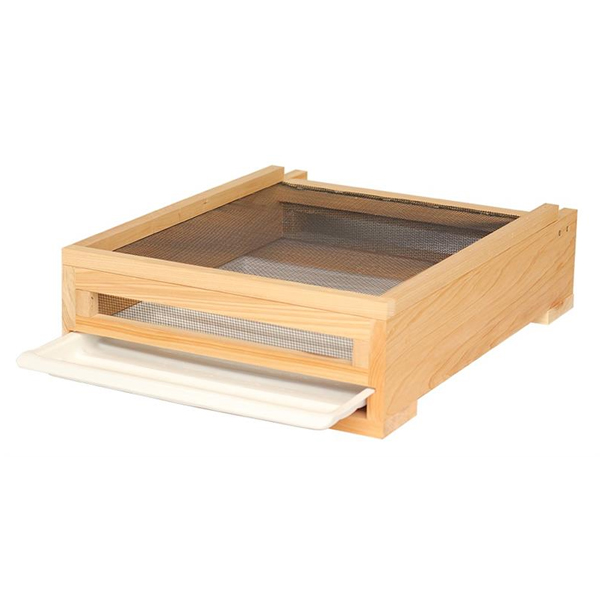
As I was thinking ahead to spring, I thought it would be good to move the nuc to the position the colony would eventually occupy. I thought it would be too disruptive if they were moved and put into a deep box at one time. I had been planning to to this for some time, but I wanted to do it early in the morning before the foragers were out. I frequently awaken early enough but do not remember to do it. Yesterday I wrote myself a reminder, and this morning, awake and up at 5 AM, I saw the note.
Suited up when it was just getting light, I moved the nuc to spot #3. I covered the door with a piece of wood as I carried the surprisingly heavy box across the yard.
I placed some grass (cut a couple of days ago in preparation) across the entrance to encourage the foragers to reorient.
Also, rain is expected today and this will help keep them in the hive. See section 3 of this link. I will be checking around the old nuc site to see if a lot of foragers go there.
Later that day, a few foragers had landed on the nuc stand.
I saw a bee fanning with its Nasonov gland at the nuc's entryway, so I moved the stand and bees near the box.
Sunday, December 16, 2018
Friday, November 9, 2018
Pry-scale revisited, one more time
Last spring I had built a pry-scale with which I could monitor the changing weight of the hives. The scale worked fine but the bottom board could not tolerate the strain. The bottom boards have a small cross piece to support the tray. My bottom box is different than the one pictured below, but you can see a piece of wood below the white tray. This is about 3/4" square and held on with staples.
When the hives were heavy, the strip of wood was pried away from the box.
I still wanted to monitor the weight, so I had to figure out a way to re-enforce the bottom. I first used a piece of hard wood flooring. I used a router to make a space for the pry-scale levers, but this weakened the plank allowing it to bend too much. Then I thought of using a metal strap.
I got 3/8" steel straps.
Using my reciprocating saw, I cut them into 16-1/4" lengths, then drilled holes in the ends. I beveled the holes so the screw head would not protrude.
The straps were screwed onto the bottom of the boards.
I tested one placing a cinder block and several heavy stones on it and it worked. Now I will have an extra duty in the apiary next spring.
This photo has nothing to do with my bees. The mushrooms were alongside the bike path in Ireland.
When the hives were heavy, the strip of wood was pried away from the box.I still wanted to monitor the weight, so I had to figure out a way to re-enforce the bottom. I first used a piece of hard wood flooring. I used a router to make a space for the pry-scale levers, but this weakened the plank allowing it to bend too much. Then I thought of using a metal strap.
I got 3/8" steel straps.
Using my reciprocating saw, I cut them into 16-1/4" lengths, then drilled holes in the ends. I beveled the holes so the screw head would not protrude.
The straps were screwed onto the bottom of the boards.
I tested one placing a cinder block and several heavy stones on it and it worked. Now I will have an extra duty in the apiary next spring.
This photo has nothing to do with my bees. The mushrooms were alongside the bike path in Ireland.
Tuesday, October 30, 2018
Hive #1 reduced
Finally I was able to reduce hive #1 to one deep and a medium.
I went in yesterday. There was still brood and eggs in the medium as well as the queen. She has no black on her abdomen- a golden queen. There was honey and a little brood in the top deep. The bottom deep had empty comb with a very small amount of honey. I took three frames with the youngest wax from the bottom and switched them into the then top deep.
The bottom box was in need of repairs and cleaning. Most of the frames have old, black wax and will be scraped.
I went in yesterday. There was still brood and eggs in the medium as well as the queen. She has no black on her abdomen- a golden queen. There was honey and a little brood in the top deep. The bottom deep had empty comb with a very small amount of honey. I took three frames with the youngest wax from the bottom and switched them into the then top deep.
The bottom box was in need of repairs and cleaning. Most of the frames have old, black wax and will be scraped.
| My helpers cleaning the honey off of the frames |
Friday, October 12, 2018
Fall update
Much has happened since the last posting. I will try to keep it short.
#2 did not make it. The two boxes never combined and the hive was robbed. It has been dismantled and awaits bees next year.
Olea's continues to be strong on its 7 bars. On one inspection, I saw no honey so started feeding with 1:1 syrup. I used the entrance feeder, placing it inside the box. The bees accessed it by going under the following board. I added another bar when I started feeding and saw some new wax today. I also saw more honey stores so I will no longer feed them after the present batch of syrup is gone.
#1 is still doing well. When harvesting honey, there was brood in the bottom-most super so no honey was taken from that box. We did get a fair amount of honey. This is about half.
After the honey was taken, I put Apivar strips into the hives and the nuc. I took them out today.
On earlier looks, the bottom box of #1 seemed pretty empty. Today I wanted to remove it in order to reduce the hive and do some repairs on the box. However, after taking out 4 frames with empty comb, I saw a large patch of capped brood on the 5th; end of plan. So #1 still is two deeps and one medium. Some of the honey in the medium may have been made when the Apivar was in the hive, so I will not be able to harvest in. I would like to remove the box before the honey flow next spring but I won't do it as long as brood is present.
#2 did not make it. The two boxes never combined and the hive was robbed. It has been dismantled and awaits bees next year.
Olea's continues to be strong on its 7 bars. On one inspection, I saw no honey so started feeding with 1:1 syrup. I used the entrance feeder, placing it inside the box. The bees accessed it by going under the following board. I added another bar when I started feeding and saw some new wax today. I also saw more honey stores so I will no longer feed them after the present batch of syrup is gone.
After the honey was taken, I put Apivar strips into the hives and the nuc. I took them out today.
On earlier looks, the bottom box of #1 seemed pretty empty. Today I wanted to remove it in order to reduce the hive and do some repairs on the box. However, after taking out 4 frames with empty comb, I saw a large patch of capped brood on the 5th; end of plan. So #1 still is two deeps and one medium. Some of the honey in the medium may have been made when the Apivar was in the hive, so I will not be able to harvest in. I would like to remove the box before the honey flow next spring but I won't do it as long as brood is present.
Thursday, August 9, 2018
Oh where, oh where has #3 gone?
| #3 Hive stand |
I took #3 apart and put the boxes with bees onto #2 using the newspaper combine. I put the escape board below the super that had capped honey and will take the super off soon. In the next few days I will also start collecting the supers from #1 for the honey harvest
| #2 with deep and super from #3, with escape board and newspaper |
It looks like I may need my nuc after all. (Sorry Matt and Laura)
Saturday, July 21, 2018
#2 has a queen!
I looked into #2 today and saw a queen walking around on the frame. There are still not a lot of bees and I did not see eggs (nor did I look hard for them). I took off the super and will harvest the honey from it. I considered moving the frames into a nuc box or dividing the current box somehow but decided to leave it as it is.
Monday, July 16, 2018
What happened to #2?
| The apiary today |
Two days ago I noticed very little activity at #2's entrance.
| #1 |
| #2 |
| Under the telescoping lid |
| Under the Vivaldi box |
| Under the top super |
| Under the bottom super |
| Under the top deep box |

I went through the hive and found only a couple of hundred bees, mostly on 2-3 frames in the top brood box. There was a spotty patch of capped brood and some larvae. The only drone brood I saw as on a frame bare of bees. There were many queen cups, a couple of which were partially drawn out, but all were empty. There was one (smaller than usual) queen cell with an open end indicative of an emerged queen. I did not see a queen nor any eggs. I looked for any bees with DWV
or any mite feces Today I removed the bottom deep box, as in the opening picture.
If you have any more questions, feel free to ask.
There still is forage in our yard-
| Oak hydrangea |
Subscribe to:
Posts (Atom)