Saturday, June 28, 2014
The woodpeckers are eating my bees
A couple of weeks ago I saw woodpeckers hanging out in the plum tree by the hive and in the tall tree behind our house. They would swoop down and grab a bee out of the air. I had no idea woodpeckers ate this way. This site describes that sort of behavior. I did video one flying in to capture a bee.


Saturday, June 21, 2014
Post-Hawaii inspection

Hive #1. After returning from Hawaii, I noticed that the activity around the entrance was less than around the other hives, so I inspected it first. I looked into every box. My subjective impression was that there were fewer bees than before. I saw no eggs, larvae or capped brood and did not spot the queen. My first pessimistic conclusion was that the colony was queenless and dying. But I did come up with a more optimistic theory that fits all the facts, i.e., while we were away the colony cast a swarm (explaining fewer bees) and the new queen has not yet started laying. I did not see here because new queens are very shy and quick. I will wait a couple of weeks and then check for signs queen activity. I was concerned that there might be too much space in the hive for the bees to effectively patrol for wax moths so I put the bee escape board in and removed the top super. I ultimately placed the super on #3. I am also keeping a lookout for robbing activity; if/when I see any, I will replace the entrance reducer.


Hive #2. This one now seems to be the strongest. I spotted the queen in the top brood box and watched her lay three eggs. (If I had my own GoPro, you would get some great pictures and videos, clue, clue.)Most of the brood is in the top brood box, but there is some in the bottom box. There were a lot of drones all over. The drone frame in this hive and very irregular comb, many drone cells and some capped honey. I took it out and inspected the pupae for mites. I only looked at six and found four mites! I did not replace the drone frame, but I have just now decided to get a scraper and use it assiduously
Hive #3. There still is cross-combing, but I think it may be a bit better. The number of bees looks good. There is honey in top box as well as drone brood. I did not go into the bottom box. Placed honey super from #1 (that had some honey already in it) on top.
Friday, June 20, 2014
Bees in Kauai
We recently spent a relaxing week on Kauai at a lovely home with some friends. One evening, just as I got out of the shower, I was called urgently into the study. There were about 100 bees crawling around on one of the windows. We looked for the way they got in, but found none. We also saw bees flying around outside. Figuring there was a swarm nearby, I went out to try to locate it. There were many bees flying around the eave above the window, but palm fronds prohibited me from getting a clear view. Then I noticed a 4-inch diameter hole in the siding below the window (where a cable had been brought in) and a few bees were flying in and out. We notified Mike, the caretaker and he called Oliver, a local beekeeper who promised to come out the next day.
Meanwhile I discovered a small opening behind a soffit from which a bee would periodically emerge. We covered the hole with packing tape. Overnight, the bees in the room died.
When Oliver came out the next day, he found bees flying into the dryer vent and into another opening on the opposite side of the house. There were more bees in the study (now called the bee room) as well as a couple in the bathroom and in the downstairs room. Oliver set up a bait box, but no one went into it. He also showed us from where he had removed a colony from the walls of the house last year. The next day, thousands of bees suddenly appeared and settled just above the bathroom skylight and crawled into a gap in the flashing.
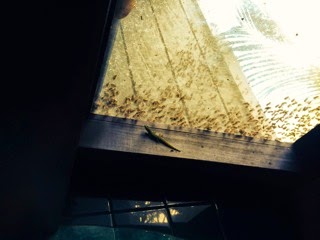 In this photo, most of the bees had already entered the wall. Note the lizard looking at a potential meal. There were geckos and lizards all over, as always in the tropics, and they were feasting on the bees. One lizard was on the wrong side of the glass (not this one) and kept snapping futilely at the bees.
Oliver came back, removed the siding and...no bees. They had crawled into the gap below the joists. He had to drill several holes in the wall of the bee room and spray in his homemade bee repellent (that smelled heavily of almond) to drive the bees out to the roof where he patiently scooped them up and put into a nuc box. Finally he caught the queen in a special cage. Now all he had to do was wait for all the girls to go to their queen in the nuc and then take the nuc away.
We swept up the dead bees and now could go barefoot again.

Meanwhile I discovered a small opening behind a soffit from which a bee would periodically emerge. We covered the hole with packing tape. Overnight, the bees in the room died.
When Oliver came out the next day, he found bees flying into the dryer vent and into another opening on the opposite side of the house. There were more bees in the study (now called the bee room) as well as a couple in the bathroom and in the downstairs room. Oliver set up a bait box, but no one went into it. He also showed us from where he had removed a colony from the walls of the house last year. The next day, thousands of bees suddenly appeared and settled just above the bathroom skylight and crawled into a gap in the flashing.
Oliver came back, removed the siding and...no bees. They had crawled into the gap below the joists. He had to drill several holes in the wall of the bee room and spray in his homemade bee repellent (that smelled heavily of almond) to drive the bees out to the roof where he patiently scooped them up and put into a nuc box. Finally he caught the queen in a special cage. Now all he had to do was wait for all the girls to go to their queen in the nuc and then take the nuc away.
We swept up the dead bees and now could go barefoot again.
Sunday, June 1, 2014
Debris on the sticky board
Yesterday I took out the sticky boards to count the mites. The results were overall good. #1, 7, #2, 20 and #3, 9. That is fewer than 10 mites a day and does not warrant treatment now. According to the Beebase calculator, I should treat #2 in about a month and the others in about two months. Of course, I will do another count before treating.
 There seemed to be much less debris on all the boards than I usually see. These are the three (home-made) sticky boards together. In the past there has been debris all across the boards. I'm not certain how to interpret this. At first I thought that the boards had been scraped while being removed, but careful forensic inspection uncovered to tell-tale marks.
The debris conains lots of chewed wax, some wax flakes, pollen balls and pieces of bees. I had also often seen these:
 I had wondered what they were, so did a bit of a google search. What I found out was not encouraging- wax moth worm poop! Since I have seen no damage to the comb, I assume the girls have this pest under control. I have often found wax moth larvae or their webbed tunnels in the thick piles of debris that accumulate in the trays, but since these are beneath the screen, I have'nt worried.
I also saw some new (to me) debris in the tray of #1 when I cleaned it out and again on the sticky board:
 These look like thin cups. Above shows one curved up and the other down. It seems that these are the top of drone cell pupa cases.
Finally, one more picture of why we have sticky boards at all:
 I visited Bruce and Gregg's hive yesterday. While watching the queen, we saw her lay two eggs, a first time and thrilling experience.

The debris conains lots of chewed wax, some wax flakes, pollen balls and pieces of bees. I had also often seen these:
I also saw some new (to me) debris in the tray of #1 when I cleaned it out and again on the sticky board:
Finally, one more picture of why we have sticky boards at all:
Thursday, May 29, 2014
Quelle mess! Or, I still don't know what I'm doing
 | ||
| Blackberries are on their way |
When I looked into #3, for a moment I was pleased to see comb and nectar in the foundationless frames, but quickly realized that they had built from the bottom and the comb was every which way, mostly crossing the frames. I pondered what to do and then did nothing and closed up the hive.
I put sticky boards into all three hives finding and squishing a fat was moth worm in #3. Then I went inside to research what to do about the crosscombing in foundationless frames.
It is not uncommon for the bees to start building from the bottom if they do not have a "ladder" to get to the top. The beekeeper should intersperse frame with either drawn comb or foundation. Live and learn.
Yesterday I went out to try to correct the crosscombing. First I had to remove the frames attempting to do little damage. Dream on! I took out two frames from the edge and gazed with dismay at what the girls had wrought.
 |
| The first part of the mess |
 | ||
| A closer view |
 |
| Another angle |
 |
| Pieces of comb from first frame with the girls lapping up the honey |
I worked away, freeing frames, trimming the comb so it was not sticking out and putting them back, alternating foundation and foundationless. Most of the comb that was left was not oriented properly but I decided to leave it anyway hoping the bees would straighten things out. More likely, they will just continue the comb at the same angle and cross comb to the foundation. (Live and learn.)
Then I came to one set of three frames that I could not see how to break apart. (I was looking between the frames and there were bees all over.) These frames came out as one unit.
 |
| Block of three frames |
I also got a bunch of wax and some unripe honey to process. In a week I'll take a look a look- keep your fingers crossed!
Saturday, May 17, 2014
Underneath #1
Before inspecting the hives today, I pulled out the trays below the screened bottom of Nos. 1&2. I was surprised to see a lot of bees on the #1 tray as well as some comb.
 I crouched down, with some difficulty, and looked underneath, worried that there may be a hole in the screen. There was no hole, but there were a lot of bees on the screen.
 The poor quality picture on the left was taken blindly, pointing the camera under the hive.
Inspection report: #3-There is some come being drawn in the top brood box, no other significant change from last week
#1- I only checked the top super for new honey production or comb. There was a fair number of bees on the frames but nothing else.
#2- Lots of brood, at least eight frames! Two of these were in the top brood box. I saw the queen in the bottom box and then saw her again on the next frame I removed; an active monarch. There was some honey production in the top brood box.
Overall, the apiary appears healthy.
After inspecting the hives, I cleaned out the trays, brushed the bees off the screen and replaced the trays. There was a large amount of debris in the #1 tray. The black tab in the center is about 3/4 of an inch high.

The poor quality picture on the left was taken blindly, pointing the camera under the hive.Inspection report: #3-There is some come being drawn in the top brood box, no other significant change from last week
#1- I only checked the top super for new honey production or comb. There was a fair number of bees on the frames but nothing else.
#2- Lots of brood, at least eight frames! Two of these were in the top brood box. I saw the queen in the bottom box and then saw her again on the next frame I removed; an active monarch. There was some honey production in the top brood box.
Overall, the apiary appears healthy.
After inspecting the hives, I cleaned out the trays, brushed the bees off the screen and replaced the trays. There was a large amount of debris in the #1 tray. The black tab in the center is about 3/4 of an inch high.
Saturday, May 10, 2014
Inspection update and #1 is queenright
 |
| The apiary this afternoon |
Hive #3- The split is developing into a good colony. On the 3rd, two of the foundationless frames had been completely drawn. The queen was on one of them with capped brood. A couple of other frames also had capped brood. The brood ball was off center so I shifted everything over one frame. Eight frames were drawn, so I added a second deep box.

 Yesterday, Sophie inspected #3 with me. There was still a fair amount of larvae and capped brood, but nothing was happening in the top brood box. Sophie did get to see brood, larvae, hatching worker, the queen, drones, workers doing the waggle dance, stored pollen and honey.
Hive #2- Two weeks ago, there was no activity in top brood box but five frames filled with capped brood. The queen was not spotted. Today I saw capped brood, larvae and eggs in the lower part of a couple of frames in the upper brood box. I did not inspect any further. Full of optimism, I added a honey super.
Hive #1- Two weeks ago, I saw lots of drones, honey being made and empty cells where there had once been brood. I looked through the entire hive and saw no queen nor sign of a laying queen; no larvae, brood or eggs. I did see one empty queen cell. I worried that #1 was queenless and wondered what to do- transplant a frame with eggs from #2 so they could make a queen? Combine #3 with #1 with the newspaper technique? I emailed Kathy who pointed out that it had been only a bit over two weeks since it had swarmed and it takes at least that long for the new queen to hatch, mate and start laying. So I waited until today.
 | ||||||
| There she is, on the frame in the center |
 |
| Capped worker brood |
 |
| Capped brood, mostly drone cells, on foundationless comb |
 |
| The three dark frames are full of capped honey |
Subscribe to:
Posts (Atom)