
Thursday, August 28, 2014
They found the water hole


Saturday, August 23, 2014
Mites and bee death
Yesterday the sticky boards had been in #2 and 3, so I took them out for the mite count. There was not much debris on either, so I was hopefully optimistic when I sat down to count. The optimism was short-lived. I stopped counting at 60 mites when I had not even examined more than half the board. More than 20 mites per day translates to more than 800 mites in the hive, way too many. I needed to treat right away.
I already had a supply of mite-away quick strips. When I have used them in the past, I was unhappy with the way the pads became somewhat squished between the boxes, so I wanted to put in some sort of spacer.
Looking around at my collection of hive parts, my eye fell on the two inner covers that had I had replaced with the Vivaldi boards. These were just the right size; all I had to do was remove the Masonite. I pondered my choices- cut it out or disassemble the frame. I elected the latter move since I would then have the Masonite to use for some other project.
Using a screwdriver and vice locks, I removed the nails with a minimum of damage, took out the board and put the frames back together.
The frame/spacers worked well giving the formic acid pads plenty of room.
It was a warm, sunny day, but the #3 bees were still testy, so I crossed "bad weather" off my list of possible explanations for their unruliness.
Later in the afternoon, I took a look at the hives and noticed several dead and dying bees. I recalled that the mite-away strips could kill bees (#6) and a quick search confirmed my belief. This is what I saw this morning.
I have confidence that they will do well in the long run.
I already had a supply of mite-away quick strips. When I have used them in the past, I was unhappy with the way the pads became somewhat squished between the boxes, so I wanted to put in some sort of spacer.
Looking around at my collection of hive parts, my eye fell on the two inner covers that had I had replaced with the Vivaldi boards. These were just the right size; all I had to do was remove the Masonite. I pondered my choices- cut it out or disassemble the frame. I elected the latter move since I would then have the Masonite to use for some other project.
Using a screwdriver and vice locks, I removed the nails with a minimum of damage, took out the board and put the frames back together.
 | |
| My usual workshop |
It was a warm, sunny day, but the #3 bees were still testy, so I crossed "bad weather" off my list of possible explanations for their unruliness.
Later in the afternoon, I took a look at the hives and noticed several dead and dying bees. I recalled that the mite-away strips could kill bees (#6) and a quick search confirmed my belief. This is what I saw this morning.
 |
| #3 |
 |
| #2 |
Thursday, August 21, 2014
Testy three
I inspected #3 yesterday. It looks like it's doing well with reasonable honey stores in the brood boxes and lots of brood. I didn't see the queen, though. I observed that the drones were concentrated on the outer frames just as they had been in #2. I tried to find reference to this online and in my books to no avail. I can speculate regarding this behavior, and I do, but it would be nice to have a more authoritative explanation. My theory is that the workers do not want them around the "work" areas and chase them off to the sides. Soon, the workers will be chasing them out of the hive altogether.
The bees in hive were testy, pinging me frequently (that is, bumping into my veil) and buzzing about my face. One guard started after me as soon as I took the top off! To stop the annoyance, I got the spray bottle of my honey-bee-healthy and spritzed the buzzing girls. Then I got the smoker going and smoked everyone. Then I just did my best to ignore them.
There are several reasons why a colony is testy; no queen, no honey flow, bad weather, robbers, etc. I seem to remember that this colony has been testy in the past, so I'm a bit worried that it might be this hive's personality. In the future, I will keep the smoker handy and note their behavior. If it continues to be aggressive, I will re-queen.
The bees in hive were testy, pinging me frequently (that is, bumping into my veil) and buzzing about my face. One guard started after me as soon as I took the top off! To stop the annoyance, I got the spray bottle of my honey-bee-healthy and spritzed the buzzing girls. Then I got the smoker going and smoked everyone. Then I just did my best to ignore them.
There are several reasons why a colony is testy; no queen, no honey flow, bad weather, robbers, etc. I seem to remember that this colony has been testy in the past, so I'm a bit worried that it might be this hive's personality. In the future, I will keep the smoker handy and note their behavior. If it continues to be aggressive, I will re-queen.
Monday, August 18, 2014
Back from Ireland
 |
| A small stream along a backroad |
 |
| Frame from #1 with capped honey and nectar |
 I had expected almost all the bees from #1 to be gone and the remaining honey being robbed as the hive has been queenless for over 6 weeks. Removing the lid, I was surprised to see lots of bees at the hole in the vivaldi box. There were still a lot of bees in the hive and they were still bringing in nectar. There was no sign of robbing, either. All the bees working there are close to 6 weeks old, so I expect them to drop off soon.
#2 is looking very strong. I did not check the frames in the supers. The top box did not feel very heavy. In the top brood box there were several frames with capped honey and some pollen. There was also a bit of brood at the bottom of a couple of outside frames. There was a lot of brood in the bottom box. I did not spot the queen. I was looking for eggs and noticed a large number of cells that had a glistening white substance in them. I suspected this might be royal jelly. You may remember that all larvae are fed royal jelly for their first three days. I went online and found pictures that confirmed my suspicions.
 This is pretty much what my frame looked like.
There were still a lot of drones concentrated on the outer frames.
In the next couple of days I'll get into #3.
Sunday, July 27, 2014
Hive #1 frames salvaged
 Yesterday and today I went into hives #2 & 3. I also opened #1 and selected frames with honey, nectar or pollen. I placed one of those frames into each brood box of #2 & 3. There were some drones hatching on one of the frames I removed from #3.
There were still a fair number of bees in #1.
The girls had done a good job of cleaning the stickies that I put on earlier this month and they had already started filling the comb with nectar.

There were a LOT of drones in both hives. The picture below is from a super frame in #3.

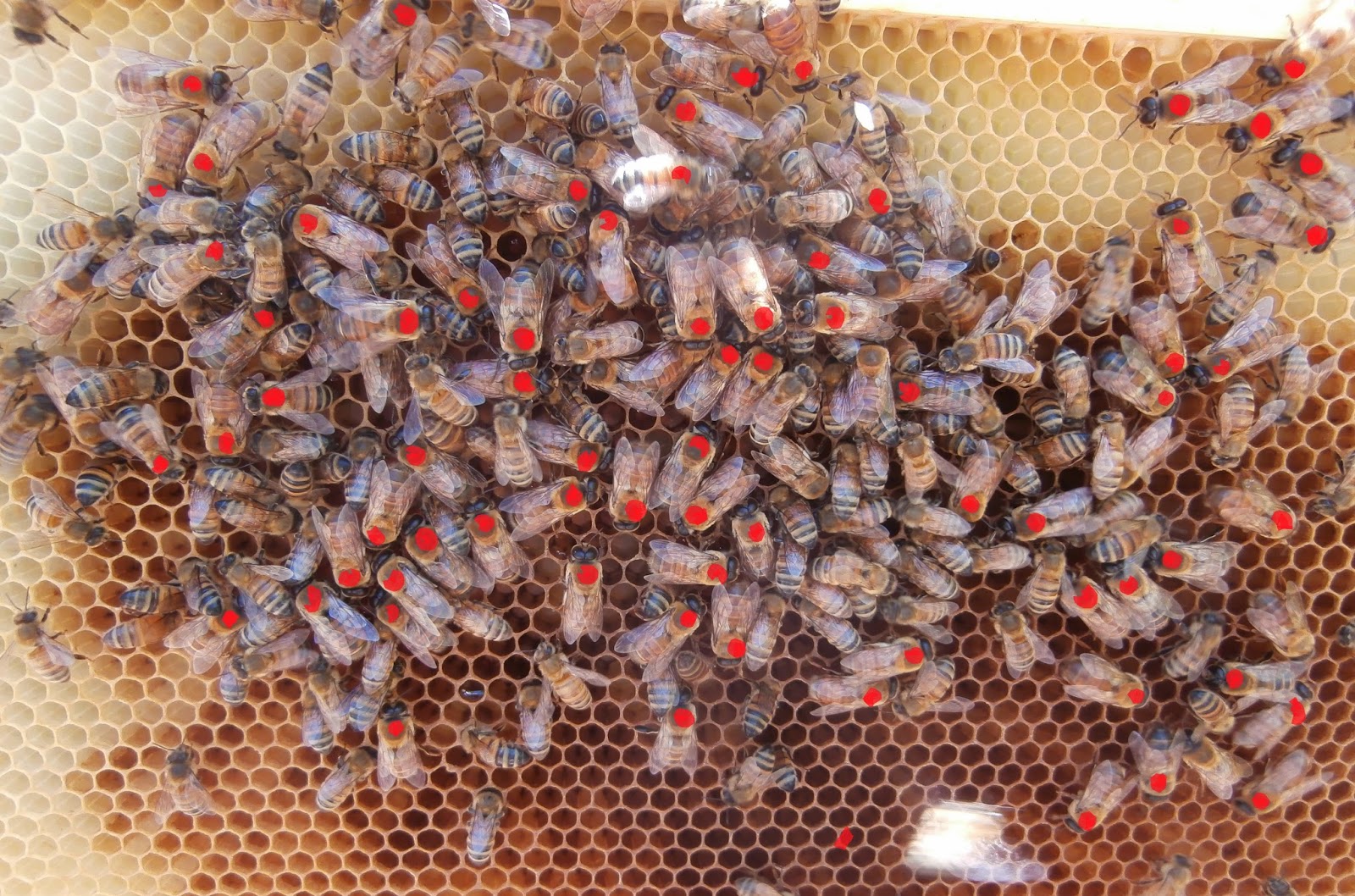
There were a few frames with a good brood pattern in #2 bottom box. I did not see, nor search carefully for the queen.
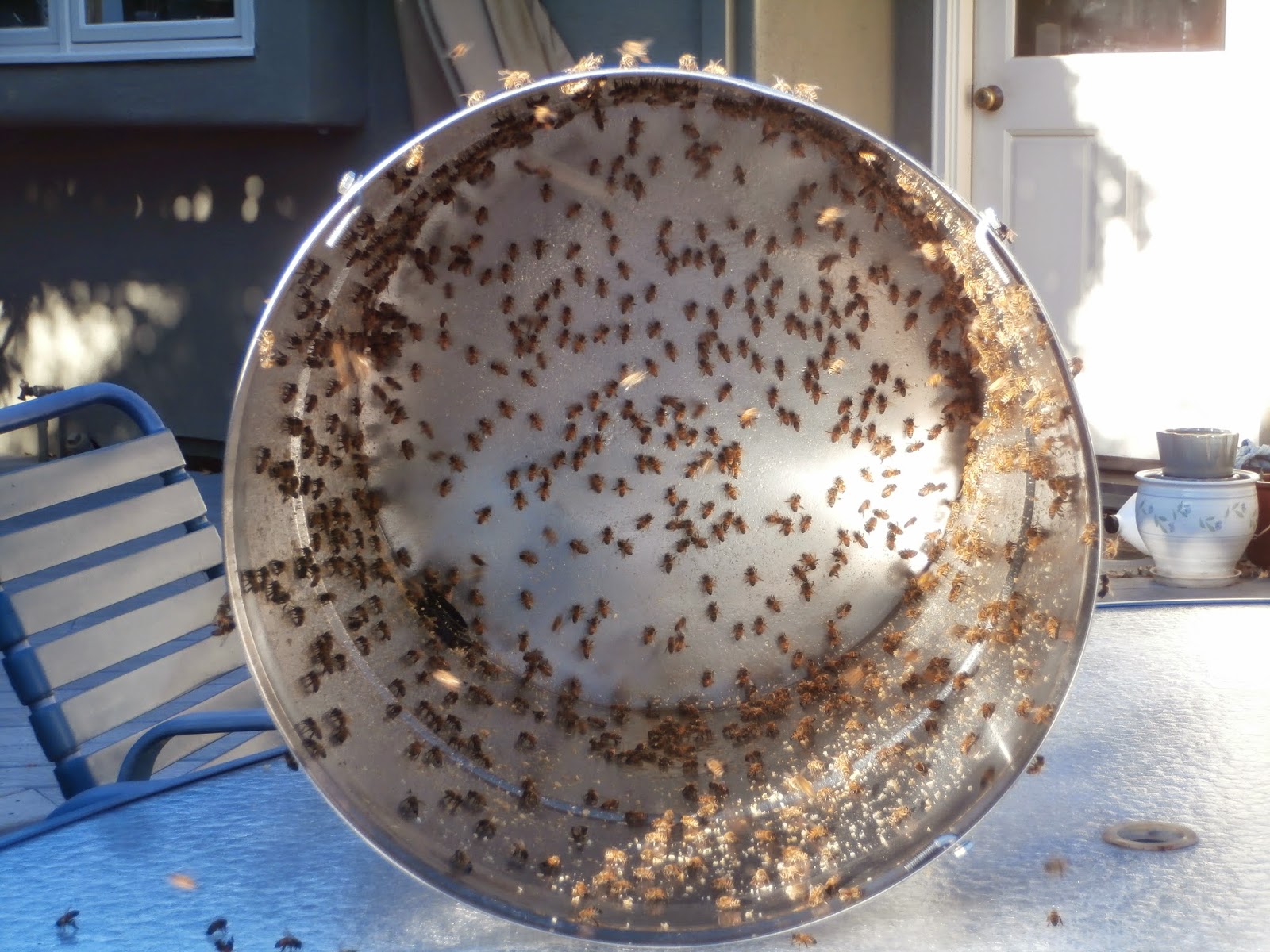
We did get nearly 2 gallons of honey. The bees cleaned the extractor for us.


Saturday, July 19, 2014
Honey from #1
I extracted the honey from the #1 supers. I do not yet know how much there is but it looks like a couple of gallons. I put the stickies onto #2 and 3. I looked into #1. There were still a fair number of bees but it looks like close to 1/3 are drones. There were only about 1/2 dozen scattered capped drone cells. The girls are still making honey and there are a couple of frames full. I need to figure when it would be best to transfer the honey and pollen into the other hives.
Tuesday, July 8, 2014
Laying workers in #1
Well, hive number one is on its way out. I went in yesterday and had to accept the bad news. I saw no queen or worker brood. There was scattered drone brood much of it in worker-sized cells. I looked for eggs to be 100% certain but could not see any. I did not take any pictures, but this is a good picture similar to what I saw in my hive.
I looked in one of my beekeeping books about what to do. If this happens early in the spring one can try to re-queen in a number of ways, but it is too late in the year for that. Franklin Carrier says in his "Keeping Bees" that one can combine the queenless hive with one of the strong hives. I would like to do that, but we are going to Massachusetts tomorrow and I won't be around to perform the necessary steps. I emailed Kathy Niven last night and she concurs that it is too late in the year to do anything and she does not recommend combining.
#1 had been my strongest hive, so I'm sad to see it go. At least its old queen lives on in #3 (remember I made a split) and she's doing well.
Today I put the escape board below the two supers and tomorrow, before leaving for the airport, I'll put the supers with all their honey in the garage.

I looked in one of my beekeeping books about what to do. If this happens early in the spring one can try to re-queen in a number of ways, but it is too late in the year for that. Franklin Carrier says in his "Keeping Bees" that one can combine the queenless hive with one of the strong hives. I would like to do that, but we are going to Massachusetts tomorrow and I won't be around to perform the necessary steps. I emailed Kathy Niven last night and she concurs that it is too late in the year to do anything and she does not recommend combining.
#1 had been my strongest hive, so I'm sad to see it go. At least its old queen lives on in #3 (remember I made a split) and she's doing well.
Today I put the escape board below the two supers and tomorrow, before leaving for the airport, I'll put the supers with all their honey in the garage.
Subscribe to:
Posts (Atom)