Saturday, May 25, 2013

Someday I may know what I'm doing

A couple of days ago I thought I should treat the hives with powdered sugar.  As you recall, this is part of controlling the Varroa mites.  I got my sifter and powdered sugar and sticky boards, donned my bee suit and went to work.  I also removed the top feeders.  In each hive, I placed the sticky board beneath the screen, took off lids and any supers to expose the tops of the brood boxes and sifted in the powdered sugar, a couple of tablespoons per box.  A couple of hours later, I took out the sticky boards to check for results.  There was hardly any sugar and no mites.  What was happening?  I checked one source.  So, I didn't use nearly enough sugar and I checked the boards too soon.  Obviously I had forgotten how I had done it in the past.  Oh well, live and learn. In a couple of weeks I'll do it again.
I just bought Top-Bar Beekeeping by Les Crowder and Heather Harrell.  Today I read the emphasis he puts on the need to manage the combs to prevent cross-combing.  This makes it very difficult for both the beekeeper and the bees to harvest the honey.  He says that after putting a package into an empty box, one should check every couple of days to manipulated the bars so that they are straight and not cross-connected.  Oops, I'm several weeks too late.  So I went out today to see what I could do.  I took out the back board and the last two, empty bars without a hitch.  the next bar had a nub of comb, no problem.  The next was stuck on the glass; I had dealt with that before and cut it away easily.  That was the last easy.  When I pulled that bar away, I, too late, discovered that there was cross-combing and the comb was pulled free, falling to the floor of the hive spilling nearly ripe honey all over.  The bees were getting a little upset.  I lit the smoker, gave them a whiff and went into the house for a bowl.  I removed and moved bars so I could fish out the broken comb.  I went back into the house for tongs.  Fished out the comb.  Then I moved and replaced the 6 bars trying to follow Les Crowder's method.
I hope everything works out.  At least we got some honey and comb. 

Sunday, May 19, 2013

Late spring report

In the past week I inspected hives 1,2 & 3.
Hive 1. I spotted the queen; the original queen with her orange dot.  She's now 2 years old (like Olea, almost).  Soon she will be superseded or I'll need to replace her.  She's already escaped one replacement.  I didn't check for brood, nor do I recall seeing much.  The queen was in the upper brood box.  At one time it was recommended to switch brood boxes so the queen would be in the lower box, but these days many beekeepers just let her alone and she eventually moves into the lower box.  There is still a lot of capped honey in the deep boxes and the honey super was filling up so I put on the second super.  Even though I don't recall seeing brood, the hive appears strong.  There were a lot of bees in the Vivaldi box when I first took the lid off.  Took out the used mite-away quick strips.  I removed the drone frame that had been in the upper brood box and placed an empty one in the bottom box.  There weren't a lot of capped drone cells, and they were even hatching as I watched.  Later I examined some pupa.  They were well past the purple eye stage; I saw only one mite.  The tray is now in the freezer. 
Hive 2. Spotted the queen.  There were larvae of different ages but no capped brood.  Since it takes 9 days from laying to capping, this makes sense.  This is the colony that had to make a new queen and had no eggs or larvae on May 1.  I inspected on the 15th which means that she had started laying a few days after I looked on the 1st.  I removed the spent mite-away quick strips.  The drone frame, in the upper box, had capped honey and honey-in-process.  I removed it and later scraped off the honeycomb.  Placed an empty drone frame in the bottom box.
Honeycomb for Seth
Hive 3.  Spotted the queen.  There were 4 frames of brood in the bottom box.  There was some comb being drawn in the middle frames of the top box and the side frames of the bottom box.  I scraped off some honey-filled brace comb that was between the two boxes.  This hive, started from the split I made, seems to be doing ok.  It's not very strong yet, but with all that brood I anticipate rapid growth.
Olea's hive.  I've decided not to go into the hive.  Through the window one can see that they're doing well.  They have built comb to about 6 inches from the back board and all the comb is covered with bees.
This is the honey flow.  Lots of flowers for the girls to visit.
This is the flower on the hedge behind the blackberries.  The bees really like them.  I saw a lot of it growing in Berkeley when we visited yesterday.  Do you know what it is?

Friday, May 3, 2013

Where's hive two's queen?

Collected pollen in comb
Hive 1- inspected 5 days ago.  Did not spot queen but lots of brood and larvae in top brood box.
Hive 2- took a look 2 days ago.  Did not spot queen.  There was some capped brood that was hatching, lots of empty cells, no larvae or eggs.  This was the hive that had swarmed, so it had had to have a new queen.  Since they swarm before the new queen hatches, there will be some delay until she starts laying.  I did see one torn open queen cell.  
http://www.tackletour.net/temp/images2012/picredwoodcitybretharte120407a.jpg
Mine looked just like this
I wondered:  was she dead?  Had she been eaten while out of the hive to mate?  Has she successfully mated and not yet started laying?  This morning I read in Keeping Bees by Franklin Carrier that one should wait 3-4 weeks after swarming to check for a laying queen.  I looked after only 12 days, so I'll be patient and wait another 2 weeks.
I put sticky boards in a couple of days ago.  I had made a new one for hive 3.  I also made one for Olea's hive.  I foolishly inserted it to check for size and was rewarded by very angry bees and two stings.  I'd had to run into the house to get away.  Later, I put on my bee suit to slide the plastic sheet into the hive.  After it was in, I realized that since it was now the floor of the hive, it shouldn't be sticky.  I took it out, washed it off and re-inserted it.  The bees were initially confused about the altered appearance of their doorway.
End of non-sticky board at hive entrance
 The Vivaldi box arrived.  It was painted and now is in place on hive 3 with a top feeder inside and the entrance feeder removed.

Saturday, April 27, 2013

Fourth hive established

I see the queen
At Maidi's suggestion, I started a fourth hive rather than putting the queen from the split back into the hive.  Last week I built a hive stand and determined where it would go. 
Trying out the new placement
I then cleared the area for the hive, put the stand in place, leveled it and then put the nuc on it so the bees could start getting oriented to their new locale. 
Hive stand leveled
Nuc on stand


I had ordered all the parts from Dadant & Sons and spent all day yesterday assembling and painting the boxes, screen bottom and frames. 
All the parts assembled and ready to be put together
Today I put the 5 frames from the nuc into the new hive.  I did spot the queen on the fifth frame.  I added 5 more frames to the box and put another deep box on top.  They don't need the room yet, but I figure it won't hurt.  The telescoping lid was back ordered, so I used an inner board and a piece of plywood to close the top.  I took the entrance feeder from inside Olea's hive and put it in the door.  The Vivaldi box has not yet arrived.  When it comes, I'll use the top feeder from one of the other hives.
Entrance feeder and bees unwilling to enter new hive
It took the bees about 20 minutes to start going into their new home even though the door was at the same spot that the door of the nuc had been, so there was a small cloud of bees in front of the hive.  Once some bees started going into the hive, they all quickly did so, thanks to the girls spreading the news at the entrance.
Nasonov fanning at entrance of newest hive
The new apiary has new names, also at Maidi's suggestion; 1,2 & 3.  Olea's is still Olea's.


Berries on the way


Waiting for the blackberries to bloom.


Finally!  I'd better go tell my sisters.

The brussels sprout bolted, but someone is still benefiting

Sunday, April 21, 2013

Swarm collected


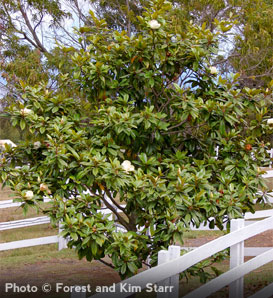
The cluster on the magnolia tree
The bees swarmed today.  Not the hive I had expected to do so- it was the hive I split 3 days ago.  I made the split to prevent swarming, and obviously was ineffectual.  When the swarm started, I told the family (Eric and Lynn and Samuel, Emory and Jessie Ingram) across the street because they had been interested in the bees.  They came over and Maidi, Cathy, the Ingrams and I watched as the cloud slowly moved across the yard and condensed on a low branch of the Magnolia tree.
I let them settle down for a couple of hours and then collected them in my remaining nuc.  The initial plan had been for me to hold up the nuc and for Maidi to shake the bees into the box.  Cathy suggested we'd have more control if we cut the branch, which we did.  I put the branch with cluster into the box and shook them off.  The video (click this link) unfortunately turned off just before the branch was completely cut off and doesn't start again until I'm putting the frames into the nuc.
Nasonov fanning on the nuc
The bees started fanning their Nasonov pheromone at the door to let everyone know where to go.  Over the next 20 minutes they had almost all gone into the nuc.  I will move the nuc onto the bench at the bottom of the yard at dusk.

           
Shortly after closing the nuc


six minutes later


20 minutes after closing the nuc
Now I have two Langstroth hives, one top bar hive and two nucs.  I could re-introduce the queen in nuc #1 into the new hive in a couple of weeks.  That would entail killing the queen that will be there, something I really don't want to do.  Or...to save postage.. I'm going to order a new hive (that will give me 4 hives) and put it to the left of the footbridge. I'll populate it with the nuc I made a few days ago and sell the nuc I collected today and when the other hive swarms, which I expect it to do soon, I'll call some beekeeper and let them collect it.

Saturday, April 20, 2013

Questions partially answered

So, what was going on in the old hive?  Was the new queen doing well?  Was it getting ready to swarm?  Could I prevent a swarm by making a split?  Inquiring minds want to know.  The only way to find out was to go into the hive, so yesterday I did.  My plan was to make a split if I found the queen and capped queen cells.
Overall, there were a lot of bees.  The hive looks strong.  There was a lot of capped brood in the top brood box and larva of various ages.  I didn't see eggs.  A careful frame by frame search did not reveal the queen.  I did find two capped queen cells on the bottom of one frame.  I made a mental note of which frame (second in) and set the top box aside.  I went through each frame of the bottom box.  A lot of capped brood, larvae and one capped queen cell.  The bees were making a new queen.  Either the hive was queenless or they were getting ready to swarm.  I didn't want to scrape the queen cells unless I knew the queen was there and laying.
I put the top brood box on and looked through it again.  And there she was!  The queen...small, dark and with a dab of orange paint on her back- my old queen!  I hadn't seen her on the two previous inspections. (Btw, the paint on her wing was gone.  My attempts at washing it off at the time of marking had been successful.)  I have never seen the queen that came with the nuc.  Had the purchased queen been killed in transport?  Had the two queens fought and the old queen prevailed?  Perhaps the workers from the hive, who outnumbered the workers in the nuc, had seen the new queen as an intruder and done away with her.  This latter possibility seems most likely to me.  But then, what do I know.
In any case, what should I do?  Make a split with the old queen?  Make a split with capped queen cells?  Let it alone?  When in doubt, do nothing.  And that's what I did.  I figure that the hive will swarm within a couple of days taking the old queen away.  I'll try to capture it and put it in my remaining nuc box.  I hope that the new queen is a daughter of the purchased queen.  If she's a daughter of my old queen, that would be all right.  After all, I have little choice.
Maidi and I have been talking about starting another hive with the nuc we already have.  This would be instead of selling it or trying to re-introduce the purchased queen.  (The queen cells in the new hive probably came from the old queen's eggs whom I was trying to replace.)  An elegant solution; but where to place it?   Do any of you want to take up beekeeping?