... o' mice an' men gang aft agley.
I had added a top bar in Olea's and the bees had built comb on it. Last week the comb was covered with bees so I added a ninth bar. Olea's seems to be doing well.
Today, I looked into #3 to see if it might need a new frame. The first thing I noticed was that there were fewer bees than I expected. Then I saw a capped queen cell. This cell is smaller than the usual queen cell. I looked for the queen, but did not see her. I am afraid that the queen died somehow and the bees are making a replacement. Unfortunately, there are no drones at this time of year for her to mate with. I have read that if a queen does not mate within week or so of emerging that she will never mate. I had schemed that this colony would be a strong one come spring and I would only need to make one split from #1. Ah, well...
I looked into #1 and there is still brood in the medium box. I did not look into the deep box.
Monday, January 21, 2019


Thursday, January 3, 2019
#3 is back!
Today I moved the five frames of the nuc into a deep box. I used the recently made divider boards to control the space in the box. There was honey on three of the frames and brood on two. I did not spend time looking for the queen as it as cool. When I was done, the bees were going in and out their new home.
Last night, it came to me that the frames probably were not aligned with the opening of the entrance reducer. I went out in the cold this morning and shifted the frames more to the side and corrected the situation. The devil is in the details.
 |
| Before |
 |
| After |
 |
| Inside the hive after transferring the frames. Note divider boards. |
Wednesday, January 2, 2019
Divider boards for the Langstroth hive.
I was contemplating the details of moving the nuc colony into a full-sized deep box when I came to the realization that I just needed to make the deep box smaller in a way that would also allow for expansion. I gave some thought to how about doing so, then looked on the internet. No need to reinvent the wheel!
I cut a top bar in half length-wise and used the wedge from it to make spacers. Then using some wood I had lying around, I made two divider boards.
Now on the the next warmish day I will transfer the five frames from the nuc into a deep box. If it looks crowded I will also add a frame or two of drawn comb.
The bees in the top bar hive have built a comb on the extra bar I put in some time ago. As of now, it is not covered with bees, but when it is I will add another bar.
I cut a top bar in half length-wise and used the wedge from it to make spacers. Then using some wood I had lying around, I made two divider boards.
 |
| The divider boards showing the two sides |
 |
| How they will go into a deep box. The frames go between, of course. |
The bees in the top bar hive have built a comb on the extra bar I put in some time ago. As of now, it is not covered with bees, but when it is I will add another bar.
Sunday, December 16, 2018
Nuc moved in preparation for Spring

Suited up when it was just getting light, I moved the nuc to spot #3. I covered the door with a piece of wood as I carried the surprisingly heavy box across the yard.
I placed some grass (cut a couple of days ago in preparation) across the entrance to encourage the foragers to reorient.

Later that day, a few foragers had landed on the nuc stand.


Friday, November 9, 2018
Pry-scale revisited, one more time
Last spring I had built a pry-scale with which I could monitor the changing weight of the hives. The scale worked fine but the bottom board could not tolerate the strain. The bottom boards have a small cross piece to support the tray. My bottom box is different than the one pictured below, but you can see a piece of wood below the white tray. This is about 3/4" square and held on with staples.
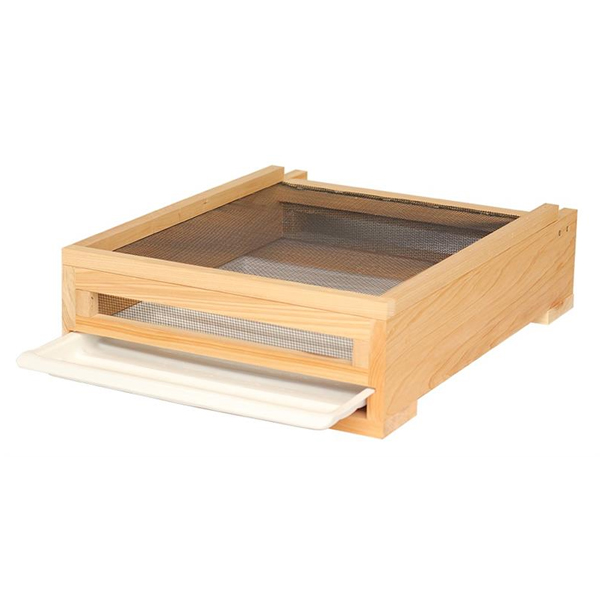 When the hives were heavy, the strip of wood was pried away from the box.
I still wanted to monitor the weight, so I had to figure out a way to re-enforce the bottom. I first used a piece of hard wood flooring. I used a router to make a space for the pry-scale levers, but this weakened the plank allowing it to bend too much. Then I thought of using a metal strap.
I got 3/8" steel straps.
 Using my reciprocating saw, I cut them into 16-1/4" lengths, then drilled holes in the ends. I beveled the holes so the screw head would not protrude.
 The straps were screwed onto the bottom of the boards.
 I tested one placing a cinder block and several heavy stones on it and it worked. Now I will have an extra duty in the apiary next spring.
 This photo has nothing to do with my bees. The mushrooms were alongside the bike path in Ireland.
When the hives were heavy, the strip of wood was pried away from the box.I still wanted to monitor the weight, so I had to figure out a way to re-enforce the bottom. I first used a piece of hard wood flooring. I used a router to make a space for the pry-scale levers, but this weakened the plank allowing it to bend too much. Then I thought of using a metal strap.
I got 3/8" steel straps.


Tuesday, October 30, 2018
Hive #1 reduced
Finally I was able to reduce hive #1 to one deep and a medium.
I went in yesterday. There was still brood and eggs in the medium as well as the queen. She has no black on her abdomen- a golden queen. There was honey and a little brood in the top deep. The bottom deep had empty comb with a very small amount of honey. I took three frames with the youngest wax from the bottom and switched them into the then top deep.
The bottom box was in need of repairs and cleaning. Most of the frames have old, black wax and will be scraped.
I went in yesterday. There was still brood and eggs in the medium as well as the queen. She has no black on her abdomen- a golden queen. There was honey and a little brood in the top deep. The bottom deep had empty comb with a very small amount of honey. I took three frames with the youngest wax from the bottom and switched them into the then top deep.
The bottom box was in need of repairs and cleaning. Most of the frames have old, black wax and will be scraped.
 |
| My helpers cleaning the honey off of the frames |
Friday, October 12, 2018
Fall update
Much has happened since the last posting. I will try to keep it short.
#2 did not make it. The two boxes never combined and the hive was robbed. It has been dismantled and awaits bees next year.
Olea's continues to be strong on its 7 bars. On one inspection, I saw no honey so started feeding with 1:1 syrup. I used the entrance feeder, placing it inside the box. The bees accessed it by going under the following board. I added another bar when I started feeding and saw some new wax today. I also saw more honey stores so I will no longer feed them after the present batch of syrup is gone.
#1 is still doing well. When harvesting honey, there was brood in the bottom-most super so no honey was taken from that box. We did get a fair amount of honey. This is about half.
 After the honey was taken, I put Apivar strips into the hives and the nuc. I took them out today.
On earlier looks, the bottom box of #1 seemed pretty empty. Today I wanted to remove it in order to reduce the hive and do some repairs on the box. However, after taking out 4 frames with empty comb, I saw a large patch of capped brood on the 5th; end of plan. So #1 still is two deeps and one medium. Some of the honey in the medium may have been made when the Apivar was in the hive, so I will not be able to harvest in. I would like to remove the box before the honey flow next spring but I won't do it as long as brood is present.
#2 did not make it. The two boxes never combined and the hive was robbed. It has been dismantled and awaits bees next year.
Olea's continues to be strong on its 7 bars. On one inspection, I saw no honey so started feeding with 1:1 syrup. I used the entrance feeder, placing it inside the box. The bees accessed it by going under the following board. I added another bar when I started feeding and saw some new wax today. I also saw more honey stores so I will no longer feed them after the present batch of syrup is gone.

On earlier looks, the bottom box of #1 seemed pretty empty. Today I wanted to remove it in order to reduce the hive and do some repairs on the box. However, after taking out 4 frames with empty comb, I saw a large patch of capped brood on the 5th; end of plan. So #1 still is two deeps and one medium. Some of the honey in the medium may have been made when the Apivar was in the hive, so I will not be able to harvest in. I would like to remove the box before the honey flow next spring but I won't do it as long as brood is present.
Subscribe to:
Posts (Atom)