I have finished the dismantling and clean-up of the defunct hive #3. With the use of the escape board, I took off box I had combined with #2. I took 4 frames of newish drawn comb from that box and replaced 4 frames with old wax in the top brood box.
I then spent a couple of days of scraping propolis and burr comb from all the frames and scraping the old wax off the foundation. I cleaned and repaired the boxes,
Now my shed is full of deep and medium boxes, plastic garbage bags with drawn comb and lots of empty frames.
I have started building the new hive stands. My drill press is inadequate for making the necessary holes in the pipes, so today I went by the Cabrillo College tool shop. The manager there said he would drill the holes for me next week after finals there are done. Pictures will be forthcoming.
Tuesday, December 6, 2016


Friday, November 18, 2016
What is wrong with this picture?

I last saw brood in #3 in mid-October when giving them pollen patties. One week ago I looked to see if the patties had been eaten and they were gone from Olea's and #2 so I did not bother to check #3. There were brood and larvae in the top box of #2.
A couple of days ago I noticed that there was little activity at the entrance of #3 and when I looked under the lid, there were no bees in the Vivaldi box or visible through the hole of the box. The next day (yesterday) I took a good look. My fears were realized. There were bees on only two or three frames in the top box and even then only covered about 1/4 of each side. No larvae or brood. The bottom box was empty drawn comb with some old bee bread. I wonder what caused the hive to go queenless.
Today I combined the top box of #3 with #2 using the newspaper method. You can see the paper sticking out in the above picture. Three frames of comb will be saved while the rest are old and black and the wax will be processed and the foundation cleaned and reused.
The bees of #3 have always been feisty, so if I have to lose a colony I would have chosen this one.
Now I have to decide what to do with the nuc, assuming in makes it through the winter. Originally I had intended it for a new #1. #2 looks strong so I could make a split in early spring and if that nuc grows strong enough make it into a new #3.
Sunday, October 23, 2016
After Apivar report
Last week I removed the Apivar strips from all the hives. Muffie joined me to look into Olea's.
A few days before, I inspected Cyn's hive with her. She had been given it by Bruce who is moving to North Carolina. What I noticed in her hive is that there was essentially no pollen. Normally there is a band of pollen around the brood and then a band of honey. You can see the pollen by the brood but not much honey in the below picture.
The below picture (also from the internet) shows a nice patch of capped brood with some drone cells in the lower left, nice capped honey but no pollen.

This is what we saw in Cyn's hive. Fortunately Bruce had also given Cyn some substitute pollen patties and we put one in her hive. She gave me some patties as a thank you gift. When I looked into my hives, it looked like there was not much pollen (even though lots of bees were bringing in pollen) so I put a patty into each hive (not the nuc).
Olea's hive had lots of bees and there was a bit more honey than the last time I looked. I saw the queen and brood in the top box of #2; did not look into the bottom box. There was brood in the top box of #3. The bottom box was just empty comb. Back in May I had reversed the boxes of #2 but not #3. Since the bottom box is empty now, I think that in the future I will reverse boxes in the spring if the queen is in the top box.
A few days before, I inspected Cyn's hive with her. She had been given it by Bruce who is moving to North Carolina. What I noticed in her hive is that there was essentially no pollen. Normally there is a band of pollen around the brood and then a band of honey. You can see the pollen by the brood but not much honey in the below picture.
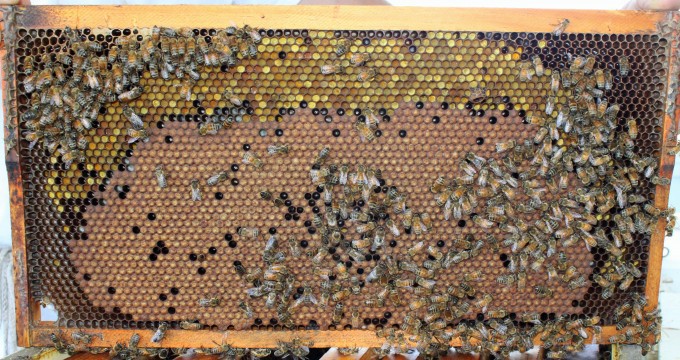 |
| picture from an internet site |
This is what we saw in Cyn's hive. Fortunately Bruce had also given Cyn some substitute pollen patties and we put one in her hive. She gave me some patties as a thank you gift. When I looked into my hives, it looked like there was not much pollen (even though lots of bees were bringing in pollen) so I put a patty into each hive (not the nuc).
Olea's hive had lots of bees and there was a bit more honey than the last time I looked. I saw the queen and brood in the top box of #2; did not look into the bottom box. There was brood in the top box of #3. The bottom box was just empty comb. Back in May I had reversed the boxes of #2 but not #3. Since the bottom box is empty now, I think that in the future I will reverse boxes in the spring if the queen is in the top box.
Wednesday, September 7, 2016
Apivar in
Four days ago I removed the final super and put the Apivar in the hives. I had thought all the brood had hatched but I overlooked one frame.
 Fortunately it is not a large number of bees lost. You can see a few bees emerging. Since I left the super in the garage for a few day, the cold killed all of them.
I had planned to take honey from Olea's hive. I found only a couple of bars with capped honey and on them, only about half the cells were capped. I decided to leave it all for the bees. I did take out three bars that had empty comb on them.
The instructions for Apivar say one strip/frame full of bees. Pretty straightforward. However, I don't know how to convert a top bar comb full of bees to a Langstroth frame FOB. I guess that each top bar is about 1/2 of a Langstroth. I had 10-11 bars FOB, so I put in only one strip. On retrospect I may have underestimated the size of the comb and probably should have put in 2 strips.
Each brood box of hives #2 & 3 got two strips. I put one strip into the nuc. In 6-8 weeks I will remove the strips.
Today I scraped the comb with capped honey off of the two frames from the super and Maidi strained in obtaining 6 cups of honey.
I put the frames outside for the bees to clean up.
 This photo was taken about 3 hours after the bees got to it. The white foundation had been coated with honey. Only a few bees were still on either frame.

I had planned to take honey from Olea's hive. I found only a couple of bars with capped honey and on them, only about half the cells were capped. I decided to leave it all for the bees. I did take out three bars that had empty comb on them.
The instructions for Apivar say one strip/frame full of bees. Pretty straightforward. However, I don't know how to convert a top bar comb full of bees to a Langstroth frame FOB. I guess that each top bar is about 1/2 of a Langstroth. I had 10-11 bars FOB, so I put in only one strip. On retrospect I may have underestimated the size of the comb and probably should have put in 2 strips.
Each brood box of hives #2 & 3 got two strips. I put one strip into the nuc. In 6-8 weeks I will remove the strips.
Today I scraped the comb with capped honey off of the two frames from the super and Maidi strained in obtaining 6 cups of honey.
I put the frames outside for the bees to clean up.

Thursday, August 25, 2016
The queen excluder seems to be working
Just a brief note. I looked into the super of #3. There are still small patches of capped brood but no larvae. The queen is no longer laying up there, either because of the excluder or her own desire. Soon I will remove the super, harvest the small amount of honey and then treat all the hives with apivar.
Tuesday, August 16, 2016
First use of a queen excluder
After extracting the honey ( 3 gallons or so), I put the stickies back onto the hives. The expectation was that the bees would clean them up, then I could remove and store them. After all the supers were off, I would treat with Apivar. In case you did not read through the instructions (on the link), the Apivar strips should be used while there are no honey supers. Like, right after the honey harvest, or now, in my case. I also wanted to treat Olea's hive at the same time, so I need to get the honey from there. I needed to wait a bit for that, too. (see end of blog from 8/9).
In any case, I went today to take off the supers. I had put the escape board in tho make it easier. In the first super, there were three frames of clean, empty comb, but the rest of the comb had nectar in it and the bees were swarming about. Now what? (Remember, I don't know what I'm doing.)
I decided to just take off all the supers and let the bees clean them up away from the hive.
 What you can not appreciate in the above picture is the small cloud of bees around and below the supers and the loud buzzing.
I did remember that there was some brood in the lowest super on #3, so I checked again, and sure enough, there was brood on two frames, even young larvae. I did not want to take this super off, but it looked like the queen was not going to stop laying up there. Now what?
Aha! I will put the queen excluder in! Leaving the hive opened, I went to the shed to get the excluder. Of course it was at the bottom of the rearmost stack of boxes and other hive parts. After I moved everything out of the way and retrieved an excluder I put everything back, a bit more organized than it had been.
Back to the hive where there was near chaos with bees everywhere and a few yellow jackets trying to get in. I guess leaving the hive opened was not the best idea. I put the queen excluder in and then examined each frame in the super 4 times for the queen. I did not see here so I closed up everything.
It takes 21 days for a worker to develop from an egg. In 3 weeks, I will take off the super, harvest any honey left in it, take the honey from Olea's and treat all colonies with Apivar.
In any case, I went today to take off the supers. I had put the escape board in tho make it easier. In the first super, there were three frames of clean, empty comb, but the rest of the comb had nectar in it and the bees were swarming about. Now what? (Remember, I don't know what I'm doing.)
I decided to just take off all the supers and let the bees clean them up away from the hive.

I did remember that there was some brood in the lowest super on #3, so I checked again, and sure enough, there was brood on two frames, even young larvae. I did not want to take this super off, but it looked like the queen was not going to stop laying up there. Now what?
Aha! I will put the queen excluder in! Leaving the hive opened, I went to the shed to get the excluder. Of course it was at the bottom of the rearmost stack of boxes and other hive parts. After I moved everything out of the way and retrieved an excluder I put everything back, a bit more organized than it had been.
Back to the hive where there was near chaos with bees everywhere and a few yellow jackets trying to get in. I guess leaving the hive opened was not the best idea. I put the queen excluder in and then examined each frame in the super 4 times for the queen. I did not see here so I closed up everything.
It takes 21 days for a worker to develop from an egg. In 3 weeks, I will take off the super, harvest any honey left in it, take the honey from Olea's and treat all colonies with Apivar.
Wednesday, August 10, 2016


Subscribe to:
Posts (Atom)