Olea's hive has survived and seems to be doing well. I have seen lots of pollen coming into the hive. Yesterday I took off the entrance reducer and today I inspected to bar #6 (there are currently 17 bars).
The two combs I broke a couple of months age have been rebuilt and there is unripe honey in one.
Bar 11 had some capped drone brood and a few larvae. Honey until bars 7-9 where there was capped brood. The pattern was ok, but a little spotty. I saw no pollen on those bars, but there was a lot on #6. I saw the queen on 8, but did not see here again when reassembling the hive. The hive has not yet started the spring build-up. I saw no drones walking around. About a week ago I saw a drone with deformed wings at the entrance. This is cause for some worry, but, as I mentioned, the hive looks pretty good. Any mites there will get diluted when the build-up starts.
I pick up the new bees April 8 in Orland. Anyone is welcome to come along; there will be speakers and demos.
Because Olea's survived, I would like to continue the line. One way is to make a split with the shook swarm method. The other, and maybe easier, is to wait for them to swarm and then capture the swarm. I will probably do the latter, but I may get ambitious.
Monday, March 13, 2017


Monday, February 13, 2017
It is tme to order packages
There has been a break in the rain and yesterday the sun was out and it was warm enough to go into the hives. I had been nervously awaiting this day, wondering just how the bees were surviving. I was wishing for the best even though I really expected the worst. And my expectations were fulfilled.
I checked the nuc first. There was only a handful of bees left, no brood, no stored food. They did not seem to be taking the syrup and much of the pollen patty was left. I just left the nuc as it was knowing it will be empty of bees in a few weeks. Actually, I was a little surprised that there were still any there.
It was sad to look into #2. Even though there was light activity at the entrance, there was less than a frame of bees in the top box. There was still plenty of capped honey and some bee bread. The bottom box was empty and the comb was moldy. There was some wax moth evidence. There was some dead brood and one pathetically small queen cell. There were no nurse bees on the brood. There was a teaspoon or so of water in the tray below the screen indicating, along with the mold, that there had not been enough bees to properly ventilate the hive.
No. 2 will clearly soon be without any bees. I took some time considering my options and decided to just leave the hive there. I did not see any robbing activity and I did not want to add these bees to Olea's.
Olea's hive looks strong. There is both capped and uncapped honey. I inspected to bar 10 which had pretty healthy looking brood. There was a lot of pollen coming in the entrance. The bad news is that I saw one bee with DWV, but even one bee does not bode well. I am just going to let Olea's alone (i.e., not treat). We can all hope it makes it.
I plan to order three packages with VSH bees.. Harris Bees looks like a good source. However, he has not responded to my several attempts to contact him. I do not know if he is even still in business. I will probably get the bees from Olivarez Bees. They say all their bees are VSH. I will order the packages this week from one or the other. Pick up is in April and it since it is a 4 hour drive, it will most likely involve an overnight stay somewhere.
If Olea's does not survive, I will repopulate it with a split, or if I get lucky, a swarm.
I checked the nuc first. There was only a handful of bees left, no brood, no stored food. They did not seem to be taking the syrup and much of the pollen patty was left. I just left the nuc as it was knowing it will be empty of bees in a few weeks. Actually, I was a little surprised that there were still any there.
It was sad to look into #2. Even though there was light activity at the entrance, there was less than a frame of bees in the top box. There was still plenty of capped honey and some bee bread. The bottom box was empty and the comb was moldy. There was some wax moth evidence. There was some dead brood and one pathetically small queen cell. There were no nurse bees on the brood. There was a teaspoon or so of water in the tray below the screen indicating, along with the mold, that there had not been enough bees to properly ventilate the hive.

 |
| Dead brood without nurse bees |
 |
| Pathetically small queen cell. A futile attempt |
Olea's hive looks strong. There is both capped and uncapped honey. I inspected to bar 10 which had pretty healthy looking brood. There was a lot of pollen coming in the entrance. The bad news is that I saw one bee with DWV, but even one bee does not bode well. I am just going to let Olea's alone (i.e., not treat). We can all hope it makes it.
I plan to order three packages with VSH bees.. Harris Bees looks like a good source. However, he has not responded to my several attempts to contact him. I do not know if he is even still in business. I will probably get the bees from Olivarez Bees. They say all their bees are VSH. I will order the packages this week from one or the other. Pick up is in April and it since it is a 4 hour drive, it will most likely involve an overnight stay somewhere.
If Olea's does not survive, I will repopulate it with a split, or if I get lucky, a swarm.
Wednesday, January 18, 2017
Olea visits her hive, and some bad news for #2

When we looked into Olea's, I inadvertently broke two comes filled with capped and uncapped honey, so we took out the broken pieces for an unexpected honey harvest.
We checked the nuc to see if they were taking their pollen and syrup. There was still plenty of each. I fear that there just are not enough bees in the nuc to survive. I had considered moving a frame or two of bees from #2, but than plan was shot down by what we saw in #2.
There was plenty of honey in the top box of #2, at first encouraging. But then I saw the brood. The pattern was spotty with several uncapped cells with dead pupae. Also, I saw 3 bees with deformed wing virus. This probably is Parasitic mite syndrome, but I have unrealistic hopes that the dead pupae may be from being chilled. I had treated this hive and believed I had the mites under control, so what could have happened? I think I know.
Not far from here is another backyard beekeeper. He had 6-7 hives and believed in no treatment beekeeping. This has become controversial in the beekeeping world with the main objection to it is that when an untreated hive dies, the mites get into (often by robbing) surrounding hives. I noted that my neighbors bee yard is now just stacked boxes, so I assume his hives succumbed. And my otherwise healthy have was overwhelmed by the mites.
In any case, #2 is very sick and I do not expect it to recover. I did treat it with Apiguard and will hope for the best. If Olea's survives, I may try to make splits from it. Otherwise I can either buy new bees, have only one hive or hope to capture a swarm.
Thursday, January 12, 2017
Can this nuc be saved?
Today the rain stopped and it warmed up a bit, so I was able to take a look into the nuc. I made this nuc as a walk away split last July using #2 as a source. The nuc seemed to be thriving and I had intended to use it this spring to replace the lost #1.
However, over the past 1-2 weeks I noticed decreased activity at the entrance and was awaiting an opportune time to inspect. It was not quite 60 degrees this afternoon but I took a look.
There were not a lot of bees, only a hand-sized cluster on 2-3 frames. There was no honey, no pollen and no brood, only empty cells (with a scattering of crystallized honey). I did see the queen, though.
What to do? They obviously needed resources and fortunately I still have some pollen patties. I got one and put it on top of the frames.
Next, carbohydrates. Unfortunately the entrance feeder does not fit in the nuc doorway. Fortunately I have some inside feeders given to me by Bruce. One of them had a cap and ladders and is a double frame size, too big for the nuc. The single frame feeders have no cap. I could use them, but I do not like the idea of some bees drowning. So I did what Eddie would have done- I made it myself.
I took the ladders (plastic mesh tubes) and cut them to be the correct length and then made a "cap" from aluminum foil, using cellophane tape to hold down the edges.
 I filled it with 2:1 sugar syrup and replaced one of the outside frames with it.
Perhaps the nuc will survive. If not, I will be making 2 or 3 splits this spring.
However, over the past 1-2 weeks I noticed decreased activity at the entrance and was awaiting an opportune time to inspect. It was not quite 60 degrees this afternoon but I took a look.
There were not a lot of bees, only a hand-sized cluster on 2-3 frames. There was no honey, no pollen and no brood, only empty cells (with a scattering of crystallized honey). I did see the queen, though.
What to do? They obviously needed resources and fortunately I still have some pollen patties. I got one and put it on top of the frames.
Next, carbohydrates. Unfortunately the entrance feeder does not fit in the nuc doorway. Fortunately I have some inside feeders given to me by Bruce. One of them had a cap and ladders and is a double frame size, too big for the nuc. The single frame feeders have no cap. I could use them, but I do not like the idea of some bees drowning. So I did what Eddie would have done- I made it myself.
I took the ladders (plastic mesh tubes) and cut them to be the correct length and then made a "cap" from aluminum foil, using cellophane tape to hold down the edges.

Perhaps the nuc will survive. If not, I will be making 2 or 3 splits this spring.
Sunday, December 25, 2016
New hive stands
I was not satisfied with my old hive stands for two reasons. Firstly, I was uncertain about their weight bearing capacity. Secondly, in order to keep the ants out, the legs were in cans holding motor oil. Bees would get into the oil, when it rained the water/oil mix was disgusting, oil would leak or spill into the soil and also soak into and up the hive stand legs.
At the UC Davis apiary, the hive stand legs were metal pipes and they kept the ants out with Tanglefoot protected from dust and bees by upside down cans. I decided to replace my old stands with ones similar to those at Davis.
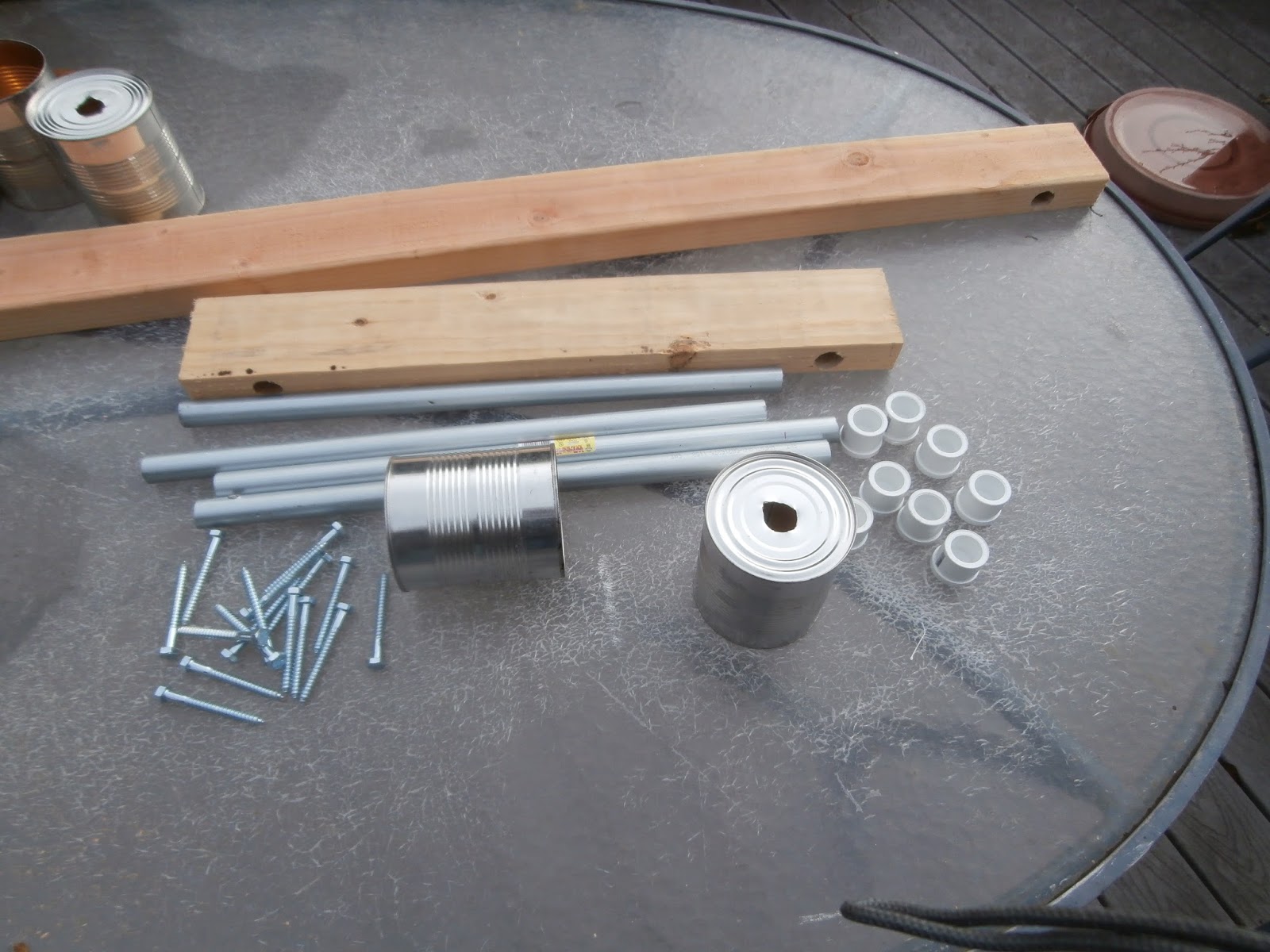
I decided to use 2x4's and some sort of pipe for legs. Initially I planned on bolting the legs to the wood, but then realized it would be better and more aesthetic to bore holes in the frame for the legs.
I found some inexpensive electrical conduit pipe at Home Depot.
I found pvc end caps for the ends of the pipe, lag screws to hold the wood together and old tomato cans to protect the tangle foot.
I had to be careful to line up the pilot holes for the lag screws and had only one small error.
I put the cans onto the legs using duct tape to hold the loose ones in place. Then I painted them with spray on enamel.
Today, with the good help of Mihir, after putting Tanglefoot onto the pipe, the old double hive stand was replaced.

At the UC Davis apiary, the hive stand legs were metal pipes and they kept the ants out with Tanglefoot protected from dust and bees by upside down cans. I decided to replace my old stands with ones similar to those at Davis.
I decided to use 2x4's and some sort of pipe for legs. Initially I planned on bolting the legs to the wood, but then realized it would be better and more aesthetic to bore holes in the frame for the legs.
I found some inexpensive electrical conduit pipe at Home Depot.
 | ||||
| Pipes and wood before cutting |
 | |
| Parts ready for assembly (not all wood or cans shown) |
 |
| An assembled stand, sans cans |
 |
| A finished hive stand |

Tuesday, December 6, 2016
Clean up the old hive
I have finished the dismantling and clean-up of the defunct hive #3. With the use of the escape board, I took off box I had combined with #2. I took 4 frames of newish drawn comb from that box and replaced 4 frames with old wax in the top brood box.
I then spent a couple of days of scraping propolis and burr comb from all the frames and scraping the old wax off the foundation. I cleaned and repaired the boxes,
Now my shed is full of deep and medium boxes, plastic garbage bags with drawn comb and lots of empty frames.
I have started building the new hive stands. My drill press is inadequate for making the necessary holes in the pipes, so today I went by the Cabrillo College tool shop. The manager there said he would drill the holes for me next week after finals there are done. Pictures will be forthcoming.
I then spent a couple of days of scraping propolis and burr comb from all the frames and scraping the old wax off the foundation. I cleaned and repaired the boxes,
Now my shed is full of deep and medium boxes, plastic garbage bags with drawn comb and lots of empty frames.
I have started building the new hive stands. My drill press is inadequate for making the necessary holes in the pipes, so today I went by the Cabrillo College tool shop. The manager there said he would drill the holes for me next week after finals there are done. Pictures will be forthcoming.
Friday, November 18, 2016
What is wrong with this picture?

I last saw brood in #3 in mid-October when giving them pollen patties. One week ago I looked to see if the patties had been eaten and they were gone from Olea's and #2 so I did not bother to check #3. There were brood and larvae in the top box of #2.
A couple of days ago I noticed that there was little activity at the entrance of #3 and when I looked under the lid, there were no bees in the Vivaldi box or visible through the hole of the box. The next day (yesterday) I took a good look. My fears were realized. There were bees on only two or three frames in the top box and even then only covered about 1/4 of each side. No larvae or brood. The bottom box was empty drawn comb with some old bee bread. I wonder what caused the hive to go queenless.
Today I combined the top box of #3 with #2 using the newspaper method. You can see the paper sticking out in the above picture. Three frames of comb will be saved while the rest are old and black and the wax will be processed and the foundation cleaned and reused.
The bees of #3 have always been feisty, so if I have to lose a colony I would have chosen this one.
Now I have to decide what to do with the nuc, assuming in makes it through the winter. Originally I had intended it for a new #1. #2 looks strong so I could make a split in early spring and if that nuc grows strong enough make it into a new #3.
Subscribe to:
Posts (Atom)