Wednesday, March 13, 2019

It looks like spring has sprung, and, getting ready to split Olea's

 It looks like spring in the apiary.  Plants are beginning to leaf, the roses are putting out shoots, the bees are visiting the birdbath in numbers
and there is bee poop on the cars.
Olea's hive has survived with minimal treatment  soI have been wanting to split it.  The problem is that I want to put the split in a Langstroth hive; the bars and frames are not interchangeable.  There seem to be different ways to accomplish such a split.  Some of these seen quite elegant if not a bit too hard.  This one is done when a hive is about ready to swarm.  I thought of making a shook swarm.  This involves finding the queen and shaking her and a bunch of other bees into the split and leaving eggs in the top bar where the bees will make a  new queen.  I thought the easiest way would be to use the same method I have always done, i.e., move a couple of  combs with eggs and a couple of combs with honey and pollen into a box with a fifth frame of drawn comb.
I thought I would cut the selected combs off a top bar and hold them in a frame with rubber bands, as one does it collecting a cut out. 
IMG_9254mod
Picture taken from another site
I posted a query on a beekeeping forum asking for advice from others who have done this.  One beek suggested just tying the entire top bar to a top of a Langstroth frame.  This seemed to be the easiest way, so today I did a trial.
Old top bar and a Langstroth top bar

Held together with rubber bands
 I had to see if it would fit as the top bars from Olea's are wider than the langs.
They all fit
 I had to figure how to space all the bars.  I put side bars on the langs and off-set the top bar bars so that they met each other and were flush with the langs on the outside edge.
The light wood are the langstroth tops and the dark wood between are the top bar bars
 I plan to make the split tomorrow when it is warm.
There were ants in #1!  The tanglefoot had lost its tangle.  I reapplied it the best I could (those dang cans make it difficult) to all the legs in the apiary, then spent some time killing ants that were crawling over the boxes.
I saw a couple of bees (at least two) looking at and in the bait box.  I do not know if they are scouts from a swarm (I hope) or just curious foragers.  I will find out in a couple of days.

Sunday, February 10, 2019

Fun (?) with Number One

A few days ago there was a break in the rain and it was warm enough to go into the hive.  There were a number of things I needed to do.
1.  See if the combining with the survivors of #3 had been successful.
2.  If there was no brood in the medium box, place a queen excluder between the bottom deep box and the medium.
3.  If brood is present in the medium box, find the queen in the bottom box and place the excluder as above.  Then when all the brood in the medium has emerged I will be able to move the box as I wish.
4.  Take frames with honey and pollen from the top deep box and place them into the bottom deep box.  Remember, the top deep has only 5 frames; it was hive #3.
My goal is to get #1 back to 3its previous formation of two deeps for brood and mediums for me to harvest.  I also plan to use queen excluders on one or two hives this year to see how they do.  There is quite a bit of controversy.
Here is what I saw.
1.  The combine had been successful with almost all the newspaper chewed away.
2.  There was still brood in the medium box.
3.  There was a lot of brood including drone cells in the deep box.  I could not find the queen.  I did not spot the queen in the medium box, either.
I took three frames with resources from the erstwhile #3 box and switched them into the bottom box.  I put the queen excluder between the medium and top box,
I hope the queen will eventually move into the bottom box and I will be able to restructure the hive.  If not, so be it.

Monday, January 21, 2019

The best laid schemes....

... o' mice an' men gang aft agley.
I had added a top bar in Olea's and the bees had built comb on it.  Last week the comb was covered with bees so I added a ninth bar.  Olea's seems to be doing well.
Today, I looked into #3 to see if it might need a new frame.  The first thing I noticed was that there were fewer bees than I expected.  Then I saw a capped queen cell.  This cell is smaller than the usual queen cell.  I looked for the queen, but did not see her.  I am afraid that the queen died somehow and the bees are making a replacement.  Unfortunately, there are no drones at this time of year for her to mate with.  I have read that if a queen does not mate within week or so of emerging that she will never mate.  I had schemed that this colony would be a strong one come spring and I would only need to make one split from #1.  Ah, well...
I looked into #1 and there is still brood in the medium box.  I did not look into the deep box.

Thursday, January 3, 2019

#3 is back!

Today I moved the five frames of the nuc into a deep box.  I used the recently made divider boards to control the space in the box.  There was honey on three of the frames and brood on two.  I did not spend time looking for the queen as it as cool.  When I was done, the bees were going in and out their new home.
Before

After
Inside the hive after transferring the frames.  Note divider boards.
Last night, it came to me that the frames probably were not aligned with the opening of the entrance reducer.  I went out in the cold this morning and shifted the frames more to the side and corrected the situation.  The devil is in the details.

Wednesday, January 2, 2019

Divider boards for the Langstroth hive.

I was contemplating the details of moving the nuc colony into a full-sized deep box when I came to the realization that I just needed to make the deep box smaller in a way that would also allow for expansion.  I gave some thought to how about doing so, then looked on the internet.  No need to reinvent the wheel!
I cut a top bar in half length-wise and used the wedge from it to make spacers.  Then using some wood I had lying around, I made two divider boards.
The divider boards showing the two sides

How they will go into a deep box.  The frames go between, of course.
Now on the the next warmish day I will transfer the five frames from the nuc into a deep box.  If it looks crowded I will also add a frame or two of drawn comb.
The bees in the top bar hive have built a comb on the extra bar I put in some time ago.  As of now, it is not covered with bees, but when it is I will add another bar.

Sunday, December 16, 2018

Nuc moved in preparation for Spring

As I was thinking ahead to spring, I thought it would be good to move the nuc to the position the colony would eventually occupy.  I thought it would be too disruptive if they were moved and put into a deep box at one time.  I had been planning to to this for some time, but I wanted to do it early in the morning before the foragers were out.  I frequently awaken early enough but do not remember to do it.  Yesterday I wrote myself a reminder, and this morning, awake and up at 5 AM, I saw the note.
Suited up when it was just getting light, I moved the nuc to spot #3.  I covered the door with a piece of wood as I carried the surprisingly heavy box across the yard.
I placed some grass (cut a couple of days ago in preparation) across the entrance to encourage the foragers to reorient.
Also, rain is expected today and this will help keep them in the hive.  See section 3 of this link.  I will be checking around the old nuc site to see if a lot of foragers go there.
Later that day, a few foragers had landed on the nuc stand. 

I saw a bee fanning with its Nasonov gland at the nuc's entryway, so I moved the stand and bees near the box.

Friday, November 9, 2018

Pry-scale revisited, one more time

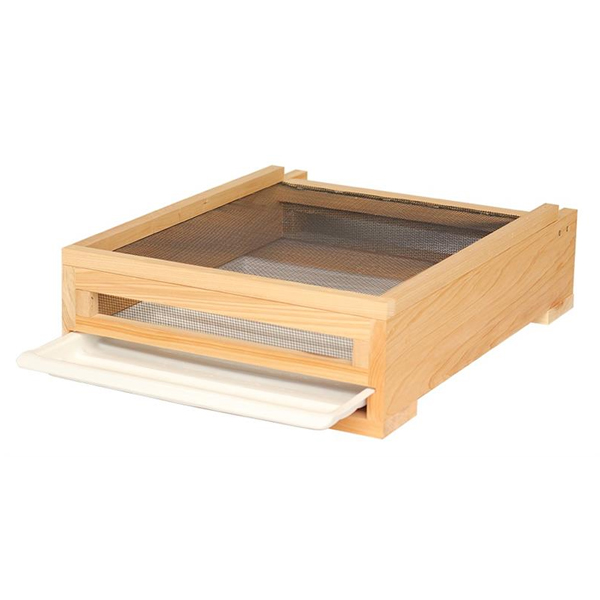
Last spring I had built a pry-scale with which I could monitor the changing weight of the hives.  The scale worked fine but the bottom board could not tolerate the strain.  The bottom boards have a small cross piece to support the tray.  My bottom box is different than the one pictured below, but you can see a piece of wood below the white tray.  This is about 3/4" square and held on with staples.


When the hives were heavy, the strip of wood was pried away from the box.
I still wanted to monitor the weight, so I had to figure out a way to re-enforce the bottom.  I first used a piece of hard wood flooring. I used a router to make a space for the pry-scale levers, but this weakened the plank allowing it to bend too much.  Then I thought of using a metal strap.
I got 3/8" steel straps.
Using my reciprocating saw, I cut them into 16-1/4" lengths, then drilled holes in the ends.  I beveled the holes so the screw head would not protrude.
 The straps were screwed onto the bottom of the boards.
I tested one placing a cinder block and several heavy stones on it and it worked.  Now I will have an extra duty in the apiary next spring.
This photo has nothing to do with my bees.  The mushrooms were alongside the bike path in Ireland.