I went into the hive a couple of days ago.
#3- bees still on only 4 frames, but two frames had an excellent brood pattern. The bees have not drawn new come but have cleaned the old comb. I did see (and removed) a wax moth cocoon. Even though the colony has not grown in the past 2 weeks, I am optimistic that it will grow and survive.
#1- I only checked the top super. The bees had not drawn any new comb nor deposited any nectar. I hefted the bottom super and it felt heavy. I conclude that #1 is storing honey and will continue to do so. I will need to inspect the bottom boxes.
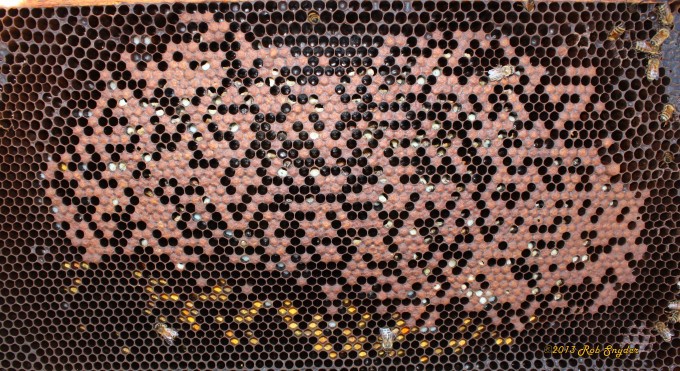
Olea's- a month and and 1/2 ago, Olea's had 22 bars with bees on all of them. Since then, the population had gradually decreased. I thought (and still do) that it swarmed when we were away for Passover. But it continued to see more bare comb through the window. I hadn't planned to inspect it, but I was not tired, so I did. I started at bar 11 and looked to bar 4. There was not much honey and the brood pattern was spotty (picture from web). I did not see any evidence of DWV. I did see guanine crystals (more pictures from the web) in some cells, a sure sign that the colony was overwhelmed by mites, leading of parasitic mite syndrome. I had not done a mite count on Olea's and treating a top bar hive for mites is problematic. So, Olea's is dying and I do not want it to be a mite bomb. I put an Apiguard tray in the hive in hopes that it would markedly diminish the numbers of mites before the colony completely dies.
I do not intend to recolonize Olea's. I find the top bar too hard to work and there is no good way to treat it for mites. I plan on replacing it with a long Lang.
Friday, May 24, 2019



Wednesday, May 8, 2019
Swarm trapped and ensconced

That afternoon, I prepared the swarms new home. One deep box with 10 frames of drawn comb in #3 position. I placed Ant Moats under the legs of the stand. (I saw these a few weeks ago when I helped Dinah with her bees. They are neat and effective. I bought enough for all my hives.)
So... I wanted to transfer all the bees, so it had to be done before the foragers started their jobs. I went out when it was dark and plugged the entrance hole. While on the ladder, I tapped the trap and was satisfied to hear an answering hum.
I still intended to transfer them before their work-day began, so-

 |
| Trap in a box near the hive |
Placing the pot into the hive, I have it a sharp shake. The bees tumbled into the hive and started to climb up the side frames.
 |
| The small swarm in their new home |

Whenever I had captured a swarm, I noted that 100-200 bees would return to the cluster spot. This occurred here as well, even though I had placed grass across the entrance. I had read that when moving a hive, placing grass across the entrance encourages the bees to re-orient.

It had only been 5 days since the transfer, but my curiosity overcame by caution. I went in. The bees only covered 4 frames. There was some nectar. And I saw the queen! She is large and moderately dark. I watched as she laid and egg and saw some other eggs, no larvae.
I looked into #1 also. There is brood in all 3 boxes. The 2 mediums have worker brood and it looks like it might be spotty. I will need to do a mite count after we return from our upcoming trip. The bottom box had some drone brood. There was some honey being made in all three boxes. I added a super with foundation only frames.
Wednesday, April 10, 2019
Reconfiguration successful!

I brought over an empty box to hold the frames as I worked through them and put it on a work table.
The first few frames were either empty comb or a bit of honey. Then there was some brood, honey and pollen and then, much to my surprise, I saw the queen, fat and golden. I had been moving the frames into the empty box, but there was nothing under it. I went back to the shed, dug around and retrieved a telescoping top that inverted and placed the empty box on. Then I carefully moved the frame with the queen into the box, keeping my eye on her. I selected four frames with brood, some resources and the queen to move into the bottom deep.
After lifting off the medium, I went through the deep to find four frames to remove. Two were easy to select- black comb, no honey or pollen. For the other two, I found frames that were drone brood and larvae (I could tell by the size of the cells) and some nectar and pollen. These would be sacrificed.

I got the four frames into the bottom box, once again being very careful with the queen. Voila! A normal looking hive.
I scraped the old comb and sprayed B.T. onto the six I will keep and use again. I looked at some of the capped drones and saw no mites. Good news, but taken with a grain of salt as none of them were at the purple-eyed stage. This is when one usually finds the mites.
Split not made, swarm not trapped
A week ago I went to make a split from Olea's. The plan was to get two frames with pollen and honey from #1 and get a frame with eggs and two with capped brood from Olea's. These five frames would go into a nuc. There the bees would raise a new queen from the eggs.
I collected everything I needed including wires with which to hold the top bar combs to the Langstroth holders and a work table to hold the nuc. Smoked #1 and went in. Alas...
There was very little brood in the top box and only one frame with nectar and pollen. I put this frame into the nuc. Then I looked into the bottom box (did not check the medium box). There were no frames with food to take but there was some brood. It looks likeh the queen has moved downwards. I briefly considered removing the top deep box, move the frames with brood into the bottom box and have a hive with a single deep brood with mediums for the rest. However, it would have been too much to do and not in today's plan. (Avoid impulse beekeeping!) I figured I would do that another day- probably today. So-
I would have to get resources from Olea's as well as eggs and brood to make a total of five frames for the split.Going through all the bars of a top bar is a lot of work as each comb needs to be cut away from the box. There was brood in the the second bar, all drone. The queen was on one of the first bars. She is quite dark. There were no eggs and no resources, bar after bar. Finally, in mid-box, a frame with eggs and larvae. But these were drone-sized cells and some capped drone brood. These eggs would not a queen make. I did not find worker brood until 4 bars from the end. No eggs. I gave up trying to make a split and closed up. I did find the brood area odd; drone at one end of the box and worker at the other end. I wonder if there might be two queen in the hive.
Olea's hive is filling up with bees and I keep adding new bars. Today I but all 22 bars into Olea's. Twice, once a few weeks ago and again today, the bees had built comb on the follower board.
There has been on and off activity around the swarm traps, but nobody has moved in yet.
I collected everything I needed including wires with which to hold the top bar combs to the Langstroth holders and a work table to hold the nuc. Smoked #1 and went in. Alas...
There was very little brood in the top box and only one frame with nectar and pollen. I put this frame into the nuc. Then I looked into the bottom box (did not check the medium box). There were no frames with food to take but there was some brood. It looks likeh the queen has moved downwards. I briefly considered removing the top deep box, move the frames with brood into the bottom box and have a hive with a single deep brood with mediums for the rest. However, it would have been too much to do and not in today's plan. (Avoid impulse beekeeping!) I figured I would do that another day- probably today. So-
I would have to get resources from Olea's as well as eggs and brood to make a total of five frames for the split.Going through all the bars of a top bar is a lot of work as each comb needs to be cut away from the box. There was brood in the the second bar, all drone. The queen was on one of the first bars. She is quite dark. There were no eggs and no resources, bar after bar. Finally, in mid-box, a frame with eggs and larvae. But these were drone-sized cells and some capped drone brood. These eggs would not a queen make. I did not find worker brood until 4 bars from the end. No eggs. I gave up trying to make a split and closed up. I did find the brood area odd; drone at one end of the box and worker at the other end. I wonder if there might be two queen in the hive.
Olea's hive is filling up with bees and I keep adding new bars. Today I but all 22 bars into Olea's. Twice, once a few weeks ago and again today, the bees had built comb on the follower board.
 |
| Comb cut off follower three weeks ago |
 |
| Comb on follower today |
 |
| Comb on follower today |
Tuesday, March 26, 2019
Unusual configuration

This is the current configuration of #1. This link discusses the common variations. However, nowhere have I seen this set-up. It did not come about by choice. When I harvested the honey last fall there was still brood in the medium box so I left it. I have checked many times and there has persistently been brood in the medium. I left the bottom deep box in hopes that the queen and court would move into it.
Then I had my nuc. I put the five frames into a deep box with follower boards to limit the space and put it in place of #3. Well, as you faithful readers know, the colony lost its queen, so I used a newspaper combination in order to save the remaining bees. I expected them to all move into the lower boxes and then I would take off the deep and have a single deep brood box.
So...
Yesterday I took a look into #1. On previous inspections the bottom deep had only drawn comb and some honey and pollen. If that had still been the case, I planned to do a lot of manipulation to get one deep brood box. If the brood was gone from the medium, then I would rearrange to two deeps.
But the bees were not privy to my intentions. There was brood in all three boxes! I saw my (lovely) queen in the top deep box. There was a fair amount of drone brood as well as worker in the bottom box. What to do? I added enough frames to make 10 in the top deep and left it as it was.
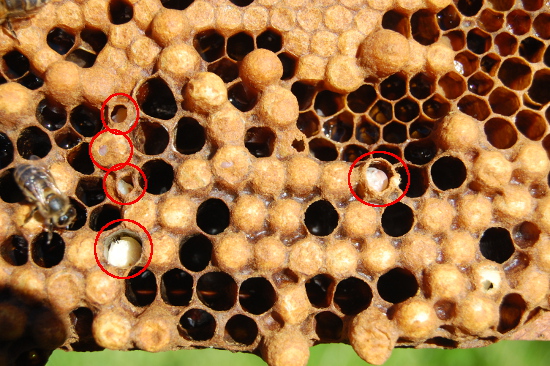
I did see a lot of uncapped drone brood and many with holes in the cap.
This picture is from another website and shows both uncapped larvae and caps with holes.
I figured there must be a moderately high mite count. Since I had intended to do a spring mite treatment anyway, I did not do a count but just put in Mite-away Quick strips. I had to do some thinking about where to place them since the instructions say to place them between the two brood boxes; no suggestions for three boxes. I did a bit of chemistry research and learned that formic acid fumes are heavier than air. I put the strips between the medium and top super. I also took out the entrance reducer to provide proper ventilation.
Olea's continues to go like gangbusters. There were a total of 15 bars. I saw brood on bar 14. I added two more bars; 17 total now.
There continues to be sporadic activity around the swarm traps.
Tuesday, March 19, 2019
bees scouting the bait box

I attended a Bee Cafe meeting with Laura, a beekeeper to be. The Sonoma County Beekeepers Association apparently has clusters and the meet at various homes. The people were lovely and the food was delicious. I learned about a swarm trap made from pulp pots and made one as soon as I could on returning home.
 |
I hung it in a tree in front.


One needs to check this trap daily. When a swarm moves into a new hive, it begins building comb right away. Moving them would be difficult once there is comb.
Wednesday, March 13, 2019
It looks like spring has sprung, and, getting ready to split Olea's


Olea's hive has survived with minimal treatment soI have been wanting to split it. The problem is that I want to put the split in a Langstroth hive; the bars and frames are not interchangeable. There seem to be different ways to accomplish such a split. Some of these seen quite elegant if not a bit too hard. This one is done when a hive is about ready to swarm. I thought of making a shook swarm. This involves finding the queen and shaking her and a bunch of other bees into the split and leaving eggs in the top bar where the bees will make a new queen. I thought the easiest way would be to use the same method I have always done, i.e., move a couple of combs with eggs and a couple of combs with honey and pollen into a box with a fifth frame of drawn comb.
I thought I would cut the selected combs off a top bar and hold them in a frame with rubber bands, as one does it collecting a cut out.
 |
| Picture taken from another site |
 |
| Old top bar and a Langstroth top bar |
 |
| Held together with rubber bands |
 |
| They all fit |
 | |
| The light wood are the langstroth tops and the dark wood between are the top bar bars |
There were ants in #1! The tanglefoot had lost its tangle. I reapplied it the best I could (those dang cans make it difficult) to all the legs in the apiary, then spent some time killing ants that were crawling over the boxes.
I saw a couple of bees (at least two) looking at and in the bait box. I do not know if they are scouts from a swarm (I hope) or just curious foragers. I will find out in a couple of days.
Subscribe to:
Posts (Atom)