Wednesday, July 10, 2019

First extended oxalic acid follow-up

I wanted to see how much of the shop towel the bees had removed, so I took a look into the hives a couple of days ago.
The bees had chewed nearly none of the towel in #2 & 3.
Hive #3
Hive #2
These hives had only a deep box so I do not think the bees had much of an incentive to get the towels out of there way.
However, the towel in #1, which has supers above the towel, was nearly half gone.
Hive #1
The frames in both 2 and 3 were full of bees,as you can see in the pictures.  I put a super on each.  Now it seems that my new configuration will be one deep and one medium for brood.  Of course, this may change back to two deeps.
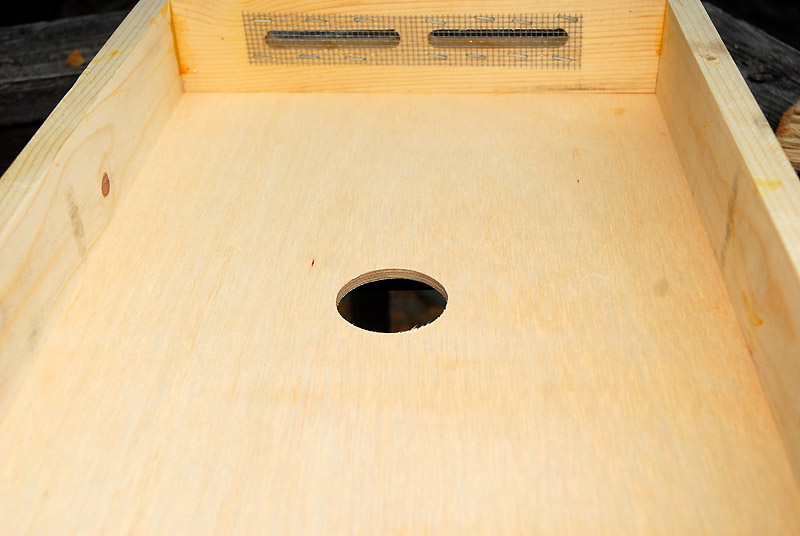
As previously mentioned, I want to build a long lang.  It dawned on me that I could probably use the board from my extra deeps.  This would obviate the need to cut rabbets
On another note, I am committed to reaping some grapes this year.  Just see the birds get them now!

The are over 60 bags each around a grape cluster.

Wednesday, July 3, 2019

Extended-realease oxalic acid

For some time, oxalic acid has been used to control mites.  It is effective, safe and does not affect the honey and does not seem to hurt the bees.  It is very effective at killing phoretic mites.  It is usually applied by a dribble or vaporization.  One drawback is that it does not penetrate into the capped brood where the mites are developing.  Randy Oliver, whom I have mentioned in many blogs, has been working on a way to deliver oxalic acid over an extended period of time.  This link will take you to his progress report. 
I did a second alcohol wash mite count on  #1 4 days ago- 15 mites, or 5%.  This is definitely above my treatment threshold.  The next day I prepared and applied oxalic acid impregnated shop towels as per Randy Oliver.  The following morning I saw evidence that the bees were chewing up the towel on the tray below the screen bottom.

Tuesday, June 25, 2019

A new Beek

On his way to the hive.  All Eshel photos by Olea
Last week while visiting from Seattle, Eshel went into the hives for his first time.  We went into #3 and #2 on separate days.

Eshel sees the queen
He was very interested and would peer into the hive, often blocking my view.  We saw the queen in each hive, an uncapped queen cell in #3 and lots of brood.  #3 has expanded to 7 frames and is drawing comb on #8.  #2 has 4 frames of bee with brood on 3 of them.
Yes, Olea's hive is gone and will be put into storage until it moves to Seattle.  I noted a lot of debris and some dead bees on the porch, a sign that the hive had been robbed.  I had been expecting that. 
Capping debris and dead bees on porch
Inside the box after some frames have been removed      

Thursday, June 13, 2019

Swarm report and mite count

I went into the 3 hives today.
#1- There is some nectar in the top super and still a few empty frames.  The second super is heavy with honey.  The bottom super is heavy and may have some brood in it still; I did not inspect it.  I saw the golden queen in the bottom box.  She was on a comb with drone brood and drone-sized cells.  An alcohol mite count showed a 1.6% infestation, below the 2.0% threshold.  I will repeat the count in 2-3 weeks.  If high, I will treat with the shop towel/oxalic acid as per Randy Oliver.
#2- This is the most recent swarm, hived 10 days ago.  The bees are on 4 frames with brood and larvae.  They have done a good job on cleaning all the comb.  There I spotted the queen.  I can tell by her coloration that she has some carniolan in her.  A significant number of the workers are also dark.
#3- The bees now cover 6 frames and I saw an excellent brood pattern on at least two frames (I did not inspect the final frame).
So all three seem to be doing well.  We should get some honey from #1, but I don't expect any from #2 or 3.  Olea's continues to diminish.  There are still some bees visible through the window, but very little action at the entrance.  The swarm trap is back up in the front, but not much happening there.

Monday, June 3, 2019

A swarm in June...


A swarm in May... but this is June and one can not always get what one wants
Over the past couple of days I have noticed increasing interest in the pulp pot swarm trap.  This afternoon while I was changing out of my pickleball clothes, I heard a loud buzzing coming from the front.  I ran out in my stocking feet and saw what I expected- a swarm moving into the trap.
The first part of the video shows the cloud of bees, then a close-up of the entrance.  The next two segments show the bees forming a beard on the trap as they land and start moving inside.  The whole process took 10-15 minutes.  Some still photos of the process
The swarm approaches the trap

They begin to land and enter the trap

Traffic jam.  The bees are landing faster than they can go inside

Just about all the bees have landed
As I waited for them to all get inside, I went out back to prepare their new home.  I collected a screen bottom, one deep box with 10 frames, some with comb, a Vivaldi board and a telescoping lid.
Then, I made my big mistake.
I had been wanting to place ant moats under all the hive stands, and I thought it would be easier to place them now before adding another hive.  What I misjudged was just how heavy #1 was.
The whole thing was a bit tilted after I was able to lift the stand and place the moats under three of the legs.  The last leg was in the front below the hive.  As I tried to lift it, the inevitable happened-
the stand and entire hive fell over backwards!
I quick like a bunny ran to the shed, donned my bee suit, tried fruitlessly to get the smoker going, and ran back to the apiary.  There I righted the stand, easily placing the moats under the legs.  I re-assembled the hive from the bottom up.  Inspected the ground to see if the queen was there (I did not see her) and then went back to the intended job.
I placed the new hive in #2 position and removed all but the two outermost frames and put grass across the entrance.  I then went to the front, plugged the entrance to the swarm trap, unhooked it and carried it into the back.  I decided to keep the bee suit on since I did not know how mad the bees from #1 would be after their big disturbance.
Proud papa
After placing the trap in the deep box, I unscrewed the two halves.  There were still a lot of bees in the bottom half, so after removing the slum gum and piece of comb, I dumped them into the hive.  I then dumped in all the majority of the swarm that had gathered in the top half.  I then filled the moats with mineral oil and, voila!  three hives in the apiary. 

In a few days when all the stragglers from the swarm are gone, I will re-hang the swarm trap.

Saturday, June 1, 2019

Olea's is definitely on the way out

This is what I removed today from Olea's hive.
Over the past weeks, I have seen Olea's population gradually decrease.  After putting in the Apiguard 10 days ago, the bees moved further back onto more central combs, away from the thymol.  They were on only 2-3 combs.  I went in today to start removing bars.
I also wanted to look for the queen.  If she were still there and I found her, I intended to move her into a nuc and add some frames with honey and pollen from #1 as well as many nurse bees and maybe a frame with brood.  However, the plans were moot as I did not spot the queen.
The two back most bars had no comb.  The next 4 had honey and were cross-combed.  I removed them en bloc.  The following bars had spotty brood, dead pupae, dead emerging workers and some apparently living larvae.  As I mentioned, the queen was nowhere to be seen.  There was a small number of drones.  I thought I saw one bee with K-wing.  However, this is due to tracheal mites, not varroa.
Image result for k-wing in bees
I closed up the hive decreasing the space with a follower board.
I broke the comb with honey off the bars into a large bowl.  After Maidi sees it, we'll mash it up and strain the honey.
Meanwhile, I expect Olea's will be without bees in a couple of weeks.

Friday, May 24, 2019

It looks like Olea's is on the way out

I went into the hive a couple of days ago.
#3- bees still on only 4 frames, but two frames had an excellent brood pattern.  The bees have not drawn new come but have cleaned the old comb.  I did see (and removed) a wax moth cocoon.  Even though the colony has not grown in the past 2 weeks, I am optimistic that it will grow and survive.
#1- I only checked the top super.  The bees had not drawn any new comb nor deposited any nectar.  I hefted the bottom super and it felt heavy.  I conclude that #1 is storing honey and will continue to do so.  I will need to inspect the bottom boxes.
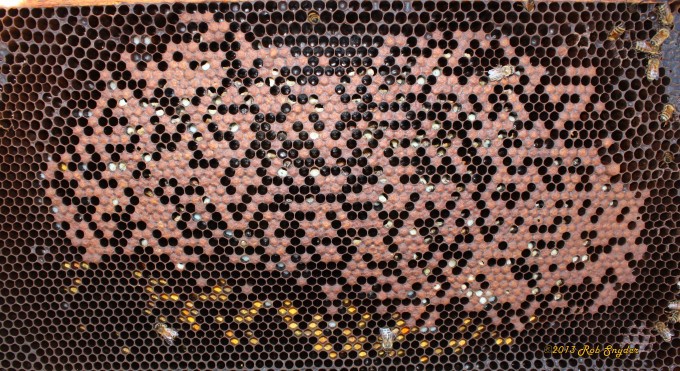
Olea's- a month and and 1/2 ago, Olea's had 22 bars with bees on all of them.  Since then, the population had gradually decreased.  I thought (and still do) that it swarmed when we were away for Passover.  But it continued to see more bare comb through the window.  I hadn't planned to inspect it, but I was not tired, so I did.  I started at bar 11 and looked to bar 4.  There was not much honey and the brood pattern was spotty (picture from web).  I did not see any evidence of DWV.  I did see guanine crystals (more pictures from the web)  in some cells, a sure sign that the colony was overwhelmed by mites, leading of parasitic mite syndrome.  I had not done a mite count on Olea's and treating a top bar hive for mites is problematic.  So, Olea's is dying and I do not want it to be a mite bomb.  I put an Apiguard tray in the hive in hopes that it would markedly diminish the numbers  of mites before the colony completely dies. 
I do not intend to recolonize Olea's.  I find the top bar too hard to work and there is no good way to treat it for mites.  I plan on replacing it with a long Lang.