Saturday, August 4, 2012

Olea's hive swarms! Apiary expands!

Admiring the swarm and the roses
Yesterday, while I was in the yard getting ready to feed the roses, Olea's hive swarmed.  The bees came flying out making a buzzing cloud in the yard.  As before, we watched to see where they would settle.  As I stood in the cloud, bees would land all over me.  This time, they flew into Paul's yard, and I went over there where I watched them buzz around.  They landed on all the bushes, finally clustering on an iron fairy decoration.  Note the clump on the ground.  I used the bee brush and a dust pan to get them into the box.
The cluster on the fairy


The fairy without her bees
Some had become caught in a spider web in our yard, but don't fret, Maidi saved them.

I called a couple of beekeepers to see if they wanted to capture the swarm, leaving a message with the first and speaking with the second, James.  (The same James who got the last swarm.)  He suggested I keep it myself since he hates to give away his bees, the more the better, etc.  When I told him I had nowhere to put them, he proposed putting them in the top bar hive.  I could divide the box in half with the back board and drill a door into what is now the back.  As I was hesitant to do that, he next offered me a 5-frame medium nuc.  He lives on the west side of Santa Cruz and getting there then would be impossible with the traffic.  He told me he would leave it on his front porch and I could pick it up last night or this morning.

I went into Paul's yard with a box that had once contained Bump wine.  I had punched many holes in it.  I shook the bees into the box and after they had settled down a bit, taped the box shut and brought it into our yard.  Laura and I weighed it on the kitchen scale- about 4 pounds!  Now I had a box of bees.

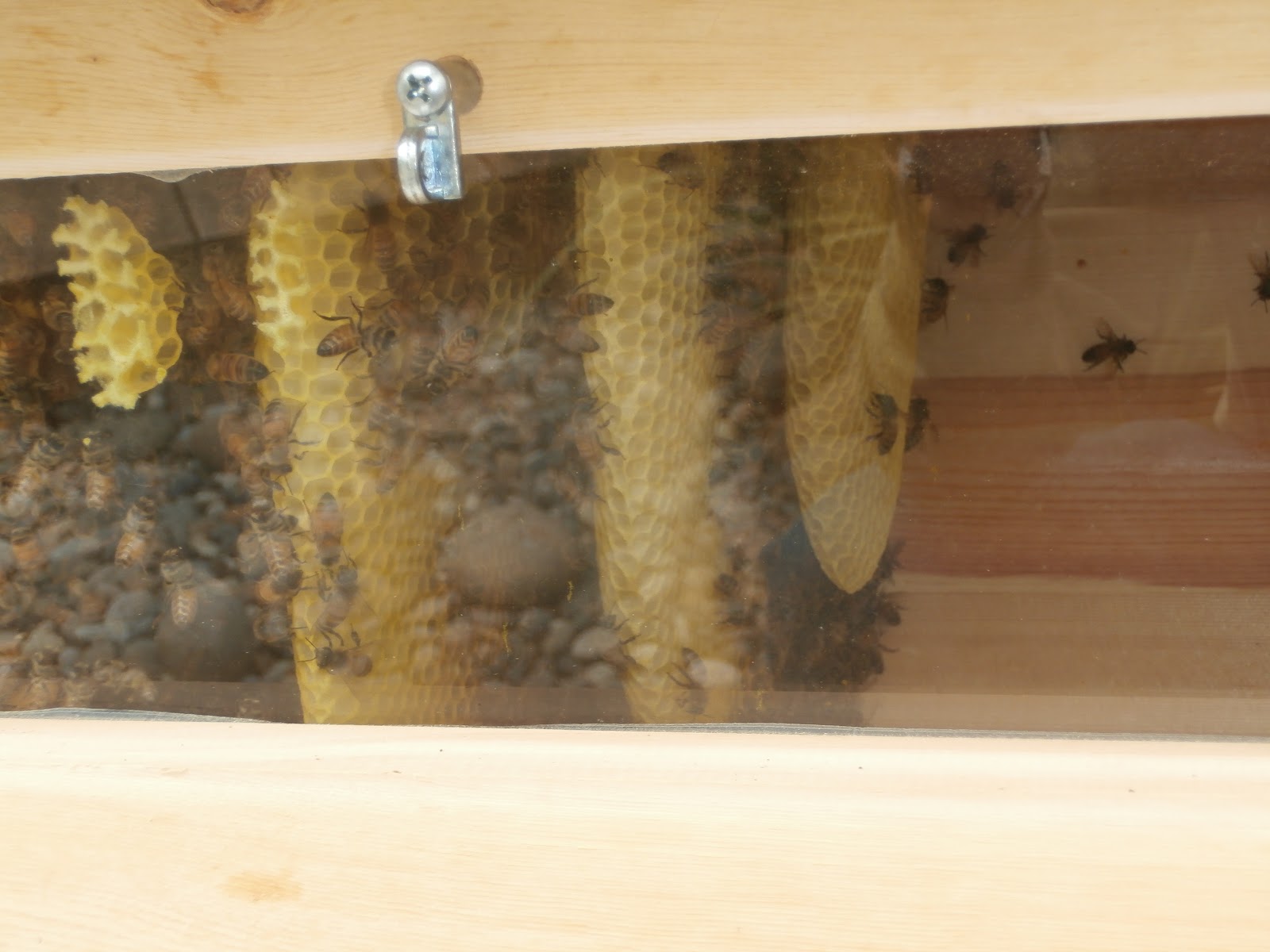
 Then I went to look through the observation window of Olea's hive.  It was obvious that a lot of bees had left.  The two endmost combs were bare of bees and there were clearly fewer just crawling around.  I also noticed a dozen or so drones crawling around on the rocks.  Maybe they had been forbidden to travel with the swarm- girls only.

I drove to the west side this morning and James was true to his word, leaving the nuc on his porch.  Unfortunately, it had only a bottom board, no inner cover or lid.  So I built them today.

First, let me say it's a good thing I don't try to do carpentry for a living.  I did get them built, though, with only a couple of incorrect measurements and re-cuts.  Fortunately, I had cut too long rather than too short.  I even used the router to make a groove in the frame to fit the inner board.
The weather was overcast with even a few splatters of rain.  An internet search assured me that I could safely (for the bees) hive in this weather.  I placed two frames in the nuc and dumped the bees in.  I brushed a few bees from the box into the hive as well, in order to be sure that the queen was in the nuc.
Right after hiving
45 minutes after hiving
 I left the box by the hive and in about half-an-hour all the bee s had left the box.  Over the next hour, they all crawled into the nuc.

When they were all in, I put the entrance feeder on.  I figure they'll need all the sugar they can get to build comb and store enough honey to get through the winter.  Of course, they'll have the eucalyptus to help, come December.
My apiary now
I don't know what to do with these bees.  If one of my other hives doesn't survive this year, I can use these as replacements.  Otherwise I may have to have a fourth hive (four is the maximum county regulations allow) or sell it or give it away.  Do any of you want to start beekeeping?

Sunday, July 29, 2012

Good news, bad news

I have both good news and bad news to report.
First the good news.  I went into the old hive.  First, in the upper brood box I saw capped honey, larvae and capped brood.  In the lower box there was even more capped brood, larvae and even some eggs.  Then I spotted the queen!  I believe she's new because she looks less dark, more golden, than I recall.  She's still a bit smaller than the queens in the other hives.  So the old hive looks healthy.  There were a few frames of capped honey in the upper brood box. The bees do seem a bit more feisty, but that is something difficult to measure.
Now the bad news.  Actually three bits of bad news.
1.  I wanted to take a look into Olea's hive.  Instead of taking bars from the end, I tried to take a bar from near the end.  I got it loose ok, took it out ok, but then I must have tilted it because it broke partway off the bar.  I managed to stop it and keep it balanced verically.  But when I tried to invert it to put back into the hive, it broke off even moreso.  I finally just took it off, deciding to take it in for the honey.  I looked carefully to make sure the queen was not on the comb, shook and then brushed off the bees and put the bar back in place with its remnant of comb.  There was some capped brood in the broken piece, but what could I do?  Then I saw that some of the brood was hatching.  So I propped the comb on top of the bars and left it there.
Spilt honey and broken comb
About 1 1/2 hours later
This evening I'll take it away.  The unhatched brood will be lost.  There was also a mess of honey spilled onto the top bars.  I hope that most of it will be eaten by this evening.  I will need to replace the cover and roof.

 2.  Some bees got mired in the spilt honey.  While trying to free one, a drone, I saw a mite on its abdomen.  So Olea's hive has mites, and maybe a lot of them.  I'll have to do a sugar shake count.  I also don't know how to treat a top bar hive for mites.  Most top bar beekeepers don't treat at all.  Top bar hive, being more natural, have smaller cells that the mites supposedly don't like.  I suppose one can but the thymol or formic acid in the hive.  I'll ask my mentors.

3.  In the old hive, there was capped brood in the drone frame, so I took it out and put an empty one in.  All the pupae I tried to examine for mites were upside down in the cells.  That is, their abdominal ends were up.  At least, that's what it looked like.  I went online for an explanation.  It seems that the bees may be infected with a virus called sacbrood.  There is no treatment.  Control involves removing comb that has infected brood, replacing old, dark comb and re-queening.  I may ask my mentors to help me determine if I do have sacbrood.
If it's not one thing, it's another.

Saturday, July 21, 2012

What's new in the new hive

I went into the new hive this afternoon.  Here are the findings from the top down.
There is a small amount of nectar and capped honey in the supers.  These are the eight frames with drawn comb, the ones from which the honey was extracted.  No comb drawn on the two added frames.
There is no drawn comb in the top brood box.
In the bottom brood box, there are a lot of bees.  Very little comb on the frames I added to the nuc.  On the drone frame, empty cells, some with nectar.
There are 3-4 frames with capped brood and larvae.  And I spotted the queen.  She looks like the one in Olea's hive.  I assume she developed after the second swarm and, obviously, successfully mated.
By the way, I saw the bees on the Oak Leaf Hydrangea.  They had white pollen on their legs.

Friday, July 20, 2012

Friday afternoon

It's a clear, calm and warm afternoon.  So, what are the girls up to?  Let's take a look.
These movies are today, one without sound and one a bit out of focus.  I haven't yet figured out the details of my camera.
I got a better movie of Olea's hive doing orientation flights last week.
Here's where they were doing in our yard.

 Getting pollen from the roses.  Here she's visiting Timeless.  She's a bit difficult to see, but she's there.


 And here's another one trying to get into First Prize.
On the Spanish lavender


 They are all over the lavender.
 They really like the salvia.  I often refer to it as sage; it is in the same family.
 There will always be several on the Dahlias, often more than one at a time on the the florets.

 This is the cascading oregano.  In an earlier blog, I related how I'd discovered that it was this flower that was making a white mark on the bees' thorax.
 They like the agapanthus even though I don't particularly.  The deer like them, too, and eat all the blossoms in the front.


With all the attention to the cantaloupe flowers, I hope to get some fruit this year.


And, of course, the blackberries.  This year is going to be a huge crop.  Momma made the first batch of jam today.  I have 5-pounds of berries to make blackberry/honey beer.  I started it yesterday and it's fermenting now with a steady bop, bop, bop, bop.  It should be ready for consumption in about 4 weeks.

Mais oui, the girls love the the French lavender, aussi


 I don't often see them on the lavatera.
                                               There are bumblebees in the yard also
 One of the girls pollinating a lemon cucumber.  There will be a big crop of these this year, too.  I planted three hills.  I'm going to try pickling them.  I made bread and butter pickles with one of the green cucumbers a few days ago.
On the bidens in the front.

Monday, July 16, 2012

No eggs, no larvae, no capped brood......no queen?

I went into the old hive yesterday with Seth. 
There were a few frames with capped honey.  One section of frame was filled with pollens of all hues.
In the top brood box, there were only empty cells and capped honey.
In the bottom brood box, alas, it was the same.  No queen seen and no sign of any egg-laying activity.  Only empty cells.  Lots of bees and only a couple of drones.  There were 4 or 5 partially constructed queen cells.  All the cells on the drone frame were empty, as well.
It looks like there's no queen, again.  No capped brood means there have been no eggs for at least 3 weeks.  Perhaps I injured the queen during my last inspection, June 19.
I've decided to wait and see.  Last time this happened, the queen was replaced by the bees.  Perhaps that will happen again.  Or, the colony will die off.  I'll check again in two weeks.  Keep your fingers crossed.

Saturday, July 7, 2012

What to do about mites?

I did a 3-day sticky board count today.  The old hive had 5 mites (1.67/day) and the new hive had 19 mites (6.3/day).  Interesting and perhaps valuable data, but, how do I interpret it?  This isn't the first time I wondered about this.
So, back online to Scientific Beekeeping.  I reread a couple of articles and came across a new table.  Also a reference to a Varroa count calculator at a British site, Beebase.I can also dust with powdered sugar, which I think is most effective in the fall.  I am using drone frames already, but the new hive hadn't drawn comb on the drone frame last week.  I did put in an old frame (with dead drone pupae), so perhaps the queen will lay some drone eggs and when I remove it in two weeks, it will be full of pupae with their attendant mites.

Saturday, June 30, 2012

New hive inspection report

The new hive was inspected today, about three weeks after it cast its second swarm.  Findings:
The sticky frames (leftover from the honey extraction) in the super were no longer sticky.  The bees had cleaned them.  There was a small amount of capped honey.
There was no comb at all drawn in the upper brood box, just frames with foundation.
All the action was in the bottom brood box.  Only a little new comb had been drawn and there was only a bit of irregular comb on the drone frame.  However, five frames had either empty brood cells or capped brood.  I also saw larvae of all ages and maybe a couple of eggs.  I couldn't find the queen, but she had got to be there doing her job.