Friday, April 1, 2016

The bees beat me to it

Today was the day I was going to populate Olea's hive with a shook swarm from the nuc.  I had planned to then place the brood from the nuc into #2 in order to give its population a boost.

As a sidebar, I have been concerned about #2.  It has been the weakest hive and is not expanding as quickly as I would want.  After treating with MAQ, I saw no activity at the entrance of #2 and worried that they may have absconded.   This has happened after treatment with MAQ but usually when it is hot or the bees are disturbed too soon.
No activity at #2, on the left
Back to the main story.  Yesterday the nuc swarmed! 
It clustered low down on the orange tree.
Starting to cluster
Cluster formed

I was just getting ready to leave for my clarinet lesson but I quickly got Olea's hive ready to receive bees.  I was disappointed when I opened the bag storing the old comb as much of it was moldy.
One can use moldy comb, but three of them were just too foul looking for my taste.  They are sitting outside now and perhaps I can use them later.
Early this morning I captured the swarm in a box and then poured the bees into Olea's hive.
The box ready to receive the swarm
Olea's hive ready to receive the swarm
Bees in a box

Bees in another box

A peek through the window
Now what to do with the nuc and #2.  The nuc now has a virgin queen so I just cannot put in the brood frames unless I find and remove the old queen in #2.  So I contacted Kathy Niven who suggested combining the hives by use of my double screen board (that I built some time ago) and after the bees are acclimated, finding and removing the old queen (who apparently is not doing well as manifested by the weakness of #2 colony).  I need an empty deep box to hold the nuc frames and Kathy is going to lend me one.  I will get it this morning and combine the hives.

Saturday, March 26, 2016

Mites galore

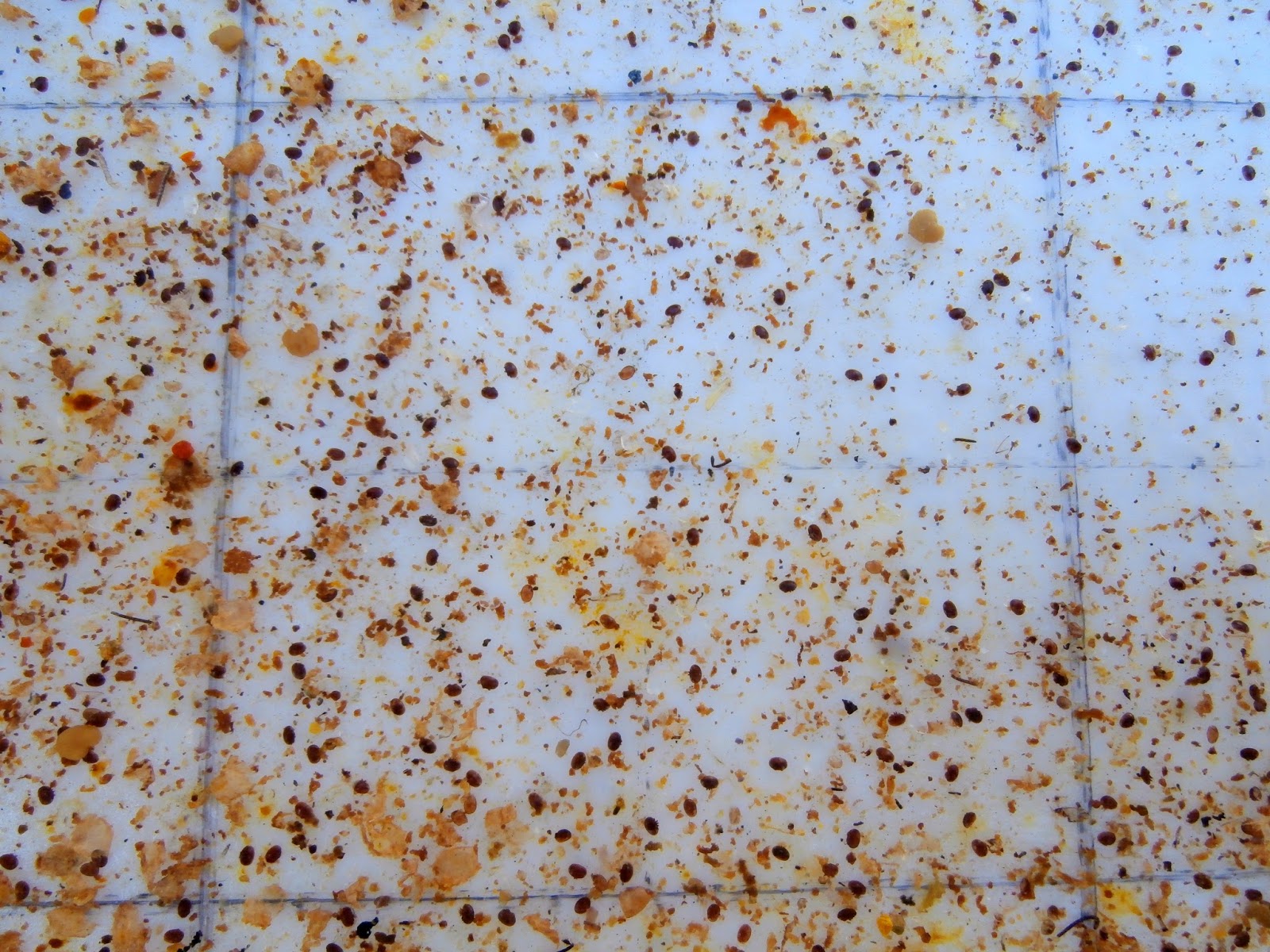
I did a 6-day sticky board count.  This is what I saw:
The square is 2 inch/side.  Since you all have been following this blog, you know that the brownish ovals are mites.  I did not bother to count the mites; there were hundreds on this board.  I treat if there are more than 4 per day I knew treatment was needed and soon.  I have been seeing some bees with deformed wings, also not a good sign.
It is a good thing I had recently ordered more MAQs.  I put the formic acid in #1 & 3 yesterday.  I only had two spacers.  I made a third yesterday and put the MAQ in #2 today.  I was pleasantly surprised by the new packaging of the strips which made them much easier to handle and place.
The raspberries have bloomed but the honey bees have seemingly not yet found them, only the bumble bees. 
Soon I will take the bees from the nuc and put them in Olea's hive.
The entrance of the nuc

Sunday, March 20, 2016

Into #3 with Mihir

Karly and Mihir were here for a couple of days and I persuaded Mihir to go into the hives with me.  Karly stayed way back and took pictures.

We did a thorough inspection of #3 and checked #1 & 2 for honey.
The top super of #3 was light.  There was nectar in the bottom super.  There was also some brood and eggs in the super.  There was lots of brood in the top brood box and some in the bottom box.  Two frames were all drone brood.  I again considered culling them but, out of laziness, just left them alone.
Hive #1 continues to look the strongest.  I am a bit worried about #2.  Probably at the next warm spell (it is raining today) I will shake the bees of the nuc into Olea's hive and add the frames of brood to #2.
I put sticky boards in yesterday and may treat all hives with MAQ if the mite count is up.  I just purchased three more super boxes with frames and foundation as I expect (hope for) a strong honey flow, what with all this rain.
I cleaned out the trays from under the screen bottoms a few days ago.
This is a close up of the debris.  I took it because I was curious about the white curvy things.  My sources think they are bit of pupae that have been removed for hygienic purposes.  Either the pupae were infested with mites or ill in some other way.  In the debris you can see lots of chewed off caps of brood cells (tan bowl-shapes) some wax (clear plates), some pollen balls and, unfortunately, a few mites.  There are even a couple of small beetles that almost always are in the trays.  I do not know what they are but I am sure they are not small hive beetles.

Sunday, March 6, 2016

After the fall

There was a break in the storms today with the temperature up to 60, so I took advantage and looked into #1.  We have all been curious about how it fared from its misadventure 9 days ago.  Well....
it is doing great!
The top of the top brood box
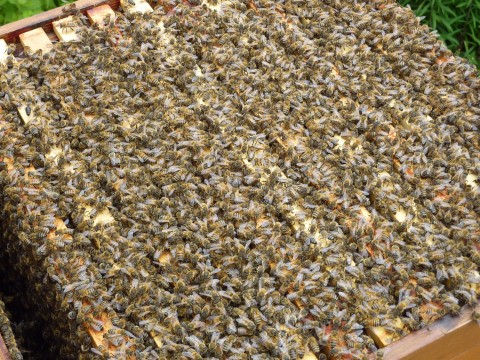
 The colony is very strong as you can see above by the number of bees covering the tops of the frames.
Compare my hive to this photo of a strong hive taken from The Guildford Dragon News' Beekeeper's Notes.
There was nectar some capped honey and even brood in the super.
A frame from the super of #1
There was brood in both brood boxes and I saw eggs in the top brood box.  The colony is expanding still.  I added a second super.
I checked how #2 was getting on.  The super felt light and the colony was not nearly as strong as #1.
The top of the top box of #2
Needless to say, I did not add a second super.  I have been considering giving #2 a boost by adding a frame or two of brood from the nuc.  Perhaps I should have done that today.  If I decide to do so, I will need to was a few days for this next expected series of storms to blow by.
#3 is somewhere between 1 and 2 in strength.  There is unripe honey in the super and a very small amount of brood.  I added a second super and checker-boarded two frames with honey into it from the lower super.
About a week ago I read an article about solitary bees.  There was an un-splittable log (even by Seth) lying in the yard.  On impulse, I got out the drill and made a solitary bee motel 6.

Friday, February 26, 2016

But- oh, what happened! First this- and then this! (apologies to H.A. Rey and Curious George)

For some time, two legs of the high stand were tipping inwards.  I had tried to re-enforce them, but it seemed to be getting worse.
I had real concern that as the weight of the hives increased over the next few months as the bees stored honey that the stand might collapse.  This, of course, would not be a good thing.  I decided that I had to take the hives off the stand and do a proper repair.
First step: get the hives off the stand.  I took the table that had held Olea's hive and placed it in front.  The ground was uneven so I used rocks to try to level and stead the table.
Next step:  lift the hives off the stand and onto the table.  I had (cleverly) measured the table beforehand and knew that the hive had to hang over the side about a half-inch.  I smoked the bees, removed the super and top box, lifted the bottom board and box onto the table and then reassembled the hive.  This went pretty smoothly.
Then it was time to fix the stand.  I had envisioned the process and gone to the hardware store to pick up the angle irons.  Naturally I had not examined the structure first.
As you can see, there is no way this brace would go on the stand leg.  So I removed the old braces and straightened those that were bent.  I unscrewed the legs and chiseled off the old glue.  I then reassembled it , but put the legs on the outside instead so that I would not be putting the screws into the old holes.
When I tried to put the stand on the bricks, it did not fit.  I realized I had moved the legs further apart and so and to replace the bricks on which they rested. 

The bricks in their original position
I figured I should also reorient the stand a bit so I would have more room behind it.  I had to leave one brick where it was, so using it as a pivot point I moved the other three bricks angling the stand away from the fence.  I lowered and adjusted all the screens (that guard the oil cans) and placed the stand.
Now I had to put the hives back onto the stand.  But- oh....
I took the super off of #2 and noted that the table tilted a bit.  I looked at the legs and it looked like there was enough support. Then I took off the top box and...
The table tilted and #1 tilted and fell off onto its side.  Just what this whole process had meant to prevent!
Angry bees everywhere!  Good thing I had my veil on.  What to do?  I thought I should get the hive assembled on the stand as quickly as possible.  I hustled over, put the bottom board onto the frame and then the brood boxes and the super.  There were a lot of bees on the ground in the dry creek bed and on the table.  I looked and looked for the queen.  Was she still in the hive or not?  I looked and looked again and again.  I never did see her on the ground so I assume she stayed in the hive.
Now I wanted to make it easier for the bees to get back into the hive, so I placed some boards for ramps.
Note the clumps of bees in the dry creek bed
I still had not put #2 back together.  So I took care of that, looked again for the queen and rearranged the boards.
I took this picture from a distance without protection
When it was all done I went to take off the bee jacket.  There still 3-4 soldier bees attacking me even when I was back at the shed.  I swatted them.  I may have gotten one superficial sting on the inside of my left arm; pretty good protection, I'd say.
In retrospect, I should have handled things a bit differently.  (After the hive had fallen, that is.  Obviously I should have been more careful about the unstable table.)  My main concern was that the queen may have been ejected from the hive.  It probably would have been better to just let the boxes lie there for a while.  Any bees on the ground would crawl back in, the queen as well.  I will know better what to do the next time a hive falls over.


Monday, February 22, 2016

Entrance reducers out

Maidi and I went into the hives a couple of days ago.  We also removed the entrance reducers from all the hives.  It looks like the honey flow is starting.  There is lots of pollen being brought into the hives and the plum trees are in bloom.  The bees should be in the midst of the spring build up when they increase the colony size rapidly to 20,000 or so.
#1- The colony looks strong with a lot of bees in the super.  The super felt kind of heavy ,probably over five pounds which means they are also storing nectar which will be our fall honey harvest.  We saw the queen, fat and golden, in the top brood box.  There was capped brood in the top box; we did not check the bottom box.
#2- There were not many bees in the super and there was no nectar.  There was a good amount of brood in the top box.  We did not look at the bottom box.  #2 appears to be the weakest of the three hives but does not look unhealthy.  I will certainly check it again in a week or two.
#3- Some nectar in the super.  Lots of brood and eggs in both brood boxes.  We did not see the queen but know she's doing her job.  #3 is moderately strong.
Even though I have not been reporting, I have been doing winter chores.  I let the bees clean all the comb from Olea's, then froze and stored what I could.  I cleaned the observation window which was smeared on the inside from all those little bee feet.  I bought more deep frames and foundation so that I could make more splits. 
And I have been mulling over the best way to repopulate Olea's hive.  One choice is to put all the bees from the nuc in the hive.  This would be like a package.  However, I would not want to just discard the brood from the nuc and would then want to put it into one of the other hives.  This would involve a bit of frame juggling.  Also, the number of bees in the nuc might not be enough and I would have to add some from one of the other hives.  Another, simpler way is to do what I did before, namely make a shook swarm from one of the other hives.  That hive would then have to make a new queen.  I would also still have the nuc and when I make splits will then have 2-3 nucs.  Maybe I could sell one.

Sunday, February 7, 2016

Spring is here?

What is going on?  Mid-winter and temperature in the 70's.
And what does this mean for the bees.  I know that they start a spring build-up, usually in late February.  However, what stimulates the build-up seems to be pollen and the girls have been bringing in a lot of pollen for a couple of weeks.  I decided today to add supers (how appropriate for super bowl Sunday). 
I had added a second brood box to #3 12 days ago, so I took a look to see if the bees were availing themselves of the added space.  They were.
Nectar and pollen

Brood with pollen and nectar
These are two adjacent frames from the top box.  Remember, these frames were empty drawn comb when they were put in the hive only 12 days ago!
I put the super on #2 without looking in.  I looked into the top box of #1 and there were two frames with an excellent brood pattern; I looked no further.
The hives all seem very healthy and are in the midst of the spring build-up.  It is a good thing I added the supers as they need the room and the added space helps in swarm control.  I considered putting in drone frames (for varroa control) but I could not decide which box to put them in and I was tired.