Monday, January 30, 2012

Bridge to the bees

The plywood board I was using to cross the dry creek was meant to be only temporary. This past week I got around to building a bridge.I made a plan, then went to the lumber yard for wood and concrete. There, after discussing my plan with the yard manager, I made some suggested changes. This involved three posts on a side rather than two and 2x6 joists rather than 2x4. This would make the bridge higher than I had wanted, so I would need a step.
So, after careful calculations and lining up, the post holes were dug.
Here are the posts in their holes ready for concrete.While digging the holes, I received my first bee sting from my girls (right eyebrow). I guess all the banging and thumping by a large creature so near the hive was upsetting the guard bees. After that, I wore a bee helmet and net. That was too uncomfortable, so I lit the smoker and did the rest of the construction in a cloud of smoke.
Here it is, ready for the planks with the posts in concrete, the joists attached with lag bolts and the step cut out.
Getting all the supplies only took one extra trip for lumber and two trips to the hardware store.
Here is the finished bridge. And it works!

Friday, January 27, 2012

Marking bees

It's been warm for the past two days and the bees are out and about. I saw dark bees on the lavender and once again wondered if they were mine. The flowers are only about 100' from the hive- maybe too close for their foraging preference. So, I decided to investigate. I went out and got a 4-0 brush and some acrylic paint at Palace Art Supplies and a butterfly net at The Mad Molecule Shop.
Then I caught some bees that were gathering nectar on the lavender, folded the net over to hold them and marked them with the paint. Easier said than done. I got paint on one's wings and then she was unable to fly. I also tried marking one with white-out, which worked well but made cleaning the brush difficult.
Then I sat by the hive to watch for a marked bee to come back. I listened to John LeCarre's Our Kind of Traitor while I waited. Then a bee got ornery and I had to leave. (I did get my first sting a couple of days ago while working on the bridge; more about that in a future blog.) I came back, but got buzzed at again. So I got my scope and set it up on the path a safe distance away.
I watched for over 1/2 hour and finally saw one of the marked bees coming out of the hive. I watched more and saw a couple of bees (or the same one twice) going into and coming out of the hive. QED, my bees do forage in our yard!

Wednesday, January 18, 2012

Much to report

A lot has happened since the last blog on the 12th.

In regard to my email about the bee with deformed wings and the mite count, Jeremy Rose replied- "50 mites is way too many. The mite away strips did not work. Order some Apiguard and treat it with that. Order a queen from me and requeen the hive in April." I asked him why I would need to requeen, and his somewhat cryptic answer implied that my current queen and her off-spring are not resistant to the mite and eventually will succumb. I have been thinking about this, and it makes sense. I still would like Carniolans- I will find out if Jeremy has those and if not, where a more mite-resistant strain can be found.
I did order the Apiguard and put it in the hive January 16th. Usually this is used in spring. The instructions say to close the screen bottom and to leave some room above the tray with the thymol gel. To close the screen bottom, I cut a piece of cardboard to sit on top of the beetle trap tray and fit up against the screen. There is a special spacing device one can buy to provide room. Also, it is implied in the instructions that there are no supers on the brood box. Since I have two supers with honey, I wasn't certain what to do. So I left the supers on and put an empty medium box over the brood box. This may leave too much empty space in the hive, but I'll just have to wait and see. One leaves the Apiguard tray in for 2 weeks; I'll take a look and replace the tray on the 30th. On the right you can see the cardboard sticking out the back and the empty super.

This time I did not resist temptation and took out one frame of honey. I replaced it with one of the new frames I purchased for the new hive. It tastes just like....honey!

The Vivaldi top I ordered arrived and is now in the shed awaiting paint. I needed more frames and a screen bottom that I ordered from Dadant. The screen bottom they sent was defective (the front of the screen was not attached). I called them and the sent a new one (arrived today) and took back the old.

Professor Tom Seeley wrote back. In regards to my question about foraging, he referred me to a chart in his book that shows foraging distance deduced from the waggle dances observed in one hive. Most foraging is done thousands of meters from the hive. He said one can use any sort of paint to mark the bees, just don't get any on the wings. In regards my question about interning; "As for interns/helpers, I'm sorry to have to report that I need to give top priority to the undergraduate students attending Cornell. But thank you for your interest!" I guess I'll have to apply to Cornell.

You probably have read about the parasitic fly that is killing bees. To check to see if there are any in my hive, I've been collecting dead bees and watching for the emergence of any flies. Little did I know that dead bees begin to have a putrid odor after a couple of days.

I built a new hive stand for next spring. It will hold two hives.

Thursday, January 12, 2012

Deformed wing

While looking at the bees today, I saw one walking around on the porch. It looked like something was stuck on her back that she was trying to get off. Then, on closer inspection, I saw that the something was actually her wing! Both of her wings were deformed into short, curled membranes. (I was unable to get a picture of her as she was gone when I got out later with the camera.) This is caused by the deformed wing virus and it is one of the symptoms of parasitic mite syndrome. PMS is not only a cause of grouchy women, but also a cause of the death of the colony. Naturally I'm concerned.
I already put in the sticky board for a natural mite drop count. I will email Jeremy Rose again to ask if it is safe to treat again at this time of year.
I also emailed Tom Seeley today asking him about his statement that bees don't forage within 500 meters of their hive. I'm looking forward to his response.

Sunday, January 1, 2012

Honey for the new year

Over the past days, I have seen the bees bringing in lots of pollen. Since pollen is important for brood, I wondered what was going on in the hive. Today was very warm and the bees were quite active, so I decided to take a look.


In the top super, there were 5 1/2 frames of capped honey. I again considered taking some.
In the middle supper were 8 frames of capped honey.


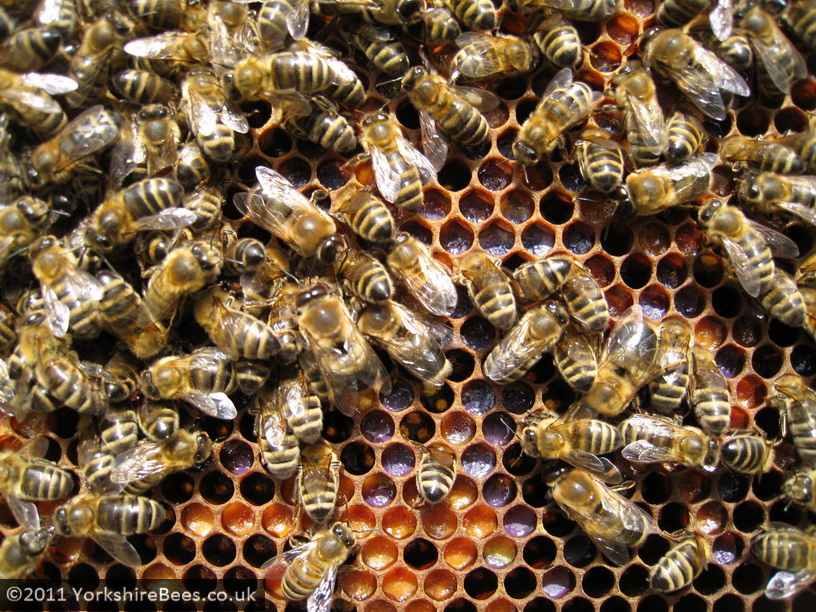
Here is a view looking onto the brood box. You can see bees eating honey from broken cells. The white stuff is powdered sugar left over from the mite counts. There is also one dead bee. I found a few others, as well.

In the brood box, I saw my queen (not pictured.) There were still two frames of brood, no more than on last inspection.
The white things in the open cells are larvae.

I didn't see much stored pollen. I expect that is because I don't know what I'm looking for.

The quality of the photos is not up to the usual Maidi-standard, as I took them myself. It's difficult to get a good angle wearing a bee suit and sticky rubber gloves.

Sunday, December 18, 2011

For some time, I have noticed that some bees have a light colored spot on their thorax. Is it a disease? Some sort of phenotypical variation?
Today I saw several such bees, so I caught one on camera (not film anymore- on pixel?). Getting this photo almost made me feel like a National Geographic wildlife photographer. I had to wait nearly 5 minutes and took several shots.
You can see the light streak on the bee's thorax. Note, also, the light-colored pollen on her hind legs.
The answer: the bee's middle legs have a "blind spot" where they cannot reach to groom. I remembered having read about this in The Biology of the Honey Bee by Mark Winston, p.23
I presume that this forager had visited a eucalyptus tree.

Friday, December 16, 2011

Late fall inspection

I hadn't been in the hive for a while and began to get curious about what was going on in there. The bees are still active (they don't leave the hive as early as before because of the temperature) bringing in pollen and presumably nectar. Their orientation flights are smaller in number.
The pollen they are bringing in is orange; no white pollen yet. I spotted some blooms high on the eucalyptus in Capitola. I had to use binoculars to see.
Since today was a sunny, calm and (relatively) warm day, I decided to take a look inside.
Lots of honey, still. 7-8 frames full in each medium super. There was only one bee in the top super. With the top super off, one can look down and see the spheroid area that the bees mainly occupy. In the deep box, two frames with brood and larva (I did see my queen). I see some pollen but not as much as the books illustrate. I figure it's my observation that is poor, not the girls' pollen collecting and storage. No queen cells and no drones or drone cells seen.
I'm reading Tom Seeley's Honeybee ecology that Cynthia so kindly checked out for me from the UCSC Science library. It's quite interesting, but he loses me with his mathematical explanation for the altruistic behavior of the workers. One bit of information I learned was that bees seldom forage withing 500' of their hive. This is one comment for which he does not give a citation. I expect I'll write to him to ask about it. Naturally, this means that my bees won't get anything from our yard, a disappointing thought.
Planning ahead- I want to divide my hive. The books and online sources say that one should move the new hive at least 2 miles away. This is something I would find difficult to do and I wonder how important it is to do so. I will be barraging my mentors with questions regarding dividing hives.