Sunday, February 23, 2014

Warm enough to inspect

From srvbeekeeping.com
I had been waiting, as I am certain all of you have, for it to be warm enough to take a look into the hives.  I wanted to be sure that #1 was as strong as it seemed and that #2 was holding on.  I also wanted to see how many drones there were.  In order to make a new, fertile queen, there needs to be lots of potential mates. 
I went into #1 10 days ago.  The hive was strong with lots of bees in all three boxes.  There were 4 frames in the super with capped honey (and a bit of unripe honey).  Later, I emailed Kathy Niven asking if it would be okay to harvest now.  She assured me that the honey flow was starting (eucalyptus and plum trees blooming) and it would be okay to take the honey in the super.  The next day I placed my bee escape board, and the following day took the honey.  I extracted a bit over two quarts and put the stickies back on the hive.
Top of frames with honey and broken comb
The super was firmly attached to the frames of the top brood box by brace comb.  Breaking the comb exposed honey, so the bees got busy drinking it. I saw my queen in the top brood box.  There were at least 4 frames of brood mainly in the top box but also extending into the bottom box.  There were a few drones.
Yesterday, Karly and I went into #2.  There were no bees in the super and only a few in the top brood box.  
We spotted the queen in the bottom brood box and a small patch of brood on two frames.  The population seems stagnant.  That's a bit worrisome because the spring build up should be starting now.  I started feeding them to try to stimulate egg-laying.  If that doesn't work, I may take a couple of frames from #1.  I still want to make a split from #1, as well.  
I had noted a lot of crawlers with deformed wings.  Instead of doing a mite count, I decided to go ahead and treat.  I put Mite-away quick strips into #1 today and took out the entrance reducer.  #2 is not strong enough to treat, so we just have to hope.

Tuesday, January 28, 2014

Spring is around the corner

 Even though it is still officially winter, the weather is warm, the purple leaf plum tree is flowering and, I hope, the bees are building up their numbers in preparation for the honey flow. 
There has been little actual work done since the last post, just planning.
The containers used to hold oil to keep the ants out failed as containers.  I am replacing them with ceramic bowls purchased at Goodwill.
On a warm day, I took a look into hive #3.  I had been feeding this weak hive with sugar syrup for a few months.  Much to my consternation, there was no colony.  No queen, a handful of bees on the frame just below the feeder and a small patch of untended, dead brood.
Bee copses on #3 screen
I removed all the frames and searched among the corpses for the queen, unsuccessfully. 
My initial plans for the apiary had been two hives and the bonus top bar hive.  At this time, I am leaning towards removing hive #3.  It is not yet time to make the splits- I need to wait until there are drones.  If my splits are fruitful, I will try to populate Olea's hive.


Sunday, December 29, 2013

Hive #1 on a warm winter's day

Hive #1 has been looking very busy and I have been wondering what was going on inside.  Today it was warm enough to allow me to take a look.  
Busy front door
After taking off the lid, I was pleased to see a lot of bees inside the top cover.
Inside the Vivaldi box
In the super, there was only a bit of honey.
Under the Vivaldi box- top of super
 If a hive is really strong, all the frames would be covered with bees.  The top brood box had a small patch of brood at the bottom of the center frames and a few frames with capped honey and bee bread.  I guess the colony is not as strong as I thought since there was only a handful of bees on top of these frames.
Top of upper brood box
The bottom brood box had old,drawn comb, no brood or honey.  I didn't see the queen and assume she is in the top brood box.  At least I hope she's there still.
Looking down on bottom brood box
I've treated myself to a new tool, a frame puller, and used it today for the first time.  It really makes it a lot easier to remove a frame.
Using the frame puller
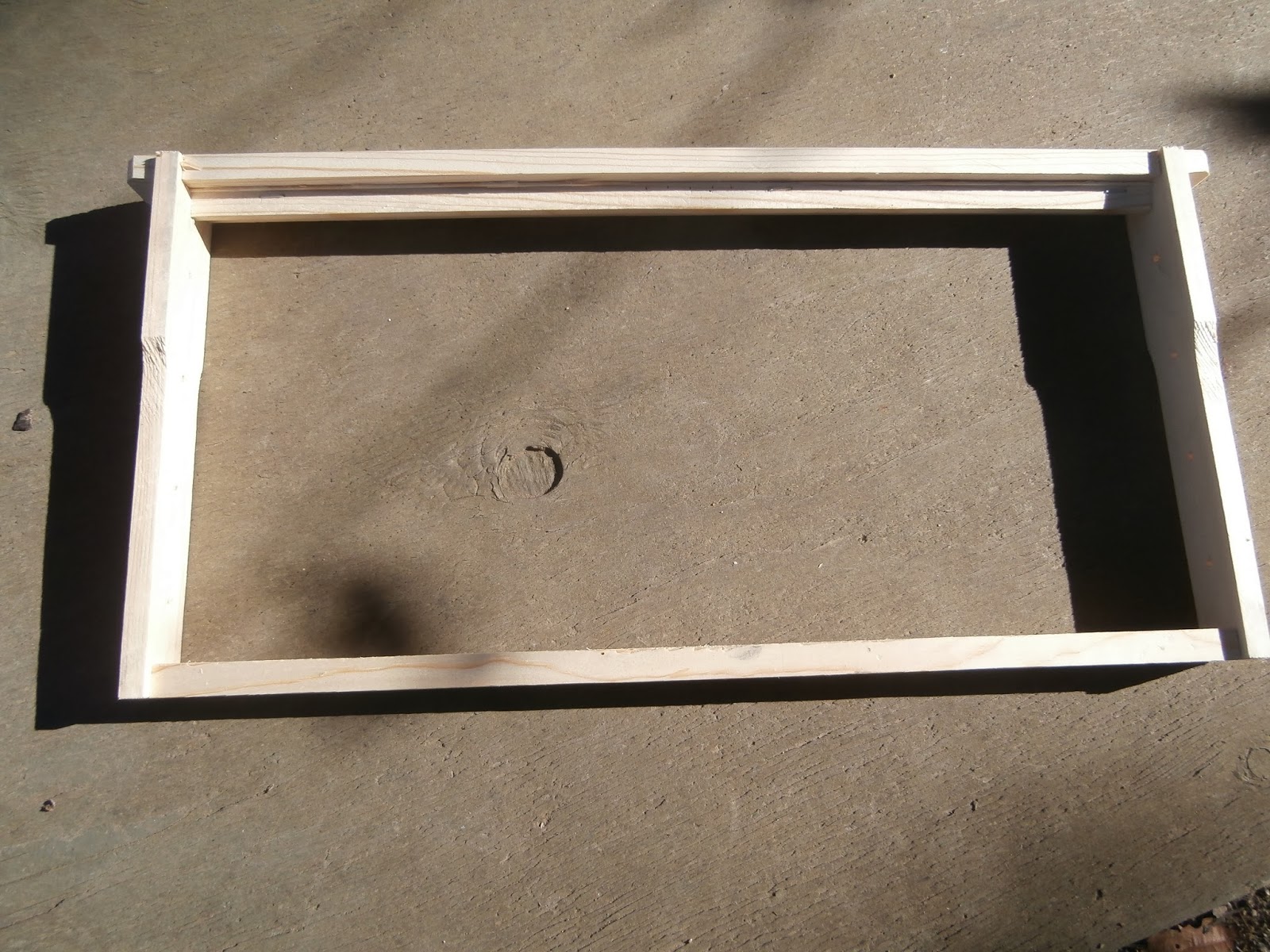
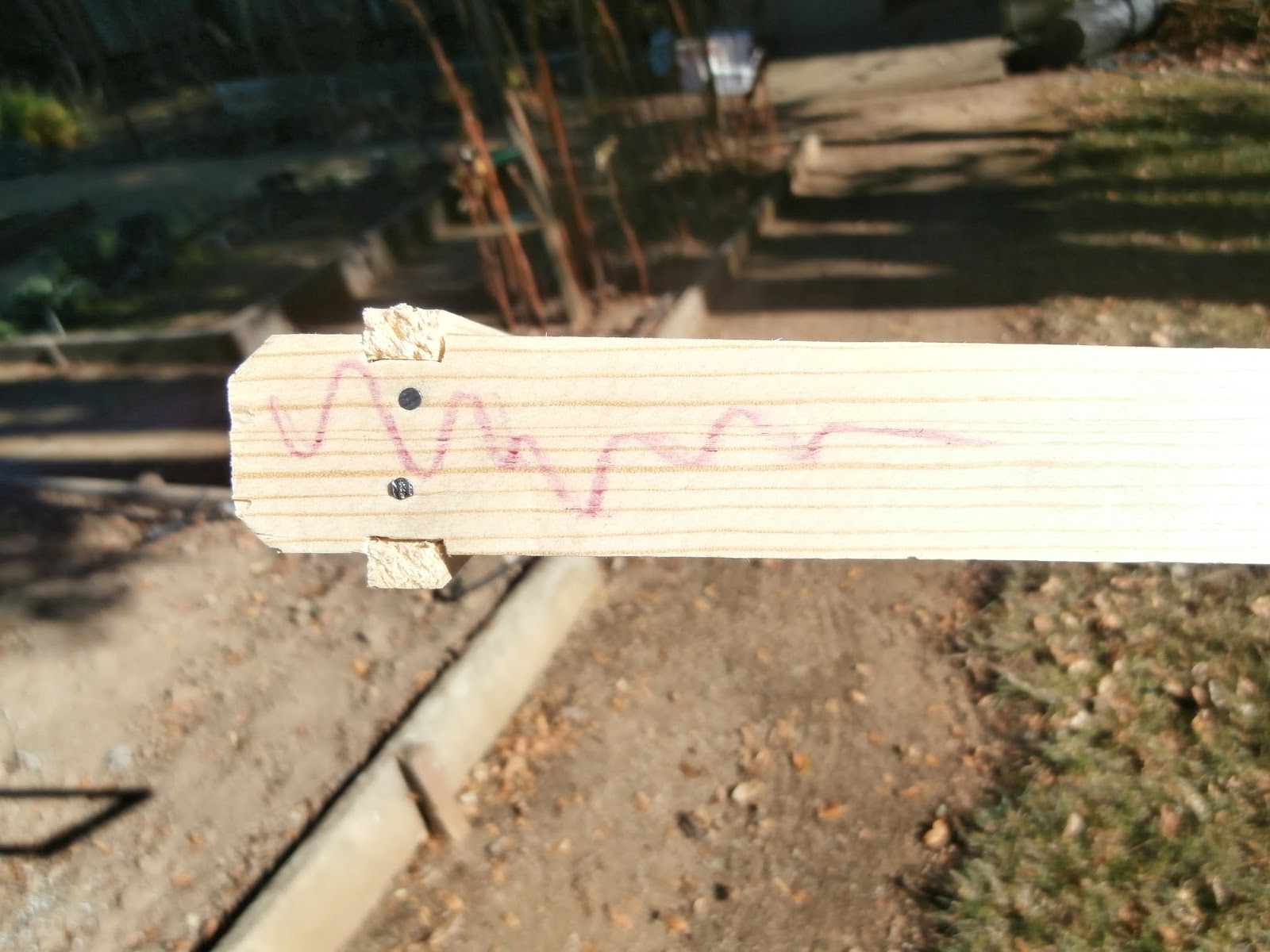
I received and put together the frames that I needed for the nucs.  I made them foundationless by putting the wedge sideways, using glue and a stapler.  As I pull brood and honey from the existing hives for splits, I'll replace them with the foundationless frames. 
Foundationless frame
Close up of my fine work
I used a maroon crayon
 I marked them with a crayon to keep track.


 A few weeks ago, bees were drinking water off the deck.  The water was there from my cleaning the beer fermenter.  I had long ago made a water station by the blackberries, but the bees never drank from there.  I made a new "pond" for them behind the new rose garden.  I haven't seen anyone drinking there yet.


Sunday, December 15, 2013

New nucs built

This spring I intend to start some nucs in order to raise new queens.  There are many reasons for doing so as well as many methods.  One method is the "walk-away split".  Since this looks to be the simplest, I plan to do this.  Thus the need for nuc boxes.  Hive #1 seems to be the strongest, so I'll use it.  I can't wait until spring to get going.
I built the boxes using these plans.
The project went pretty well, just a few snags:  Karly helped me getting the sheet of plywood.  We tied it onto the roof of the Prius, but then realized we had tied the doors shut.  The printer did not print out the "1"s, so when I cut the pieces, I measured 9-1/8" instead of 19-1/8".  Fortunately, the remaining wood was big enough to cut all the parts.
All pieces cut and ready for assembly

The finished product

Saturday, November 30, 2013

Hives #1 and #2 holding their own, as well

A couple of days before Thanksgiving I looked into hives #1 and #2.  #1 seems to be the strongest of all with lots of bees.  There is even some nectar in the cells in the super.  The queen was seen in the top brood box with some brood.  The bottom brood box is mostly empty comb.  As I recall, the queen has always been spotted in the top brood box, although I have seen brood in the bottom box before.  Since this hive is so strong, I'll take brood from it (in the spring) if #3 needs help.  I'm also planning on trying to raise a queen, and I'll use #1 for stock.
#2 seems stable with a modestly sized colony.  I spotted the queen in the bottom box.
I put entrance reducers into both hives.
Hey! What happened to our door?

Thursday, November 21, 2013

Hive #3 seems to be holding its own

I took a look into #3 a few days ago.  There was clear nectar in some frames in the top box, presumably from the sugar syrup.  In the bottom box were smallish patches of brood on two frames, much as I had seen on previous inspections.   There was a good amount of beebread.  I saw the queen, again.  The population seems about the same size, which is better than declining.  I hope that in the spring the size of the colony will rapidly grow.  If it doesn't, I'll probably transplant a couple of frames from the stronger hives.
After we had returned from our trip, I scraped out the honey that remained in the extractor.  I left the barrel out for the bees to clean up.  The girls didn't find it until the second day, which was warmer than the day before.  Perhaps the warmth let the honey aroma spread.
Lots of bees visiting the barrel

Lined up around the pool of honey

Same view as above, 1/2 hour later.

Saturday, November 9, 2013

Back from abroad and some bad news


So there we were, at the top of Sacre Coeur on Montmartre in Paris, enjoying the view.  And there on the roof top below us....bee hives.
The day before we left, I noticed that there was decreased activity around Olea's hive.  I peeked through the window, and, yes, not many bees.  I then did a thorough search.  There were very few bees, spotty brood and dead pupae.
Dead pupae from Olea's hive


There was no bad smell and no goopy larvae.  Even though I was concerned that this might be foulbrood or some other contagious disease.  I did spot the queen after I nearly lost her by nearly dropping the frame she was on.  Since we were leaving the next morning, there was nothing I could do.  I did email Kathy Niven and got a response from her in Paris.  She didn't think it was foulbrood, so I was reassured even though I knew the colony was doomed.  Upon our return, I took a look at the hive.  On the porch was lots of debris.
Debris on the porch

Inside all the honey had been robbed, as anticipated.  The debris, which was also inside, is the chewed off caps of the honey.  The hive was otherwise empty except for two dead bees and a couple of robbers still looking around.  There was some (presumably) dead brood and lots of beebread.

Spotty capped brood

Beebread
Close-up of bee bread

I emailed Eric Mussen at Davis asking if he could identify the cause of death from my picture and description.  Of course he couldn't be positive but he suspected it may be chilled brood.  I can't explain what caused the drop in population that led to the death, but at least I won't need to sanitize the hive.
I tried to remove the beebread but it was just too tedious.  I do have a small amount;  it tastes somewhat sour and grassy with sweet overtones.  I will process all the wax.
I did use the honey extractor before we left.  It's not as easy to use I had hoped.  The problem is balancing the frames;  when it is off balance, the whole thing wobbles crazily.  We did get a few pounds of honey.  Yum!