Sunday, March 30, 2014

Split made

Beekeepers at work

I had emailed Kathy Niven regarding making a nuc and she graciously came over this afternoon to assist me.  In the process of making the nuc I learned some new things and made some discoveries.
I need to correct (emend? amend?) something I said in the last post.  In regards to the nectar in the cells in the brood frames, I had said that I thought the bees were making this a honey frame- incorrect.  Bees will flood new-laid eggs with nectar, so this was an area of eggs.
When we looked at the frames in the bottom honey super, there was capped brood and drone cells in the lower third of many of them.  That is why some people use a queen excluder.  Until these last inspections, I had thought that there was only brood in the top brood box.  In fact, the brood area extends from the bottom of the bottom box through the top brood box and into the bottom of the first super. That queen is really working hard!
Here's how we made the nuc.  Because we saw the queen, we put her with the frame of brood and nurse bees into the nuc.  Kathy thinks that it is more assured that the parent hive will make a new queen.  I also think it gets the nuc off to a quicker start because it already has a laying queen rather than the three weeks or so to make a queen, for her to mate and then start laying.  One of the sources I used actually discourages walk-away splits for that reason and says to either use a queen or at least queen cells.  We then added two more frames with capped and emerging brood.  The fourth frame had honey and pollen and the fifth was an empty frame with drawn comb.  Selecting which combs to use took some looking and the girls got a bit upset.  I got one sting on my index finger through the glove.  When all five frames were in the nuc, we placed it on the stand that previously held #3, shook another frame of nurse bees into it and closed it up.   Kathy wisely pointed out the need for a cover in light of the upcoming rain and suggested a brick to keep the cover from blowing away.  Looking at the nuc later on, I saw ants on the stand so I placed bowls under the legs and filled them with water.
But wait, there's more!  Kathy advised "checker-boarding" comb with honey and empty comb in the top super to encourage the bees to go up there to draw comb and make more honey.  This is a well established manipulation and one more thing I now know about.  It was in doing this that I discovered the brood in the lower super.
Finally, over coffee (see above picture), I asked Kathy about hive #2.  She suggested putting a frame of drawn comb between two frames of brood so the queen will have more room to lay.  Later in the afternoon, I did just that.
In a week I will take a look into #1 to see if there are any queen cells.  I'll look into #2 to see if there are eggs/brood in the frame I inserted today.

Friday, March 28, 2014

Walk-away split postponed and nectar thievery


Stealing nectar from an orange blossom
Although honey bees are major pollinators, they sometimes steal the nectar.  That is, they get the nectar without coming into contact with the flower's reproductive organs.  The bees do not crawl into the orange blossom, but take the nectar from the side.  I have read that they also do this with apple blossoms. 
I had intended to make my walk-away split today, a sunny, warm day between storms.  I reviewed various sources regarding how to make a split and made a diagram for placement of the frames, one for no queen cells and one if there were queen cells, either swarm or supercedure.  I brought the nuc box and replacement frames over to the apiary and went into #1.
Bees on exposed drone pupae
Here's what I found:  There was still a lot of brace comb between the super and the top brood box.  There were drone cells in the brace comb and when I broke the super free, many drone pupae were exposed.  The bees went right to work on the pupae, probably eating them.The queen was spotted in the top box. There were a couple of frames with brood.  The central cells were empty and there was even some nectar in the central cells.  I saw no larvae and no eggs.  Even though the queen was in that box, it looks to me like these frames are going to be switched to honey storage.  
Bottom box- three frames with good brood.  There were also young larvae.  Try as I might, I could not see any eggs.  While I was looking, I was wondering if I might see a second queen, one for each box.  I had read that one should use a frame with eggs for a walk-away split, so I did not make the split.  I figure it was good news that I saw no queen cells.
I took a quick peek into #2- it still isn't full.
I will write, again, to Kathy Nevin for advice.  I hope she will come over to work with me.
My cabbage and Brussels sprouts had bolted and I left the plants for the bees.  Today I saw bees on them for the first time.
Yum!  Cabbage flowers.

Sunday, March 16, 2014

Spring is here again


The flowering cherry tree

It has been in the 70's for the past couple of days.  Many trees and flowers are blossoming and the bees look busy.  Most of the foragers head south after leaving the hive.  Today Maidi and I took a look into #2.  We wanted to see how things were going after the brood transplant 8 days ago.
We used smoke because Maidi was wearing the light bee jacket.  Hive #2 had been getting mad if I poked around too much.  The population seemed a bit larger, although that is a subjective observation and subject to bias.  We spotted the queen.  The central area of the transplanted frame had hatched and there was even young larvae in many of the cells.  Three frames altogether had brood, but only the central parts of the frame were involved.  There were still 4 frames without bees, so even though I had another brood box on hand, I did not add it to the hive.
It was hot, in the 70's, so many bees were fanning on the porch to cool off the hive.  How many fanners can you see?
We checked the weight of the super on #1.  The girls had rebuilt  the brace comb that I had so tediously scraped off at last visit, so first I had to pry the box loose.  It felt pretty heavy, so without looking to see how much honey there was, we simply added another super.
Now #2 is a single deep box and #1 has two deep boxes and two medium supers.
There will be raspberries

Sunday, March 9, 2014

Brood transplant into #2

Hive #2 was not discernibly increasing in population when I looked in a few days ago.  I decided it was time to give it a boost with brood from hive #1.  Before doing so, I reviewed several sources for the best way to do it.
I first had to look into #1 to find a frame with all or mostly all capped brood.  The queen was in the top box, still, and I found one frame with mostly capped brood cells; there were about 10 larvae visible.  Leaving the frame where it was, I then opened #2.  That hive is only one deep box now.  I removed one frame from the side, then looked at frames near the center, finding where there was some brood.  Leaving those frames alone, I shifted the other frames over making space for the transplant.  Then back to #1 to get the chosen frame.  I carefully looked to be certain the queen was not now on this frame, then spritzed all the bees with my Honey-B-Healthy.  I also spritzed into the space in #2.  Then I put the transplant frame with all the nurse bees into #2 and closed it up.  I replaced the frame in #1 with a drone frame.  Then I lifted the top box of #1 and removed the Mite-away quick strips.  I cleaned off a lot of brace comb and closed up.  I only saw a few drones.
During all this, the girls were getting more and more upset and there were several guards angrily buzzing about my head.  When it got too annoying, I would spray them with my H-B-H.   After I was all done, there were quite a few angry bees flying around the hive, so I put off mowing the lawn for a couple of hours.
It's been sunny enough the past few days to use the solar melter.  I have been able to process all the wax I had saved since last fall, almost a pound more.

Sunday, February 23, 2014

Warm enough to inspect

From srvbeekeeping.com
I had been waiting, as I am certain all of you have, for it to be warm enough to take a look into the hives.  I wanted to be sure that #1 was as strong as it seemed and that #2 was holding on.  I also wanted to see how many drones there were.  In order to make a new, fertile queen, there needs to be lots of potential mates. 
I went into #1 10 days ago.  The hive was strong with lots of bees in all three boxes.  There were 4 frames in the super with capped honey (and a bit of unripe honey).  Later, I emailed Kathy Niven asking if it would be okay to harvest now.  She assured me that the honey flow was starting (eucalyptus and plum trees blooming) and it would be okay to take the honey in the super.  The next day I placed my bee escape board, and the following day took the honey.  I extracted a bit over two quarts and put the stickies back on the hive.
Top of frames with honey and broken comb
The super was firmly attached to the frames of the top brood box by brace comb.  Breaking the comb exposed honey, so the bees got busy drinking it. I saw my queen in the top brood box.  There were at least 4 frames of brood mainly in the top box but also extending into the bottom box.  There were a few drones.
Yesterday, Karly and I went into #2.  There were no bees in the super and only a few in the top brood box.  
We spotted the queen in the bottom brood box and a small patch of brood on two frames.  The population seems stagnant.  That's a bit worrisome because the spring build up should be starting now.  I started feeding them to try to stimulate egg-laying.  If that doesn't work, I may take a couple of frames from #1.  I still want to make a split from #1, as well.  
I had noted a lot of crawlers with deformed wings.  Instead of doing a mite count, I decided to go ahead and treat.  I put Mite-away quick strips into #1 today and took out the entrance reducer.  #2 is not strong enough to treat, so we just have to hope.

Tuesday, January 28, 2014

Spring is around the corner

 Even though it is still officially winter, the weather is warm, the purple leaf plum tree is flowering and, I hope, the bees are building up their numbers in preparation for the honey flow. 
There has been little actual work done since the last post, just planning.
The containers used to hold oil to keep the ants out failed as containers.  I am replacing them with ceramic bowls purchased at Goodwill.
On a warm day, I took a look into hive #3.  I had been feeding this weak hive with sugar syrup for a few months.  Much to my consternation, there was no colony.  No queen, a handful of bees on the frame just below the feeder and a small patch of untended, dead brood.
Bee copses on #3 screen
I removed all the frames and searched among the corpses for the queen, unsuccessfully. 
My initial plans for the apiary had been two hives and the bonus top bar hive.  At this time, I am leaning towards removing hive #3.  It is not yet time to make the splits- I need to wait until there are drones.  If my splits are fruitful, I will try to populate Olea's hive.


Sunday, December 29, 2013

Hive #1 on a warm winter's day

Hive #1 has been looking very busy and I have been wondering what was going on inside.  Today it was warm enough to allow me to take a look.  
Busy front door
After taking off the lid, I was pleased to see a lot of bees inside the top cover.
Inside the Vivaldi box
In the super, there was only a bit of honey.
Under the Vivaldi box- top of super
 If a hive is really strong, all the frames would be covered with bees.  The top brood box had a small patch of brood at the bottom of the center frames and a few frames with capped honey and bee bread.  I guess the colony is not as strong as I thought since there was only a handful of bees on top of these frames.
Top of upper brood box
The bottom brood box had old,drawn comb, no brood or honey.  I didn't see the queen and assume she is in the top brood box.  At least I hope she's there still.
Looking down on bottom brood box
I've treated myself to a new tool, a frame puller, and used it today for the first time.  It really makes it a lot easier to remove a frame.
Using the frame puller
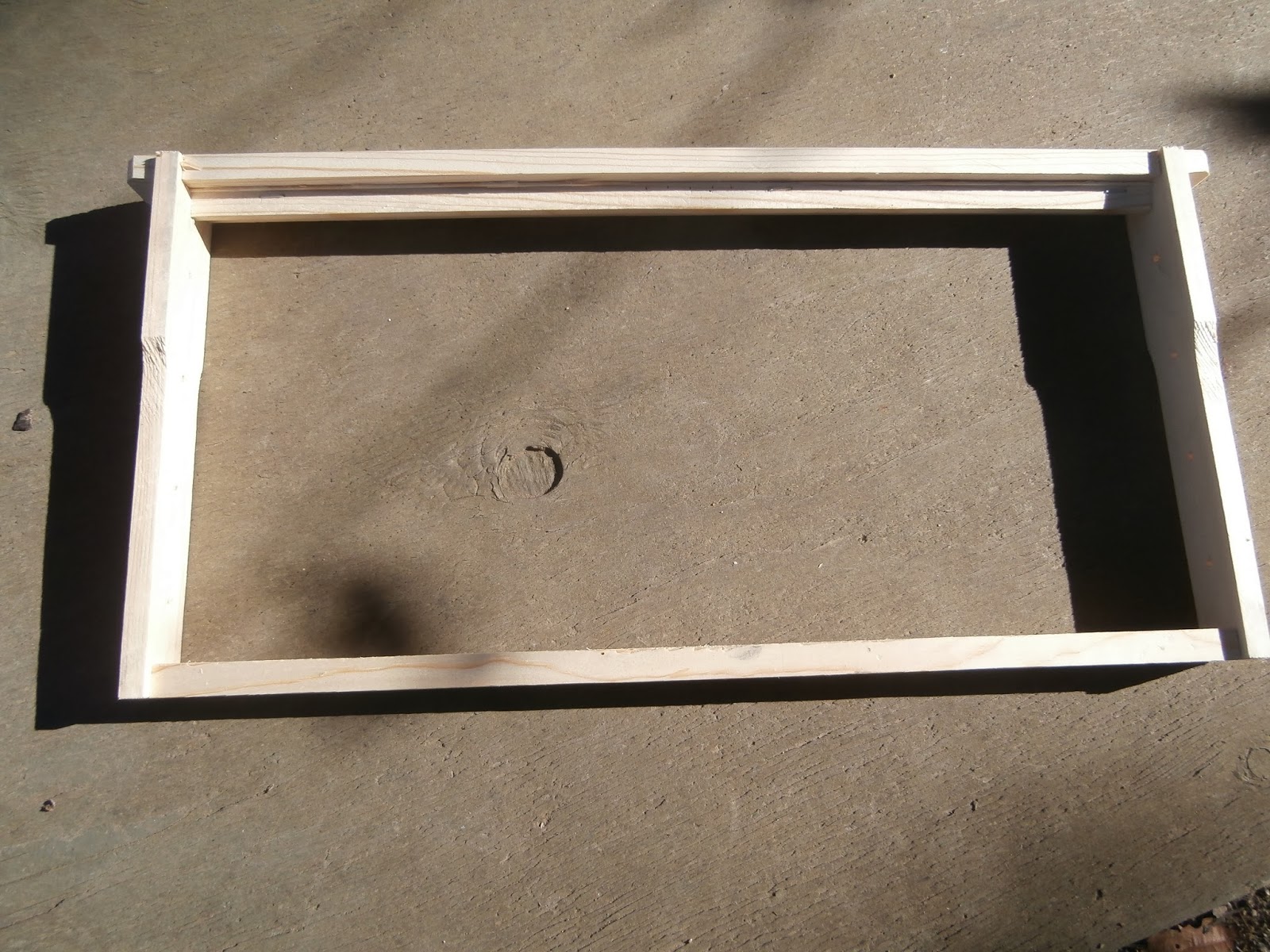
I received and put together the frames that I needed for the nucs.  I made them foundationless by putting the wedge sideways, using glue and a stapler.  As I pull brood and honey from the existing hives for splits, I'll replace them with the foundationless frames. 
Foundationless frame
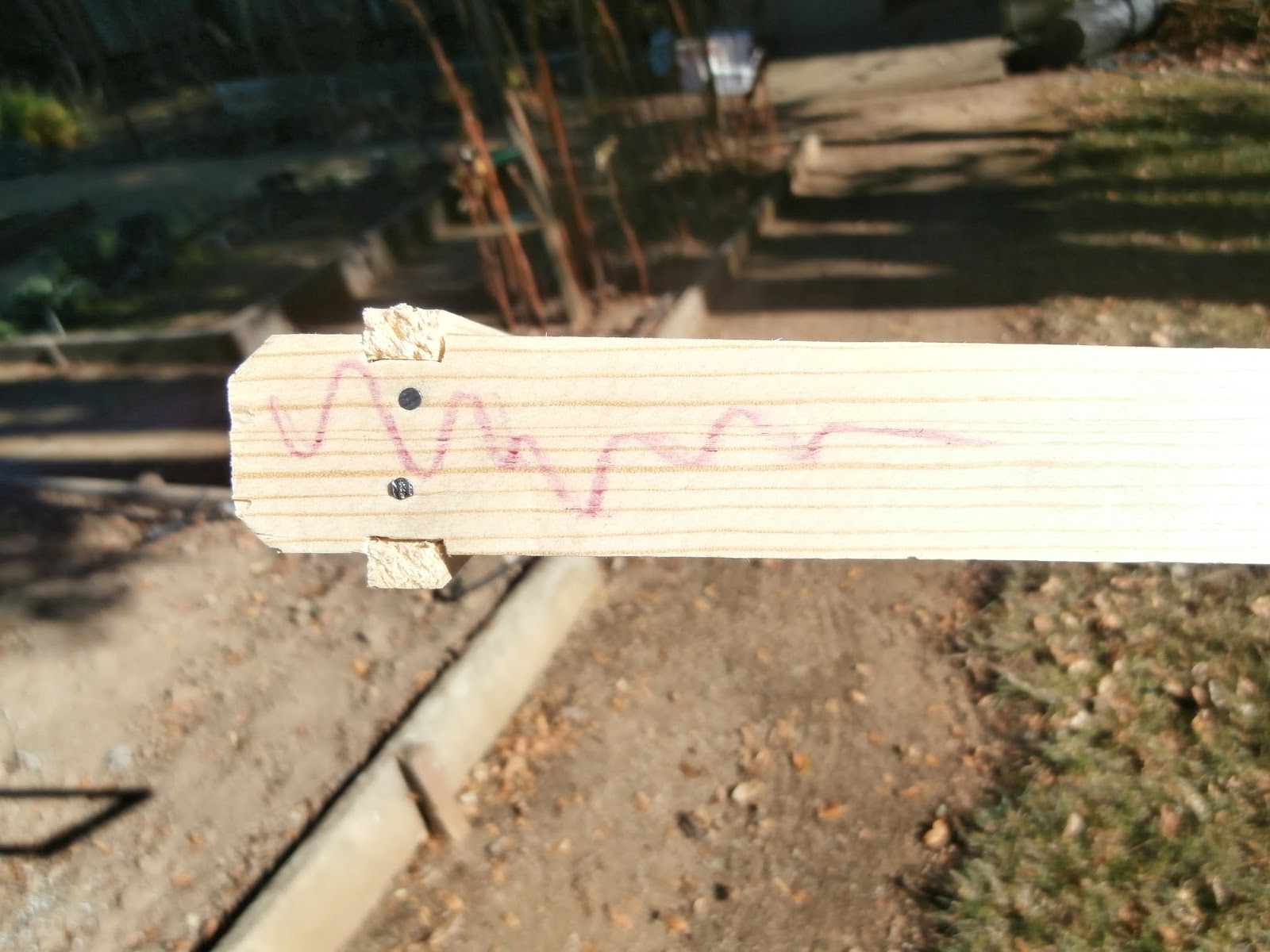
Close up of my fine work
I used a maroon crayon
 I marked them with a crayon to keep track.


 A few weeks ago, bees were drinking water off the deck.  The water was there from my cleaning the beer fermenter.  I had long ago made a water station by the blackberries, but the bees never drank from there.  I made a new "pond" for them behind the new rose garden.  I haven't seen anyone drinking there yet.