Thursday, September 22, 2022

Fall 2022 update

 I reorganized the bee shed.  It had become very difficult to find and reach desired equipment.  It looks great now.


Honey harvest was poor; about 2.5 gallons.  Other beeks also had poor harvests, so the price of honey has gone up.  I realized that the costs and amount of labor is nearly the same for any size harvest.

I'm trying a new way to store the comb.  The combs have to be protected from wax moths.  There are several ways to do so.  Previously I froze the frames for a day or two.  This requires me to tote the boxes to a neighbors house, leave them in their large freezer one at a time and then switch boxes.  With the number of boxes, this takes a couple of weeks.  I wanted to use the B402 strain of Bacillus thuringiensis, but one get it in California.  The same is true of the dichlorobenzene crystals.  I found moth balls of DCB available in California, so I got some.  I am acting on faith that the balls are not contaminated with anything bad.  So, after cleaning the frames of propolis and wax, I put the frames into plastic garbage bags, put 24 moth balls on a small paper plate on top of the frames and sealed the bags with duct tape.  Time will tell.apivar


Because the bees had so little stored honey, I started feeding them today.  They may not be taking much yet as there is still some forage.

In July, I did a mite count and it was dangerously high.  I put in oxalic acid sponges.  Now that the honey supers are off, I will treat with Apivar.  Unfortunately, I don't have enough strips for all the hives and it's taking a while for my new order to arrive.  I expect it in the next couple of days.

Happy new year everyone!

Saturday, April 2, 2022

Four hives and a nuc

 It's swarm season, for certain!  

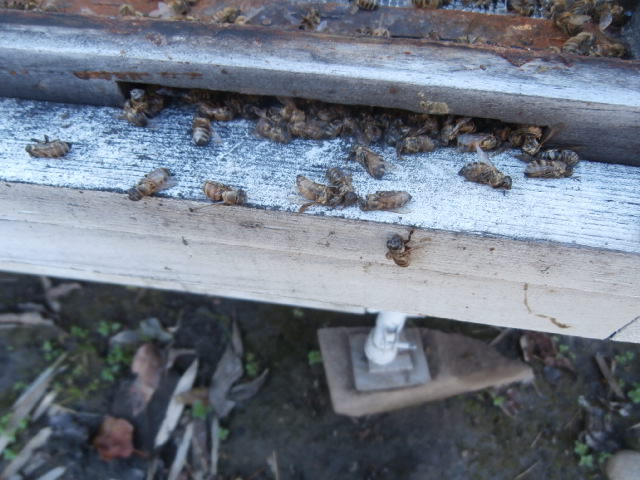
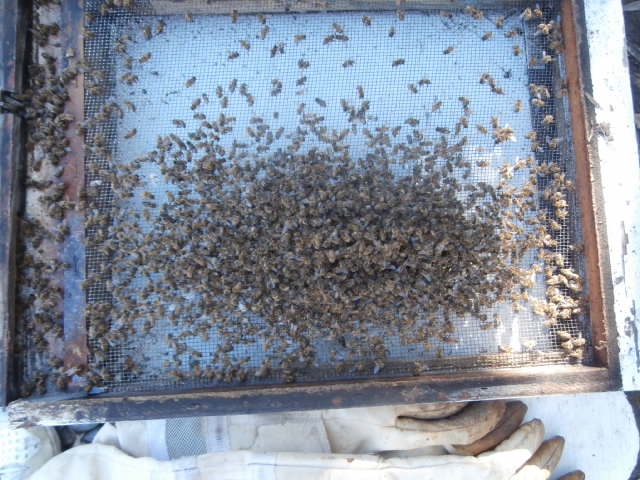
Over the winter I lost two colonies.  One, #2, was always weak and just died out.  #1 had been my strongest colony, but it died due to mismanagement.  When I harvested honey in the fall, I assumed there was enough left for the bees.  I neglected to monitor, and when I returned from a trip to Seattle, I found them all dead.  They had starved.


The pile of dead bees inside the hive


So, I was down to two colonies.  

On March 11, I saw a good-sized swarm in the yard.  I believe it had been cast from one of my hives.  It settled on the fence by the Elericks ("What's and Elerick?) and I was able to brush it into a box and hive it in #2.  Then two days ago, our neighbor knocked and told me that there was a swarm in front.  Another good sized swarm was flying between our yard and Paul's.  It may have come from one of my hives, but possibly not.  It finally settled in our yard on the Cecil Brunner.  #1 hive colonized!

Then yesterday, one of my hives cast an after swarm.  I figure it was from my hives because it was in our yard and an after swarm because it was on the smaller side.  It settled in the Eureka lemon tree.  It's now happily ensconced in a nuc box.  

If there's another swarm, I probably will offer it to my neighbor or another beek.  Or maybe a second nuc.

Sunday, April 25, 2021

Swarm cells, swarms and oxalic acid dribble

 A couple of weeks ago while inspecting #3 with Eshel, we saw some capped swarm cells. I knew this hive would swarm soon.  I had been hoping to catch a swarm in my swarm trap, but so far there had been no activity there.  I needed a colony to populate my long langstroth hive.

The next day I went out to make a swarm split.  The prerequisite is finding the old queen.  I got everything set up and, with queen catcher in my pocket, went into the hive.  I searched every frame, to no avail.  I also noted that one of the uncapped queen cells was now gone.  Disappointed, I closed up the hive with hopes that I would be able to capture the swarm when it occurred.  

Nothing happened for the next 11 days, but then, while I was preparing the tomato bed, #3 swarmed.  I watched the cloud of bees hoping they would cluster in an easily accessible spot in our yard.  Initially it headed towards the lemon tree, but then veered off to the west into Paul's yard.  I went over there watching it continue west towards the next neighbor's yard.  Then it began to coalesce and formed a cluster on the trunk of an apple tree.

I went back to my apiary, prepared the long lang with two frames of drawn comb (all I had) and three frames with foundation.  I found a box some wine had come in, suited up went to Paul's with a spray bottle of sugar syrup.  I spritzed the cluster, placed the box below it, and since I was unable to shake the trunk, brushed the bees off and into the box.  I place the box on the ground near the tree and went away for about 20 minutes.  When I returned, the bees were still in the box and fanning, so I knew the queen was in there.  I brushed a few hundred more bees into the box and closed it.  On the way to the hive, I stopped in the kitchen to weigh the bees.  The swarm was about 4 1/2 pounds, a good size.

I dumped the bees into the long lang and they have settled in well.

During this time, I also had removed the entrance reducers and started formic acid treatment.  This year I am doing the single strip treatment as Randy Oliver reported better mite control.  Rather than two strips for 2 weeks, one strip for 10 days followed by another single strip for ten days. 

 I wanted to treat the swarm as well.  Since there is no brood or honey, it is the perfect time to treat with oxalic acid.  This can be applied with a vaporizer, which I do not have, or by dribble.  At the most I would need 20 cc, bur the recipe I could find makes much more.  A little arithmetic and I made about 4 oz. (I had to make this volume in order to be able to weigh the oxalic acid with some degree of accuracy.)  Using a 5cc dropper, I easily applied the dribble to the  now ensconced swarm.  It was gratifying to see all five frames with bees.

In another week or so, I will check out the long lang and add frames if needed.

Sunday, March 14, 2021

Apiary update, and a bit about pickleball

 It feels and looks like spring here. The bee colonies are starting to expand.  I've but second deep boxes on hives 2&3.  #1 has a deep and a medium and I put a queen excluder and a medium onto it.  I tried excluders last year without a problem, so I'll be using them on all hives, except for the long lang.  I took a look in the hives a couple of days ago and they all look good.  There are a lot of drones, suggesting swarm season is upon us.  I put up the swarm trap, but no visitors as yet.  I lowered the stand for #1&2 and restructured it.  There hives are now on a board which is held up by six ant traps.


As for pickleball:   It is the fastest growing sport in the country.  It is played on a badminton size court with paddles and a perforated plastic ball.  The net is 34" high in the center and 36" high at the posts.  The game is: hit the ball over the net, either volley or after a single bounce.  There are a couple of quirky rules.  The ball has to bounce after the serve and on the return of serve.  There is a 7' deep area on each side of the net which is the non-volley zone, also known as the kitchen.  One cannot hit a volley if in that zone.  Serves are underhand and contact of the serve must be below the waist.  Most people play doubles, although one can play singles.  It is easier on the knees than tennis in that the court is smaller.  It is a very social game.  I suggest you take a look at any of the innumerable videos available online, then go to a local court.  It is likely that you'll be invited to play, at least pre-covid.  


Monday, September 21, 2020

2020 Fall honey harvest


Here is the fall honey harvest sitting in our pantry.  87 pounds, over 7 1/4 gallons.  Our largest harvest yet.  Keep in mind that commercial beekeepers get 100 pounds or more per hive.  But still... . 

More than sticky honey extraction has been going on in the apiary since the last post.  A quick summary:

Mite count was high in July.  I wanted to treat with oxalic acid on shop towels.  I wrote to Randy Oliver to find out his latest formula.  He told me that he is using Swedish sponge cloths now instead of shop towels and that he has changed the formula a bit.  I couldn't find that particular brand, but found some by Scotch-Brite that seemed the same.  I put the OA into the hive using Randy's latest formula.  I did not do a repeat mite count.  After removing the honey supers and the remains of the sponge cloths, I put in Apivar strips as I have done yearly.

The long lang colony never had honey or pollen stores and did not thrive.  I always spotted the queen, but no brood.  As the population diminished, I fed it in hopes it could recover.  This led to robbing of the syrup!  I removed the feeder and vacuumed out the corpses.  Next year, either a split from #1 or another swarm.

I plan to reconstruct the hive stand for #1 & 2.  I will make it lower and change the position of the ant moats to the more secure position of the other stands.

Other winter bee care involves rejuvenating frames and foundations.

I hope you're all doing well in these troubled times.  

Thursday, July 2, 2020

#3 rebuilt and relocated

#3 new site in front of new fence

While building the new fence in the back, I foolishly tried to move #3 hive over a few inches on its hive stand.  This resulted in sliding the stand legs off of the ant blocker.  Fortunately all it did was jolt the hive, not knocking it over.  There was a brief flurry of angry bees and then all was well.
It was time to move the hive further from the fig tree and to get rid of the agapanthus that were in the way of working the hive.
I moved the hive onto a temporary stand, dug up the offending plants and brought in and leveled new dirt.
I needed a stable way to put the hive on the ant blockers.  I realized that the hive could sit on a board and the ant blockers could be under the board.  I screwed the blockers onto the stand and the board onto the blockers.  Voila!
The hive stand for #1 and 2 is still in the previous precarious situation:
Unfortunately, moving the hives off the stand at this time would be too difficult.  I will wait until after the honey harvest to make the desired alteration.  Let us hope that the stand does not slip before then!

Friday, June 5, 2020

Trying something new, part I

Hive #3 has continued not to thrive.  On inspection a couple of days ago, it looked the population had actually decreased.  The bees were only on the lateral 4 combs in both brood boxes and there was not much honey in the super.  There was capped brood and I did spot the queen.  There were a couple of frames with dead drone brood and no nurse bees.  I decided that I would combine this hive with #2. 
But, as expected, there are a problem that must be solved.  #2 consists of 2 deep boxes and 2 mediums.  #3 has one deep and 2 mediums.  Simply stacking the boxes would create a ridiculously high and unworkable tower.  So the number of boxes has to be reduced.  A project I started today.
The super in #3 had 3 frames with honey.  I switched these 3 frames into #2's super; one box down.  I then looked for the queen in #2, but could not find her.  I put the queen excluder between the deep and medium.  There is capped brood in the super which will emerge in the next 10 or so days.  At that point, I can shake the bees out of the super and combine the remaining deep with #2.  If it turns out that the queen is in the medium box, the process will be the same.  I would, in the latter case, probably put the medium frames into a deep box so there will be room for all the bees.
It kind of sounds like I know what I'm doing.  Don't be fooled!

Tuesday, April 21, 2020

Alas! Brood transplant failed

One week ago, I transplanted a frame of brood with all its nurse bees from #1 into the long lang.  I spritzed everyone with homemade honey-b-healthy in hopes that their hive odor would be covered up and they would share scents by grooming off the sugar.  I saw no fighting at the entrance for the next day, so I had hopes that things were peaceful inside.
However (and I know you are not surprised- the title is a spoiler), it did not work out a planned.
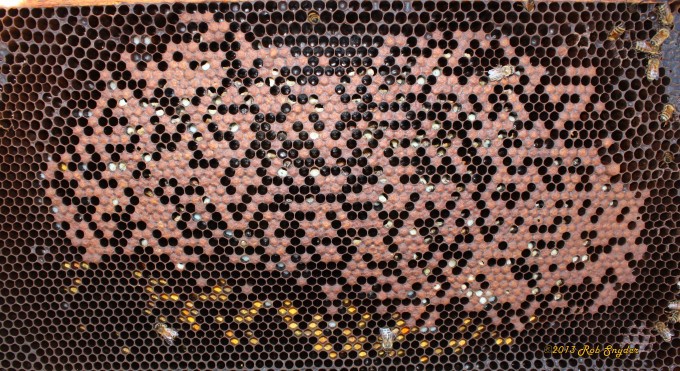
This is the transplanted frame today.  I have not moved the bees.  As you experienced hive examiners can see, there are no nurse bees on all that brood.  Brood without cover will die from cold.  You can see some uncapped cells as well.  There were some partially emerged.dead bees.
Now what?  I intend to just let this colony try to make it.  If it dies out, I will make a split from #1.  If #1 swarms, I will try to capture it and either put it in a nuc, or maybe figure out how to put it into the long lang. 
Of course, if any of you have a suggestion, please share it.

Tuesday, April 14, 2020

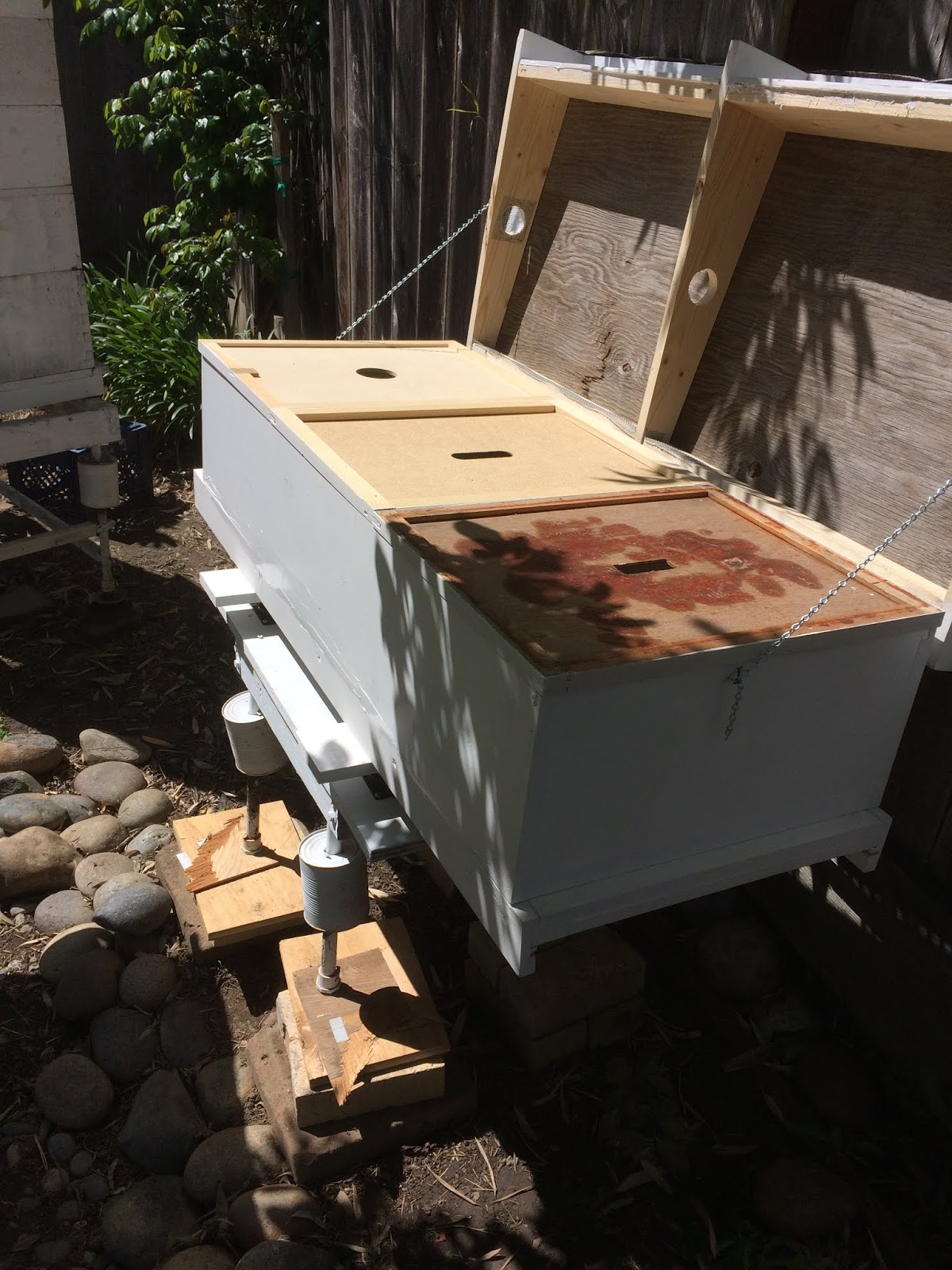
Do-it-yourself Long Langstroth hive

I was intrigued by an article In the April, 2018 issue of the American Bee Journal by Caroline Abbot about Long Lang hives and I decided I wanted to build one.  This is a link not to the article, but her description of it on her website.  As with many of my projects, it took a while to get started.  But this winter, I committed to doing it.
First I needed plans.  I wrote to Caroline and she graciously sent me her plans.  Of course, I had to make one change;  I wanted to make a screen bottom.  I found plans for that here.  This had to be made longer, naturally.
I am not a carpenter, nor do I play one on TV, so I needed to find someone who had knowledge and tools.  Maidi had met Collette at spin, and she is a builder.  She expressed interest in building the hive with me.
I attached my old Yakima racks to my Volt and went shopping at San Lorenzo Lumber for 12- foot planks of pine 1x12 and 1x6 as well as a couple sheets of plywood.  Then I set a date with Collette, expecting it to be a 3 to 4 hour project.
At first it went quite well, building a long box.  Unfortunately, one end was not flush and when I tried to even it (using Collette's planer), I had difficulty setting the depth of cut and ended up making the box 1/4" too shallow.  I went back to the lumber yard and then to Collette's and built a second box.
We used her router table to build the side bars of the screen bottom board, and even though I did a kind of sloppy job, it worked okay.
The box sitting on the screen bottom.  Still needs to be painted
The to make the roof.  The original plans called for a peaked roof, but Collette suggested making it flat, and since that would be easier, I acquiesced.  A mistake.  There needs to be some space above the inner covers and the roof for feeding.  I had already cut the roof board so I decided to make a canted roof.
The roof on top of the hive box
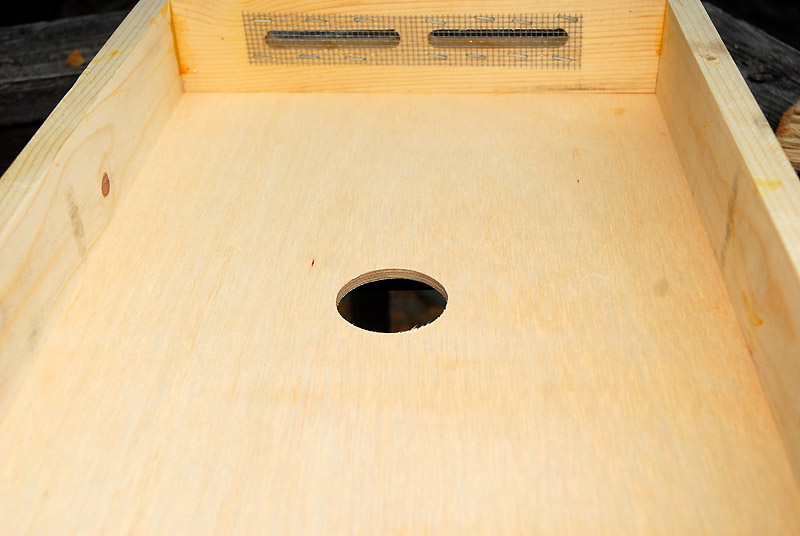
Inside view of the roof showing communication and vent holes
I covered the roof with roofing paper left over from building the garden shed.  Then I had to figure out how to attach it with hinges.  Collette had suggested a piano hinge, which sounded great.  Unfortunately, I had not realized that the roof sat on and exposed the sides of the inner covers and the hinge I had was not wide enough.  Nor did any local hardware stores a wide enough hinge.  An online search found what I needed, and a few days later I had my hinge.  Of course, it was too long, but I new that in advance and sawed it (with some difficulty) in half.
I was able to attach the roof and put on chains to limit the opening, and all set!  Or so I thought.
Problem #1- I had used 3/4" plywood for the roof and it was so heavy that when the roof was opened it would tip the hive over.
Problem #2- The hive components did fit flush in several places.  Bees will fill small cracks with propolis, but these were not small gaps.
Solution #1-  Dismantle the roof and rebuild it with 1/2" plywood.  Fortunately I had an old (<40 yrs.) sheet to use.  Re-assembling the roof was quite difficult.
Solution #2-  fill all the gaps with white, 100% silicon caulk.  Cut narrow strips of wood and glue them to the edge of the roof to make a better fit.
Now, done!


Ready for bees.  It just so happened that a couple of days before finishing the hive, I caught a small swarm in my pulp pot swarm trap.  I put them in a nuc on the the hive stand (so they would orient to the right place) while finishing the hive.  So, when the hive was ready, I moved the frames from the nuc into the long lang.  There are only 6 frames in the box with a following board.
The swarm is very small and I have been watching it closely for the past two weeks.  If it wasn't doing well today, I was ready to make a split from #1 (which is very strong).  However, there was capped brood.  This colony is so small that they cover a patch about 4 inches in diameter on three sides of frame.  I decided to give them more of a chance and transplanted a frame of brood and nurse bees from #1.  We'll see in another week.  I can always make a split or capture another swarm.
Thanks for reading this.  Stay safe and stay well.

Wednesday, April 8, 2020

A guest blogger

Even though I have not blogged for some time, much has happened in the apiary. I will be publishing a complete account when I get around to it. 
In the meantime, here is an account from a fellow beek, Laura.
 
 
The Beekeeper's Daughter

March 21, 2020:

Sonoma County announced a shelter-in-place order due to COVID-19, while Sabine, Amaya, Matt and I were in the mountains. When we came home a few days later, we found that a swarm of bees had decided to shelter-in-place in our very own pulp swarm trap! Matt had made and hung it in the nectarine tree about a week earlier. Was it the lemongrass-infused q-tip that drew them in? The blooms that were suddenly covering our fruit trees and flowering plants? The height and placement of Matt's expertly crafted trap? Beginner's luck? Who cares?! We were thrilled.

The first thing we did, of course, was call our guru and favorite beek-- Papa/Daddy-o. He advised that we not move our new friends straight into our hive, as we weren't sure when the swarm had arrived and the bees were already oriented to the precise location of the swarm trap. So, we decided to rig up our modified langstroth hive up on a ladder so it was positioned about 2 ft. from the entrance of the swarm trap. Around 4:30/5pm (it was still light out and not too cold), Matt geared up and poured the bees from the pulp swarm trap into our hive, while the girls and I stood by, watching with wonder and excitement. 

It looked like a success! After an hour or so, the air was clear of bees and only a small cluster remained on the trunk of the nectarine tree, where the swarm trap had previously been. Daddy/Papa said to expect this small, stubborn crew of bees to remain at the site of their original chosen home. He said to leave them alone. Of course, I felt that I needed to "save" these 50 some stragglers who were out in the cold without their queen. So later that evening, just when the sun was setting and it was significantly cooler, I climbed the nectarine tree, without any protective gear on whatsoever, and brushed a large number of bees into a Tupperware container. The remaining bees got very upset, and when one stung my upper lip, I dropped the Tupperware, which got everybody mad. I jumped from the tree down to the ground, and a high speed chase ensued, all the way to the edge of a neighboring Apple orchard. Bees were covering me-- in my hair, my shirt, even my pockets! Miraculously, I managed to get just one other sting on my head. Poor Sabine, Amaya and Daddy had watched the whole affair from Amaya's bedroom window, including my frenzied sprint out of sight, and were very worried. When I got home, I got possibly the biggest hug I've ever gotten from Amaya, and she got me an ice-pack straight away to put on my stings. The whole fiasci was humbling, and the lower left side of my face, which blew up to 3x its normal size the following day, served as a good reminder that I should always listen to my father and, if I don't, to at least put on a damn bee suit.

First pic is the wise son-in-law, all suited up and doing an expert job escorting our new residents into their new home. Second pic is your daughter, who certainly learned her lesson about bothering bees.


Thursday, August 22, 2019

New queen healthy and a-laying

I went into #1and removed the formic acid pads that had been in for two weeks.  They definitely killed mites.  I just hope it killed enough.
Dead mites on formic acid pad
The bees seemed less defensive at first, but after some time, there were several pinging me.  But they did not follow me more than a couple of yards from the hive.  Overall, I have the impression that the re-queening has diminished the unwanted aggressive behavior; time will tell.
There were eggs and young larvae in the super and the queen was running around in the deep box, where there were larvae also . 
The top super had a reasonable amount of capped honey.  I may extract the capped honey before we leave next month.

Wednesday, July 31, 2019

The queen is dead! Long live the queen!

Ouch!  That was the final straw.  An angry bee stung me on the back of the neck while I was in the roses, 10-15 feet from the hive.  And the bees had not been disturbed for days.  This was not the first unprovoked attack.  Amaya had been stung on the scalp while looking at the hive from the path and I had been harassed while doing yard work in the vicinity of the apiary.  It was time to re-queen.
The first step was to determine which hive was defensive.  I was pretty sure it was #1, but I needed to be certain.  An internet search turned up different ways to measure defensiveness.  The leather square seemed to be the one that would be best.  Other articles stated that a 2"square of blue suede had been used.  Where to get blue suede? Aha!  One of the marimba players owns a leather shop, and yes, he has blue suede scraps I could have.  Off to downtown Santa Cruz.  I got two shades of blue not knowing which would be best. I made my squares and went out to test the hives.

There was no reaction at any of the three hives.  So I contacted Tom Seeley and asked if something needed to be done to the leather first.  He replied,
I would remove the outer and inner cover of each hive, and see which one has bees flying up at your when you do so.  If one is super defensive, it will start attacking in response to having the cover removed.  Well, duh.  I did just that and there was no question that #1 was overly defensive (for me).
Next step, find a new queen.  I contacted the queen suppliers I have used, but either they had no queens or the price was too high ($35 for the queen, $38 for shipping).  Posting in the local bee guild forum produced no response.  Finally, I found Wildflower Meadows.  Their bees were what I was looking for and they had good reviews.  They would ship for $18.50.  I ordered a queen and picked a date for shipping.
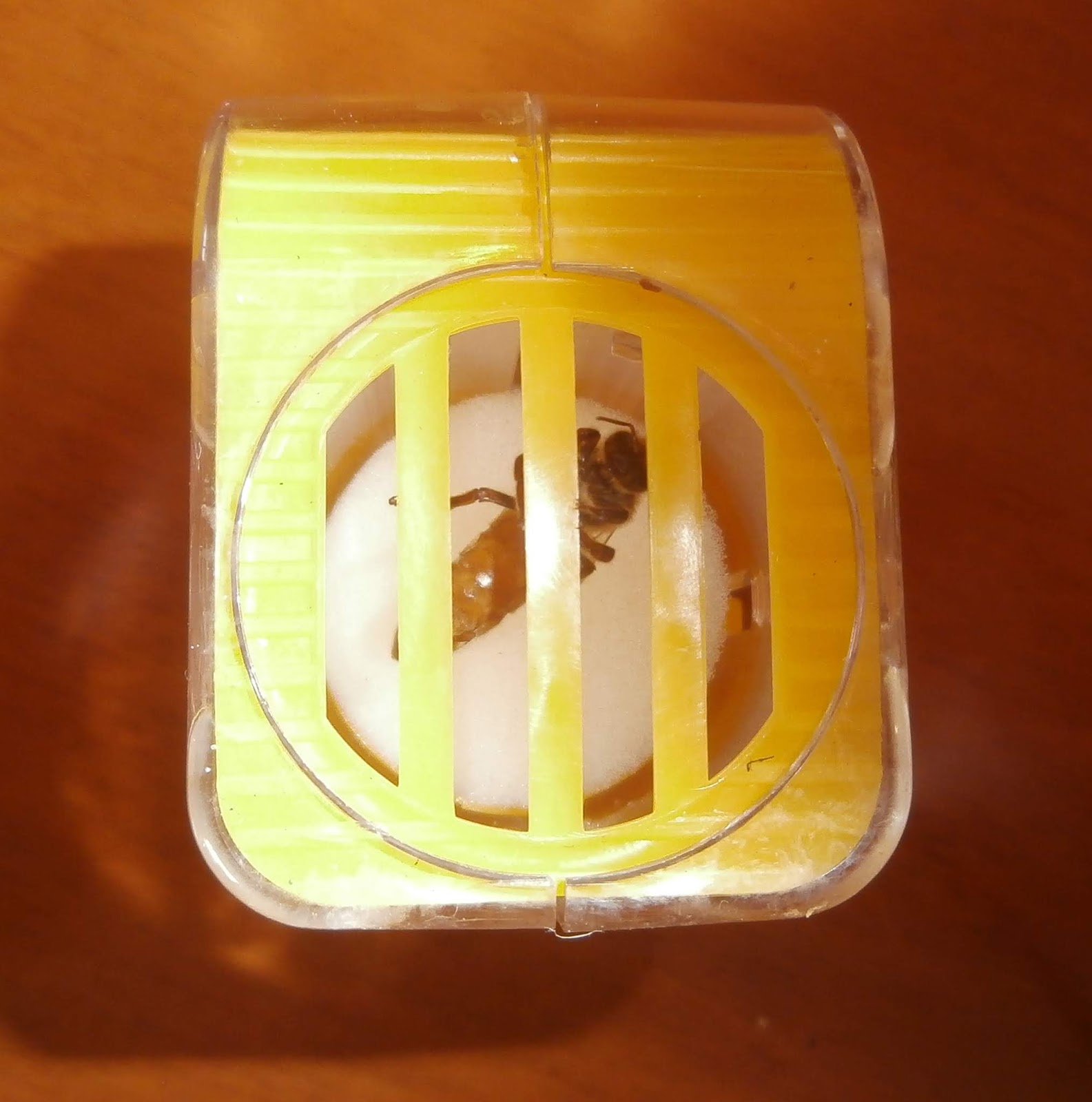
The old queen needs to be removed from the hive 24-48 hours before installing the new.  So I needed a queen catcher.  There are two types, clip and cylinder/marker.  I ordered the latter.
The queen was to arrive today, so yesterday morning I went to capture the queen.  I also had to find any queen cells present and destroy them.  I also planned to do an alcohol wash mite count to see if the oxalic acid/shop towel had been effective.
I found the queen in the bottom box and captured her easily.


There was brood in the bottom (deep) box and the next two mediums.  I did the mite count, a dismaying >30, and selected a frame on which I would place the new queen.  The old queen went into the freezer and she will get a proper burial.
The large number of bees flying around and pinging my head reinforced my decision to re-queen.
I would like to treat the mites with MAQs but it feels too risky to both treat and re-queen at the same time.
Today I stopped by UPS to pick up the queen.  

The queen marked with green
She's in there with her attendants.  This is the best picture I could get.
She is now in the hive and I will take a look in a week to see if she is out of the cage.  I will also treat for mites.

Wednesday, July 10, 2019

First extended oxalic acid follow-up

I wanted to see how much of the shop towel the bees had removed, so I took a look into the hives a couple of days ago.
The bees had chewed nearly none of the towel in #2 & 3.
Hive #3
Hive #2
These hives had only a deep box so I do not think the bees had much of an incentive to get the towels out of there way.
However, the towel in #1, which has supers above the towel, was nearly half gone.
Hive #1
The frames in both 2 and 3 were full of bees,as you can see in the pictures.  I put a super on each.  Now it seems that my new configuration will be one deep and one medium for brood.  Of course, this may change back to two deeps.
As previously mentioned, I want to build a long lang.  It dawned on me that I could probably use the board from my extra deeps.  This would obviate the need to cut rabbets
On another note, I am committed to reaping some grapes this year.  Just see the birds get them now!

The are over 60 bags each around a grape cluster.

Wednesday, July 3, 2019

Extended-realease oxalic acid

For some time, oxalic acid has been used to control mites.  It is effective, safe and does not affect the honey and does not seem to hurt the bees.  It is very effective at killing phoretic mites.  It is usually applied by a dribble or vaporization.  One drawback is that it does not penetrate into the capped brood where the mites are developing.  Randy Oliver, whom I have mentioned in many blogs, has been working on a way to deliver oxalic acid over an extended period of time.  This link will take you to his progress report. 
I did a second alcohol wash mite count on  #1 4 days ago- 15 mites, or 5%.  This is definitely above my treatment threshold.  The next day I prepared and applied oxalic acid impregnated shop towels as per Randy Oliver.  The following morning I saw evidence that the bees were chewing up the towel on the tray below the screen bottom.

Tuesday, June 25, 2019

A new Beek

On his way to the hive.  All Eshel photos by Olea
Last week while visiting from Seattle, Eshel went into the hives for his first time.  We went into #3 and #2 on separate days.

Eshel sees the queen
He was very interested and would peer into the hive, often blocking my view.  We saw the queen in each hive, an uncapped queen cell in #3 and lots of brood.  #3 has expanded to 7 frames and is drawing comb on #8.  #2 has 4 frames of bee with brood on 3 of them.
Yes, Olea's hive is gone and will be put into storage until it moves to Seattle.  I noted a lot of debris and some dead bees on the porch, a sign that the hive had been robbed.  I had been expecting that. 
Capping debris and dead bees on porch
Inside the box after some frames have been removed      

Thursday, June 13, 2019

Swarm report and mite count

I went into the 3 hives today.
#1- There is some nectar in the top super and still a few empty frames.  The second super is heavy with honey.  The bottom super is heavy and may have some brood in it still; I did not inspect it.  I saw the golden queen in the bottom box.  She was on a comb with drone brood and drone-sized cells.  An alcohol mite count showed a 1.6% infestation, below the 2.0% threshold.  I will repeat the count in 2-3 weeks.  If high, I will treat with the shop towel/oxalic acid as per Randy Oliver.
#2- This is the most recent swarm, hived 10 days ago.  The bees are on 4 frames with brood and larvae.  They have done a good job on cleaning all the comb.  There I spotted the queen.  I can tell by her coloration that she has some carniolan in her.  A significant number of the workers are also dark.
#3- The bees now cover 6 frames and I saw an excellent brood pattern on at least two frames (I did not inspect the final frame).
So all three seem to be doing well.  We should get some honey from #1, but I don't expect any from #2 or 3.  Olea's continues to diminish.  There are still some bees visible through the window, but very little action at the entrance.  The swarm trap is back up in the front, but not much happening there.

Monday, June 3, 2019

A swarm in June...


A swarm in May... but this is June and one can not always get what one wants
Over the past couple of days I have noticed increasing interest in the pulp pot swarm trap.  This afternoon while I was changing out of my pickleball clothes, I heard a loud buzzing coming from the front.  I ran out in my stocking feet and saw what I expected- a swarm moving into the trap.
The first part of the video shows the cloud of bees, then a close-up of the entrance.  The next two segments show the bees forming a beard on the trap as they land and start moving inside.  The whole process took 10-15 minutes.  Some still photos of the process
The swarm approaches the trap

They begin to land and enter the trap

Traffic jam.  The bees are landing faster than they can go inside

Just about all the bees have landed
As I waited for them to all get inside, I went out back to prepare their new home.  I collected a screen bottom, one deep box with 10 frames, some with comb, a Vivaldi board and a telescoping lid.
Then, I made my big mistake.
I had been wanting to place ant moats under all the hive stands, and I thought it would be easier to place them now before adding another hive.  What I misjudged was just how heavy #1 was.
The whole thing was a bit tilted after I was able to lift the stand and place the moats under three of the legs.  The last leg was in the front below the hive.  As I tried to lift it, the inevitable happened-
the stand and entire hive fell over backwards!
I quick like a bunny ran to the shed, donned my bee suit, tried fruitlessly to get the smoker going, and ran back to the apiary.  There I righted the stand, easily placing the moats under the legs.  I re-assembled the hive from the bottom up.  Inspected the ground to see if the queen was there (I did not see her) and then went back to the intended job.
I placed the new hive in #2 position and removed all but the two outermost frames and put grass across the entrance.  I then went to the front, plugged the entrance to the swarm trap, unhooked it and carried it into the back.  I decided to keep the bee suit on since I did not know how mad the bees from #1 would be after their big disturbance.
Proud papa
After placing the trap in the deep box, I unscrewed the two halves.  There were still a lot of bees in the bottom half, so after removing the slum gum and piece of comb, I dumped them into the hive.  I then dumped in all the majority of the swarm that had gathered in the top half.  I then filled the moats with mineral oil and, voila!  three hives in the apiary. 

In a few days when all the stragglers from the swarm are gone, I will re-hang the swarm trap.

Saturday, June 1, 2019

Olea's is definitely on the way out

This is what I removed today from Olea's hive.
Over the past weeks, I have seen Olea's population gradually decrease.  After putting in the Apiguard 10 days ago, the bees moved further back onto more central combs, away from the thymol.  They were on only 2-3 combs.  I went in today to start removing bars.
I also wanted to look for the queen.  If she were still there and I found her, I intended to move her into a nuc and add some frames with honey and pollen from #1 as well as many nurse bees and maybe a frame with brood.  However, the plans were moot as I did not spot the queen.
The two back most bars had no comb.  The next 4 had honey and were cross-combed.  I removed them en bloc.  The following bars had spotty brood, dead pupae, dead emerging workers and some apparently living larvae.  As I mentioned, the queen was nowhere to be seen.  There was a small number of drones.  I thought I saw one bee with K-wing.  However, this is due to tracheal mites, not varroa.
Image result for k-wing in bees
I closed up the hive decreasing the space with a follower board.
I broke the comb with honey off the bars into a large bowl.  After Maidi sees it, we'll mash it up and strain the honey.
Meanwhile, I expect Olea's will be without bees in a couple of weeks.

Friday, May 24, 2019

It looks like Olea's is on the way out

I went into the hive a couple of days ago.
#3- bees still on only 4 frames, but two frames had an excellent brood pattern.  The bees have not drawn new come but have cleaned the old comb.  I did see (and removed) a wax moth cocoon.  Even though the colony has not grown in the past 2 weeks, I am optimistic that it will grow and survive.
#1- I only checked the top super.  The bees had not drawn any new comb nor deposited any nectar.  I hefted the bottom super and it felt heavy.  I conclude that #1 is storing honey and will continue to do so.  I will need to inspect the bottom boxes.
Olea's- a month and and 1/2 ago, Olea's had 22 bars with bees on all of them.  Since then, the population had gradually decreased.  I thought (and still do) that it swarmed when we were away for Passover.  But it continued to see more bare comb through the window.  I hadn't planned to inspect it, but I was not tired, so I did.  I started at bar 11 and looked to bar 4.  There was not much honey and the brood pattern was spotty (picture from web).  I did not see any evidence of DWV.  I did see guanine crystals (more pictures from the web)  in some cells, a sure sign that the colony was overwhelmed by mites, leading of parasitic mite syndrome.  I had not done a mite count on Olea's and treating a top bar hive for mites is problematic.  So, Olea's is dying and I do not want it to be a mite bomb.  I put an Apiguard tray in the hive in hopes that it would markedly diminish the numbers  of mites before the colony completely dies. 
I do not intend to recolonize Olea's.  I find the top bar too hard to work and there is no good way to treat it for mites.  I plan on replacing it with a long Lang.


Wednesday, May 8, 2019

Swarm trapped and ensconced

This is what I saw when I looked at the swarm trap 6 days ago.  A swarm had moved in while we were away from the house.  I knew I had to transfer it to it's new hive.  This had to be done soon before much comb was built.  Since I had never done this before, I had no idea on how to go about it.  An online search resulted in no useful advice. 
That afternoon, I prepared the swarms new home.  One deep box with 10 frames of drawn comb in #3 position.  I placed Ant Moats under the legs of the stand.  (I saw these a few weeks ago when I helped Dinah with her bees.  They are neat and effective.  I bought enough for all my hives.)
So... I wanted to transfer all the bees, so it had to be done before the foragers started their jobs.   I went out when it was dark and plugged the entrance hole.  While on the ladder, I tapped the trap and was satisfied to hear an answering hum. 
I still intended to transfer them before their work-day began, so-
I arose early and went out at first light.  I carefully lowered the trap, noting that it was not very heavy.  I carried it into the back.  I opened the hive and removed the middle 8 frames. Since I did not know in which half of the trap they would be clustered, I placed the trap in a box, where I unscrewed the halves and opened it.
Trap in a box near the hive
The bees were all clustered in the top part.  In retrospect, I should have know this would be the case.
Placing the pot into the hive, I have it a sharp shake.  The bees tumbled into the hive and started to climb up the side frames.
The small swarm in their new home
Of course, not all the bees left the pot.  After a few more shakes and raps, I left the pot nearby so that the straggles would be able to fly to the new home.  The bees had already built a small amount of comb. 
I replaced the frames and closed up.
Whenever I had captured a swarm, I noted that 100-200  bees would return to the cluster spot.  This occurred here as well, even though I had placed grass across the entrance.  I had read that when moving a hive, placing grass across the entrance encourages the bees to re-orient.
I think that these must be scouts.  The oldest foragers search for a new home.  When they reach a consensus, they lead the swarm to it.  They have the location wired into their little brains, so when the leave the new hive, they follow the path back to the old spot.
It had only been 5 days since the transfer, but my curiosity overcame by caution.  I went in.  The bees only covered 4 frames.  There was some nectar.  And I saw the queen!  She is large and moderately dark.  I watched as she laid and egg and saw some other eggs, no larvae.
I looked into #1 also.  There is brood in all 3 boxes.  The 2 mediums have worker brood and it looks like it might be spotty.  I will need to do a mite count after we return from our upcoming trip.  The bottom box had some drone brood.  There was some honey being made in all three boxes.  I added a super with foundation only frames.